

Throughout history, humans have told tales of fantastic beasts and monsters that seem too extraordinary to be real. These creatures populate our myths, legends, and folklore, often serving as metaphors for human fears or explanations for natural phenomena. However, many cryptozoologists and historians believe that some of these mythical beings might have originated from encounters with actual animals that were misidentified, exaggerated, or misunderstood by our ancestors. From the depths of the ocean to remote mountain regions, here are eleven legendary creatures that may have been inspired by real-life animals.
The Kraken Giant Squid of the Deep
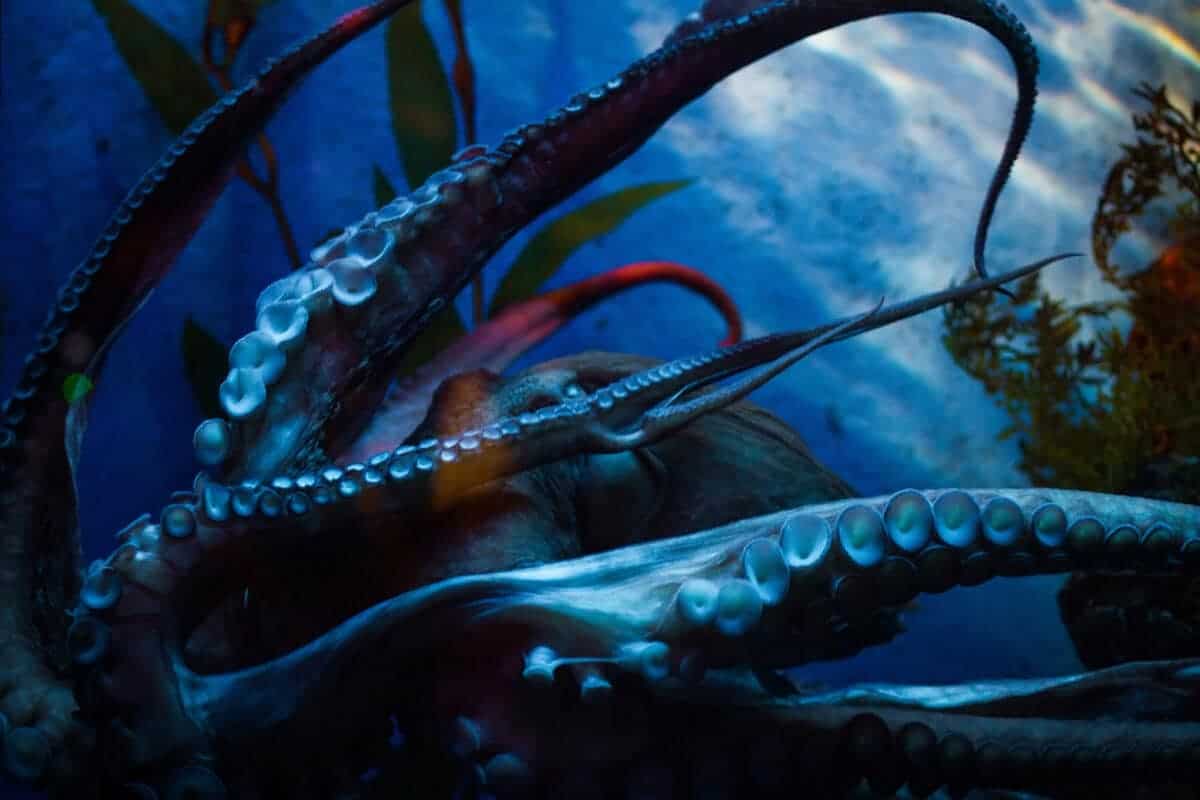
Tales of the Kraken have terrified sailors for centuries. This massive sea monster was said to emerge from the depths, wrapping its enormous tentacles around ships and dragging them to the bottom of the ocean. Norwegian sailors’ accounts described a creature “the size of an island” with arms that could ensnare the largest vessels. While these descriptions were clearly exaggerated, they likely stemmed from rare sightings of giant squid (Architeuthis dux).
Modern science has confirmed that giant squid can grow up to 43 feet (13 meters) long and weigh nearly a ton. These elusive deep-sea dwellers were only first photographed alive in their natural habitat in 2004, and the first video footage wasn’t captured until 2012. Given how rarely they appear near the surface, it’s easy to understand how pre-scientific observers might have mythologized these already impressive creatures into the legendary Kraken.
The Unicorn Narwhals and Rhinoceros
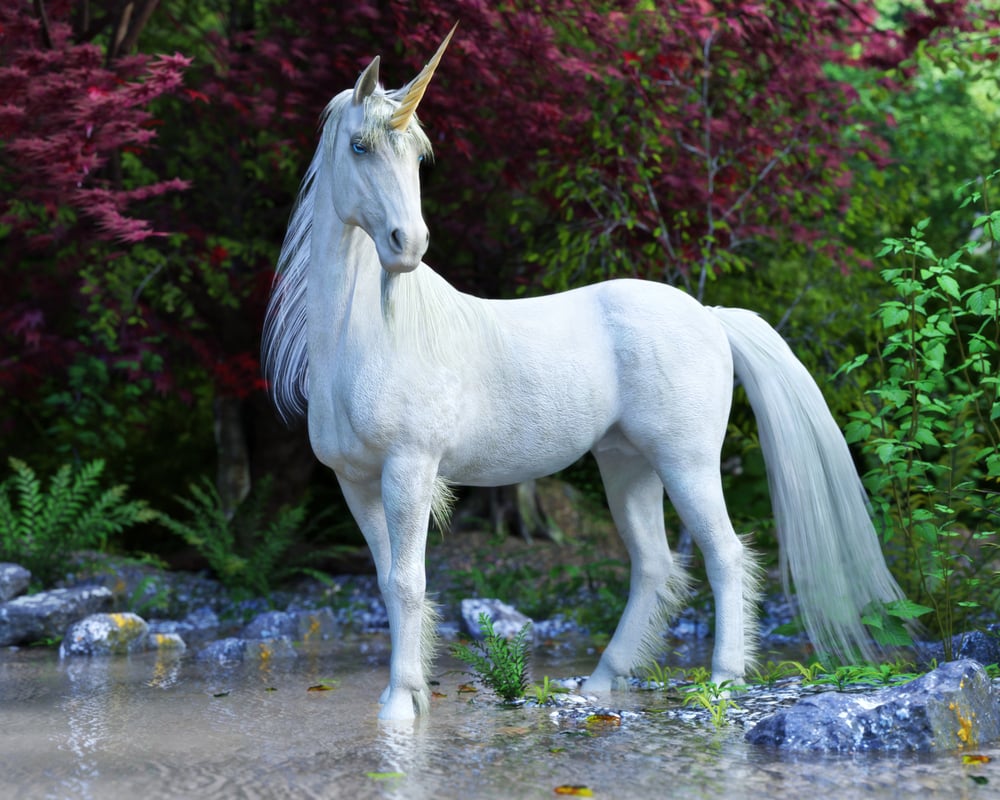
The unicorn—a horse-like creature with a single horn protruding from its forehead—appears in the mythology of numerous cultures. While modern depictions often show a pure white horse with a spiral horn, medieval and ancient descriptions varied widely. Many historians believe the unicorn myth originated from several real animals, with the narwhal being a primary contributor. These Arctic whales possess a single elongated tusk (actually a modified tooth) that can grow up to 10 feet long. During the Middle Ages, these tusks were sometimes sold as “unicorn horns” with supposed magical properties.
Another possible inspiration for the unicorn legend may be the rhinoceros, particularly the Indian rhinoceros with its single horn. When Marco Polo first encountered a rhinoceros during his travels in Asia, he identified it as a unicorn, though he noted it didn’t match the traditional European descriptions. The oryx, a type of antelope that can appear to have a single horn when viewed from the side, may have also contributed to the unicorn myth, especially in African and Middle Eastern traditions.
Dragons Dinosaur Fossils and Komodo Dragons

Dragons appear in the mythology of cultures worldwide, from European fire-breathers to serpentine Chinese lung dragons. While cultural depictions vary, the concept of large, reptilian creatures seems nearly universal. One compelling theory suggests that ancient humans may have discovered dinosaur fossils and interpreted them as the remains of dragons. In China’s Sichuan Province, where dinosaur fossils are abundant, local histories often record findings of “dragon bones,” suggesting this connection.
Living animals likely contributed to dragon mythology as well. The Komodo dragon, the world’s largest lizard growing up to 10 feet long, may have inspired some dragon legends in Southeast Asia. Crocodiles and large snakes could have also played a role in developing dragon mythology, especially in regions where these animals were common. The combination of real reptiles and fossilized remains of extinct creatures provided ample material for our ancestors’ imaginations to create the dragon myths that persist today.
Mermaids Manatees and Dugongs
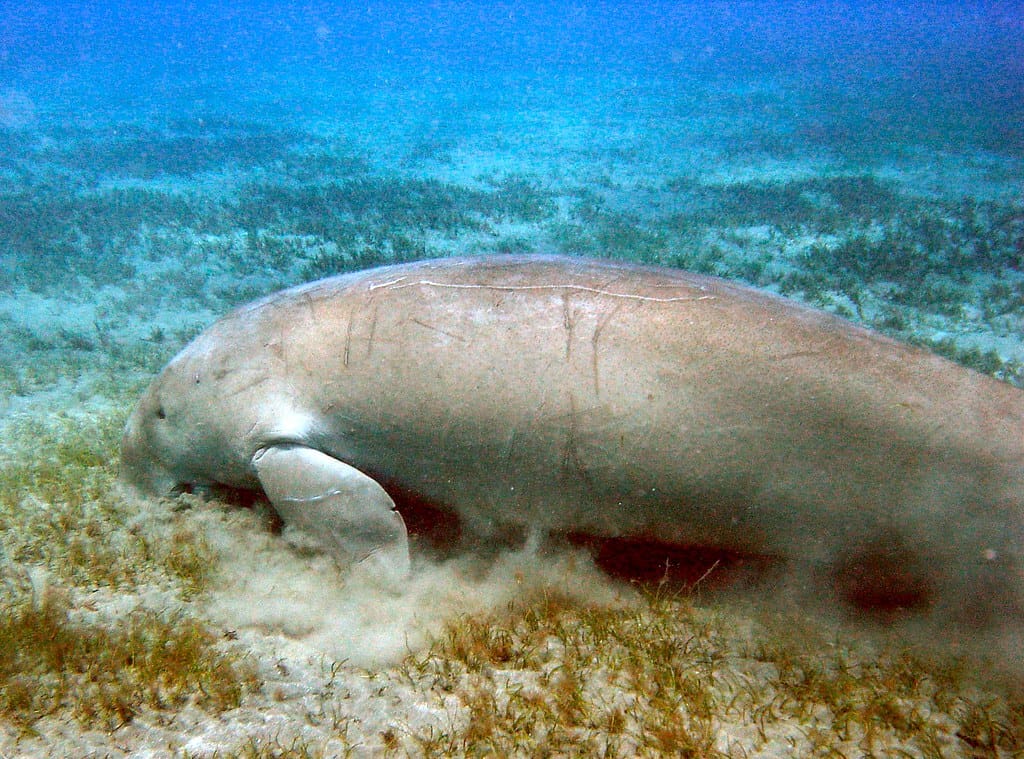
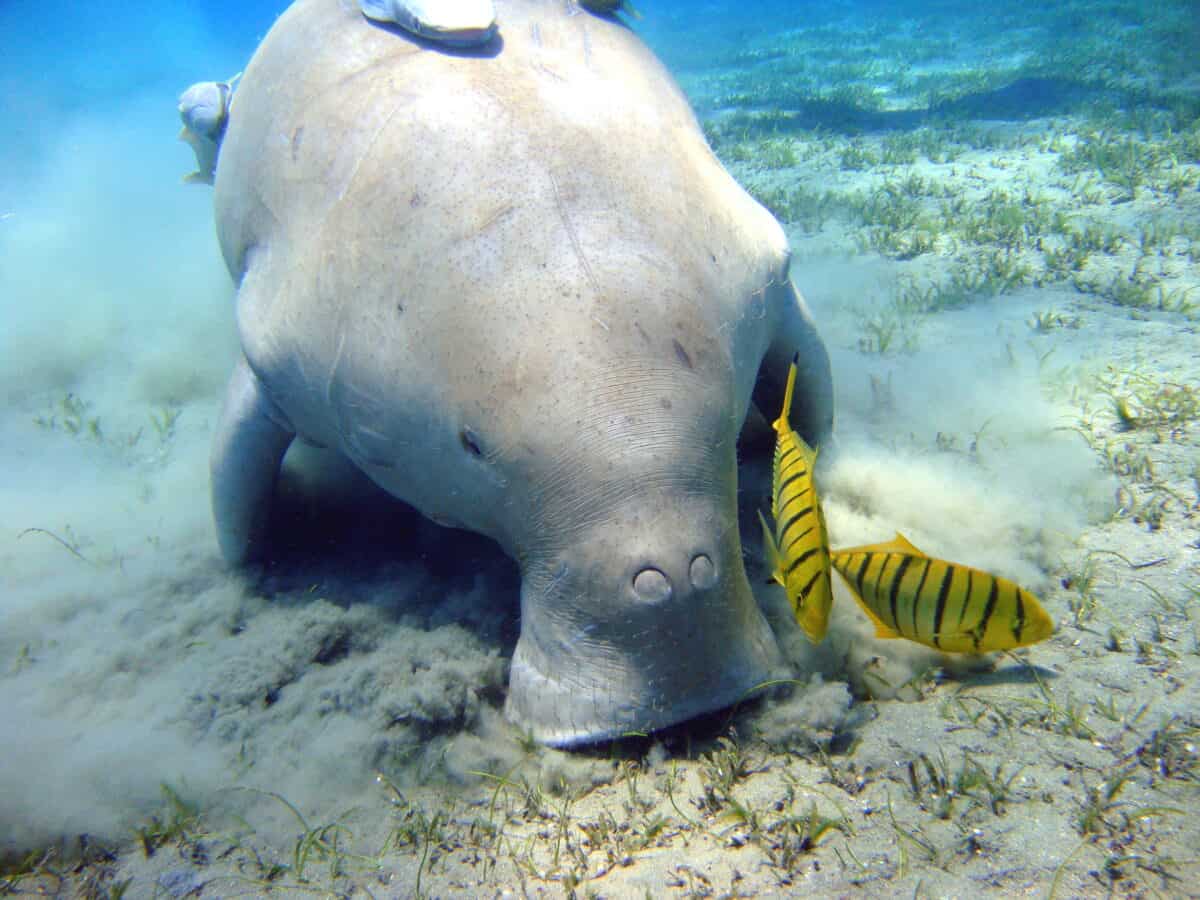
The legend of half-human, half-fish creatures dates back thousands of years across numerous seafaring cultures. Mermaids (and their male counterparts, mermen) have been reported by sailors throughout history, including by Christopher Columbus, who claimed to have spotted “female forms” rising from the sea during his voyages. The most likely explanation for these sightings is encounters with marine mammals like manatees and dugongs, collectively known as sirenians (named after sirens, the dangerous mermaids of Greek mythology).
When viewed from a distance, especially by sailors who had been at sea for months, these animals might have appeared somewhat human-like. Manatees and dugongs often rise vertically in the water, showing their head and upper body while feeding. They have a somewhat human face when viewed head-on, with nostrils rather than blowholes like whales. Female sirenians also nurse their young by holding them to their chest with flipper-like arms, a behavior that could easily be misinterpreted as a human-like mother cradling her child. Combined with the distorting effects of sea mist, distance, and perhaps wishful thinking, it’s understandable how these gentle marine mammals became transformed into the alluring merfolk of legend.
Cyclops Dwarf Elephant Skulls

The cyclops of Greek mythology—giant humanoids with a single eye in the center of their forehead—may have been inspired by an unexpected source: ancient elephant skulls. During the Pleistocene epoch, dwarf elephants lived on many Mediterranean islands, including Sicily and Crete. These elephants evolved to be much smaller than their mainland ancestors due to limited resources on the islands, but they retained the characteristic large nasal opening in their skulls that housed the trunk.
When ancient Greeks discovered these fossils, they likely misinterpreted the central nasal cavity as an eye socket. The skull of an elephant, without prior knowledge of elephant anatomy, could easily be mistaken for that of a giant humanoid with a single eye socket in the middle of its face. This theory is particularly compelling given that many cyclops myths originated in the same Mediterranean regions where dwarf elephant fossils are abundant. The Greek historian Empedocles even wrote that Sicily was “strewn with the monstrous bones of giants,” likely referring to these elephant remains that helped shape the cyclops legend.
The Griffin Protoceratops Fossils
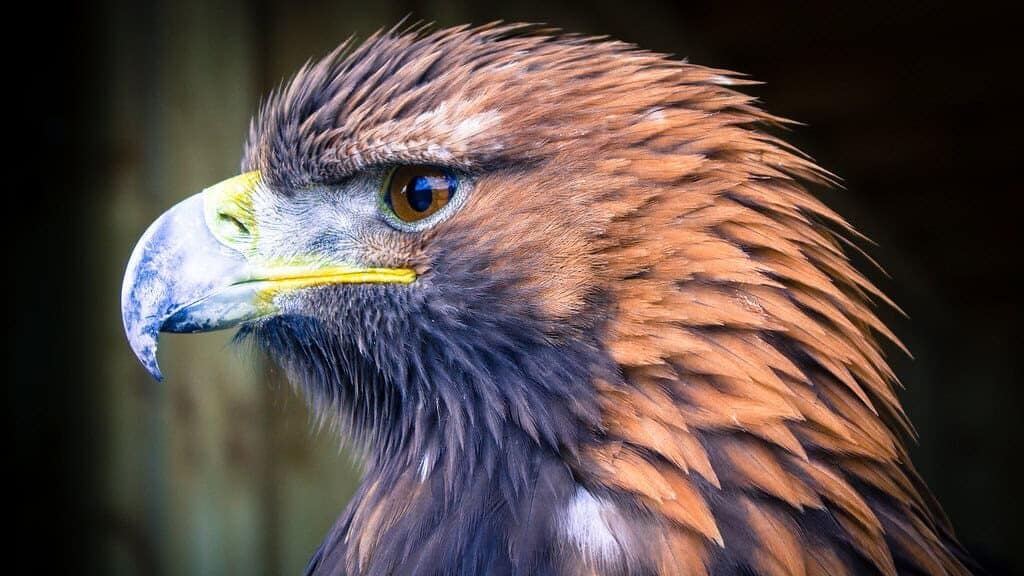
The griffin—a legendary creature with the body of a lion and the head and wings of an eagle—was revered in ancient Greek mythology as a powerful guardian of treasure and divine objects. This curious hybrid beast may have been inspired by actual fossil findings in the gold-rich Gobi Desert, where ancient Greek and Scythian gold miners encountered the remains of Protoceratops dinosaurs. These ceratopsian dinosaurs had a beaked face and a large neck frill that, when viewed as scattered bones or partially exposed fossils, could have resembled the remains of a bird-like creature.
Paleontologist Adrienne Mayor has proposed that these miners, unfamiliar with the concept of extinction and dinosaurs, interpreted what they saw through their existing knowledge of animals. The Protoceratops’ four-legged posture and the presence of a beak-like mouth structure could have easily been interpreted as a strange lion-bird hybrid. The proximity of these fossils to gold deposits may have further reinforced the association between griffins and treasure guarding. This theory provides a fascinating example of how paleontological discoveries might have influenced ancient mythology long before the science of paleontology existed.
The Leviathan Whales and Oarfish
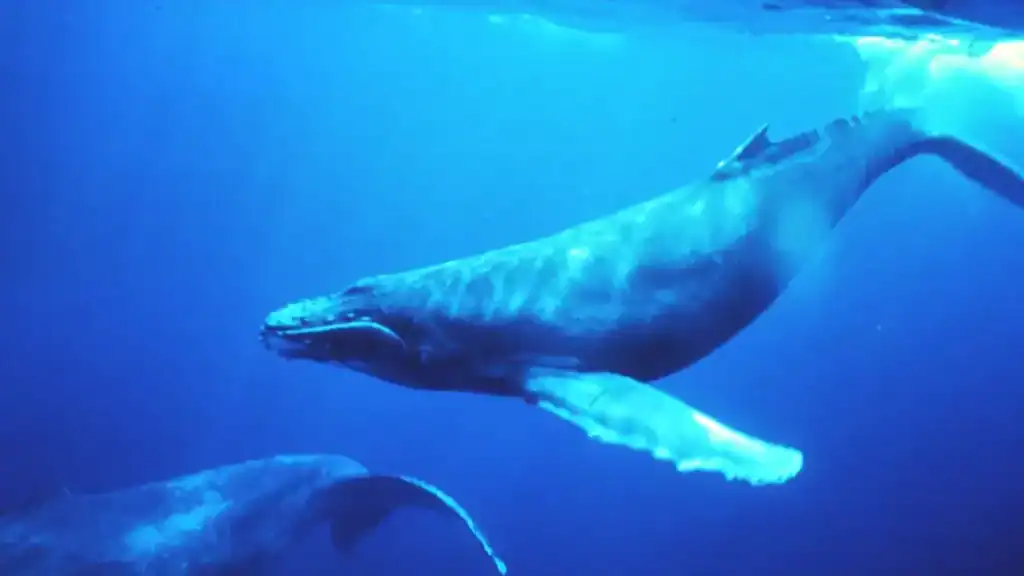
The Leviathan, a massive sea monster described in religious texts and folklore, is often depicted as a gigantic serpent or dragon capable of swallowing ships whole. While clearly embellished, this mythical creature likely has roots in real marine animals. Whales, particularly sperm whales, are prime candidates for inspiring the Leviathan legend. These massive marine mammals can grow to over 60 feet long and were known to attack whaling ships when harpooned, sometimes causing them to sink—a behavior that could easily be misinterpreted as an aggressive sea monster attacking unprovoked.
Another possible source for the Leviathan myth is the giant oarfish (Regalecus glesne), which can reach lengths of up to 36 feet. These ribbon-like fish normally inhabit deep waters but occasionally wash ashore after storms or when dying, creating spectacular and alarming sights. With their serpentine bodies, bright silver coloration, and distinctive red dorsal fins, oarfish have startled beachgoers throughout history and may have contributed to tales of sea serpents and the biblical Leviathan. Their rarity and strange appearance would have made them perfect candidates for mythologization in pre-scientific times.
The Chupacabra Canids with Mange
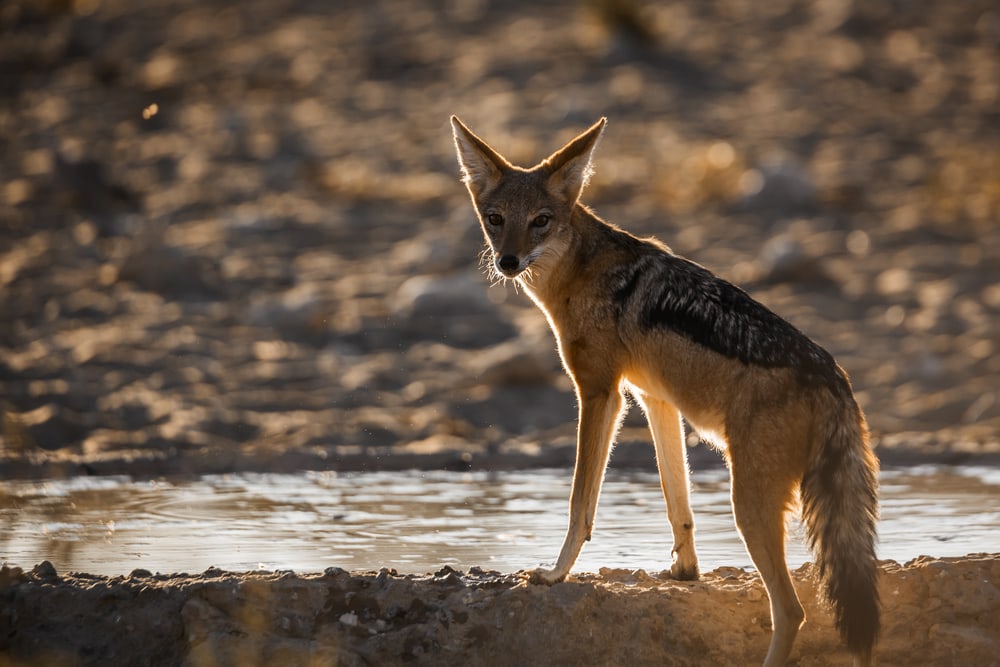
Unlike many mythical creatures with ancient origins, the chupacabra is a relatively modern legend that emerged in Puerto Rico in the 1990s. Described as a reptilian creature with spikes down its back, glowing red eyes, and a taste for livestock blood, the chupacabra (literally “goat-sucker” in Spanish) became a sensation throughout Latin America and the southern United States. Despite thousands of reported sightings, scientific investigation suggests a much more mundane explanation: coyotes, dogs, or foxes suffering from severe mange.
Sarcoptic mange is a skin disease caused by parasitic mites that leads to hair loss, thickened skin, and a generally grotesque appearance in affected animals. Canids with advanced mange often develop a hunched posture, nearly hairless bodies, and unusual skin folds that can appear spike-like. Their weakened condition may lead them to attack easy prey like livestock rather than pursuing faster wild animals. When combined with the effects of decomposition in animals found dead, these diseased canids can look remarkably like the descriptions of the legendary chupacabra. DNA tests performed on supposed “chupacabra carcasses” have invariably identified them as known species, usually coyotes or dogs with severe mange or other disfiguring conditions.
The Yeti and Sasquatch Bears and Primates

The Yeti (or Abominable Snowman) of the Himalayas and the Sasquatch (or Bigfoot) of North America share similar descriptions: large, hair-covered humanoid creatures that walk upright and avoid human contact. While many enthusiasts believe these creatures represent undiscovered primate species, scientific evidence points to misidentifications of known animals. DNA analysis of supposed “Yeti hair” samples has consistently identified them as belonging to bears, particularly the Himalayan brown bear and the rare Tibetan blue bear. When these bears stand on their hind legs, their silhouette can appear remarkably human-like, especially when glimpsed briefly in poor visibility conditions.
In North America, the American black bear is likely responsible for many Sasquatch sightings, along with misidentifications of humans or known primates. Psychological factors also play a role—pareidolia (the tendency to perceive meaningful patterns in ambiguous stimuli) can cause people to interpret distant bears or other animals as having human-like features. While indigenous traditions of wild forest people exist across many cultures, the scientific consensus remains that most Yeti and Sasquatch sightings can be explained by encounters with known species, particularly bears, combined with the human tendency to mythologize and embellish unusual experiences in remote wilderness areas.
The Hydra Polycephaly in Snakes
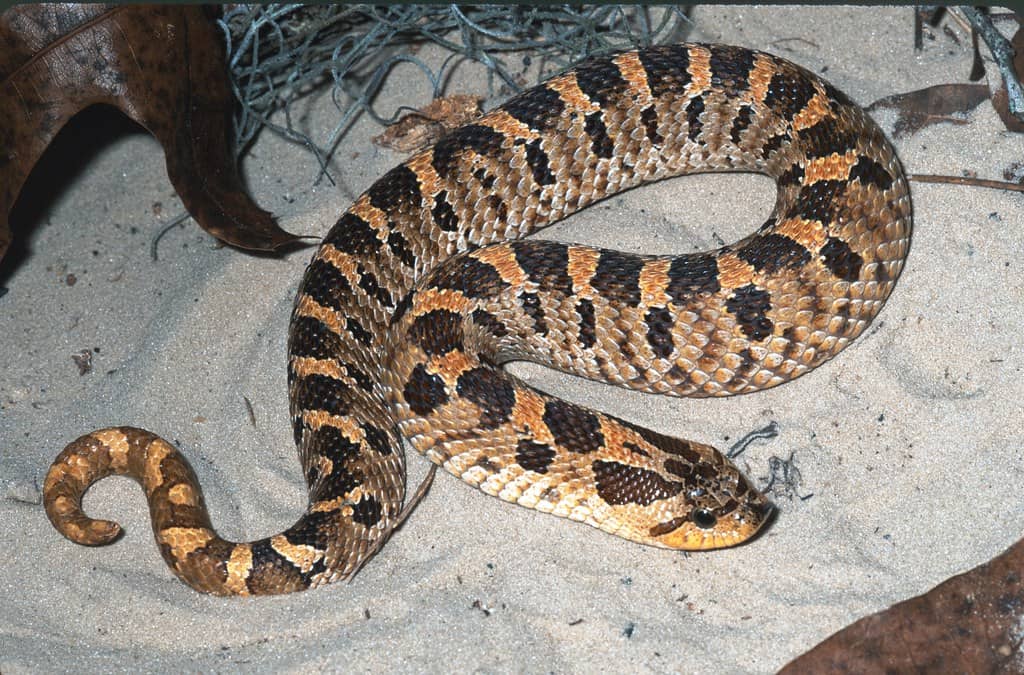
In Greek mythology, the Hydra was a serpentine water monster with multiple heads—cut one off, and two more would grow in its place. While the regenerative abilities were purely mythical, the concept of a multi-headed serpent may have been inspired by real cases of polycephaly in snakes. Polycephaly is a rare condition where an animal is born with more than one head, resulting from incomplete separation of embryos during development. Two-headed snakes are the most common form, though cases of three-headed snakes have been documented.
These genetic anomalies typically don’t survive long in the wild due to coordination difficulties, but they would have made a profound impression on anyone who encountered them in ancient times. The condition occurs in all snake species but is particularly notable in regions around the Mediterranean where the Hydra myth originated. Ancient Greeks encountering such an unusual creature might have exaggerated its features and abilities, eventually developing the legend of the Hydra. The myth’s location in the swamps of Lerna also aligns with snake habitats, further supporting the connection between this mythical monster and real biological anomalies.
The Phoenix Flamingos and Bennu Birds

The phoenix—a bird that cyclically regenerates by rising from the ashes of its predecessor—appears in the mythology of multiple cultures. While its immortality is clearly mythical, the physical description and habitat of the phoenix may have been inspired by real birds. In ancient Egypt, the phoenix myth likely originated with the Bennu, a deity associated with the sun, rebirth, and the annual flooding of the Nile. The Bennu was depicted as a large heron-like bird, and some historians believe it was inspired by the actual African sacred ibis or the goliath heron, birds that appeared during the life-giving Nile floods.
The Greek version of the phoenix, described as having crimson feathers and originating from Arabia or Ethiopia, bears a striking resemblance to flamingos. These distinctive pink birds inhabit the shallow lakes of East Africa and the Middle East, and their dramatic coloration and unusual appearance would have made them notable to ancient travelers. When flamingos take flight as a group, the visual effect of a mass of bright pink birds rising into the air could have inspired the image of the phoenix rising. The bird’s association with the sun may also connect to the way flamingo flocks often appear pink-orange at sunrise and sunset, creating a fiery spectacle that could have contributed to the phoenix legend.
The Enduring Connection Between Myth and Reality

The relationship between mythical creatures and their potential real-world inspirations reveals much about human psychology and how we interpret the unfamiliar. Throughout history, unexpected encounters with strange animals, fossils, or individuals with genetic abnormalities led our ancestors to create elaborate explanations that fit within their existing worldview. Rather than dismissing these myths as mere fabrications, we can appreciate them as creative interpretations of genuine biological phenomena by people lacking modern scientific knowledge.
This connection between myth and reality continues today, even in our scientifically advanced world. Contemporary legends like the chupacabra demonstrate that we still tend to mythologize unusual animal sightings. The persistence of cryptozoology—the search for animals whose existence lacks scientific support—shows our ongoing fascination with the possibility of undiscovered creatures. Whether ancient or modern, these myths reflect our attempt to make sense of a complex natural world.
Understanding the biological basis for mythical creatures doesn’t diminish their cultural importance or storytelling power. Instead, it adds another dimension to appreciate these legends, connecting us to our ancestors’ experiences and their attempts to explain the mysterious natural world around them. In this way, mythical beasts serve as a bridge between scientific understanding and cultural heritage, reminding us that even our most fantastic stories often contain a kernel of truth.
As we continue to explore Earth’s remaining frontiers—from deep oceans to remote rainforests—we may yet discover new species that challenge our expectations, proving that reality can sometimes be as fascinating as the myths we create to explain it.

As a little kid, I fell in love with nature, wildlife, and animals. Living in the USA, South Africa, Italy, China and Germany gave me the opportunity to discover the world's Wildlife. My favorite animals are Mountain Gorillas, Siberian Tigers, and Great White Sharks.
I'm a certified PADI Open Water Diver, went to Everest Base Camp and Trekked Gorillas in Uganda. I hold a Master of Science in Economics and Finance.
Please send any feedback to feedback@animalsaroundtheglobe.com
- 14 Most Beautiful Bird Songs You Can Hear in America - July 15, 2026
- The Longest Snake Ever Found Slithering in the U.S. - July 15, 2026
- Why Humpback Whales Are Singing Louder Off U.S. Shores - July 15, 2026