
You’ve probably watched your dog do something completely bizarre and wondered what on earth they were thinking. Maybe they spun around three times before lying down, or suddenly decided the grass in your backyard was the most delicious thing on the planet. Here’s the thing: even the smartest scientists who study dogs for a living can’t fully explain some of these behaviors.
Dogs have lived alongside humans for thousands of years, sharing our homes, our routines, and sometimes our beds. Yet despite this close relationship, they remain wonderfully mysterious creatures. Their actions often seem to follow an ancient logic we can’t quite crack. So let’s dive into five canine behaviors that continue to leave experts scratching their heads, searching for answers that may never come.
The Mysterious Pre-Sleep Circling Ritual

Watch any dog prepare for a nap and you’ll likely see them turn in circles before finally settling down. Some dogs do it once, others spin multiple times, and the ritual seems almost compulsive. Certified professional dog trainer Nicole Ellis says there is no definitive answer as to why dogs circle.
The most common theory points to dogs’ wild ancestors. Dogs inherited the behavior of circling before lying down from their wild ancestors, which may have circled to tamp down vegetation and smooth the soil, to detect and remove irritating objects, or to crush or drive away potentially harmful creatures. Wolves would flatten grass and leaves, check for predators, and even position themselves to face the wind for better scent detection.
Interestingly, research by renowned behaviorist Dr. Stanley Coren revealed something fascinating. He discovered that when dogs are presented with a soft, uneven surface, they are much more likely to turn in circles before they lie down, and often scratch or paw at the material to arrange it to their liking. When given a flat, smooth surface, far fewer dogs exhibited the circling behavior.
This is such a commonly observed behavior in dogs that we should have expected that there would be a reasonable amount of scientific literature which explains this behavior. Unfortunately, research revealed no studies that specifically address this spinning behavior in dogs. The absence of concrete data hasn’t stopped speculation, though.
Some experts believe it’s also a safety measure. Dogs might be scanning their environment one last time or checking that pack members are nearby. Others think it helps them regulate body temperature by creating the right sleeping position. Still, the true reason remains elusive, a behavior so ingrained that even our pampered pets with orthopedic beds feel compelled to perform it.
Grass Eating: Nature’s Mystery Snack
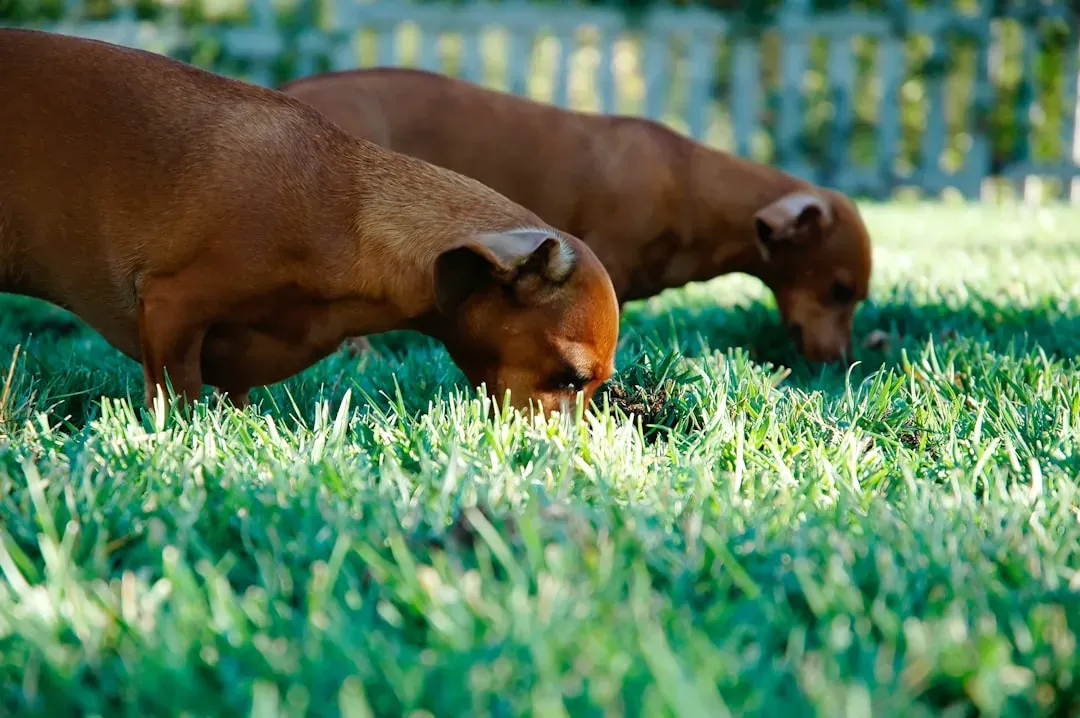
Few dog behaviors confuse owners more than watching their carnivorous companion suddenly become a grazer. You’re walking your dog, and without warning, they start munching grass like a tiny cow. The really puzzling part? Experts can’t agree on why this happens.
The general consensus is that nobody really knows why dogs eat grass, but scientists’ best guess is that they simply enjoy the taste. That’s right, after decades of research, the answer might just be “because they like it.” Let’s be real, that’s not exactly the groundbreaking revelation we were hoping for.
The age-old belief that dogs eat grass to make themselves vomit doesn’t hold much water. A limited study conducted at the UC Davis School of Veterinary Medicine showed that only about 22% of dogs studied frequently vomited after eating grass, and only 9% frequently showed signs of illness prior to eating grass. Most dogs who eat grass don’t seem sick beforehand and don’t vomit afterward.
Other theories include the fiber hypothesis. Dogs need roughage in their diets and grass is a good source of fiber. A lack of fiber affects the dog’s ability to digest food and pass stool, so grass may help their bodily functions run more smoothly. Perhaps they’re self-medicating, fulfilling some nutritional gap their regular diet doesn’t provide.
Then there’s the psychological angle. Anxious dogs eat grass as a comfort mechanism, much like nervous people chew their fingernails. Whether dogs are bored, lonely, or anxious, it is often noted that grass eating increases as owner contact time decreases. So your dog might be eating grass simply because they’re bored and it gives them something to do. Honestly, it’s hard to say for sure, but the mystery continues to baffle veterinarians worldwide.
The Adorable Head Tilt That Melts Hearts

You say something to your dog and they suddenly cock their head to one side, looking impossibly cute and seemingly deeply interested in every word. Dog owners everywhere know this gesture well. Scientists? They’re still figuring it out.
Researchers found that head tilting happened most frequently in Gifted Word Learners. GWL dogs are able to learn multiple labels for toys and retrieve them successfully beyond the ratio of chance. In one fascinating experiment, these exceptional dogs tilted their heads roughly 43 percent of the time when asked to fetch a toy by name, compared to just 2 percent for typical dogs.
The hearing theory suggests dogs tilt their heads to better locate sound sources. Dogs have ear flaps that partially or completely cover the ear canal and serve as a barrier to sound transmission, so dogs must change their position to optimize sound detection. Luckily, the canine ear flap is movable, so the dog can make the necessary adjustment to focus on the exact location of the sound.
Another possibility involves vision. Dogs with longer snouts may tilt their heads to see around their muzzle, especially when focusing on something directly in front of them. By adjusting the angle, they might be getting a better visual of your face and reading your expressions more clearly.
In humans, when you remember a story or something, you tilt your head to the side, and you have this mental image of something in your mind. Probably it’s the same for dogs. The head tilt might represent a moment of concentration, when your dog is processing language and trying to match sounds to memories.
What we do know is that roughly half the dogs studied showed a consistent directional preference, tilting either left or right. The behavior could also be reinforced by positive human reactions, treats, and praise following the tilt. Still, despite all these theories, there’s no definitive answer about what’s really happening inside that tilted doggy head.
The Strange Defecation Dance
If you’ve ever watched your dog prepare to poop, you know it’s rarely a simple affair. They sniff around, walk in circles, turn this way and that way, position and reposition themselves, and sometimes abandon a spot entirely to start the whole process over somewhere else. What are they doing?
Dogs are very particular about these landmarks, and engage in what is to humans a meaningless and complex ritual before defecating. Most dogs start with a careful bout of sniffing of a location, perhaps to erect an exact line or boundary between their territory and another dog’s territory. They might be checking who else has been there and deciding whether this is the right spot to leave their own calling card.
Some research even suggests dogs might align themselves with the Earth’s magnetic field when they eliminate. A 2013 study found that dogs prefer to orient themselves along the north-south axis during defecation, though this finding remains controversial and poorly understood. I know it sounds crazy, but it’s a genuine scientific observation that experts still debate.
The circling before pooping may also serve practical purposes from their wild ancestry. As wild canids such as coyotes, foxes, or wolves, were bedding down, they would circle to determine which way the wind was blowing. They would then rest facing the wind to detect possible predators heading their way. The same logic might apply when they’re in a vulnerable position.
Scratching the ground after defecating is a visual sign pointing to the scent marking. The freshness of the scent gives visitors some idea of the current status of a piece of territory and if it is used frequently. Dogs are leaving messages for other dogs, declaring ownership and presence through a complex communication system we barely comprehend. The entire ritual combines scent marking, territorial behavior, safety checks, and possibly magnetic field alignment into one bizarre bathroom routine.
Selective Memory for Commands

Here’s one that frustrates dog owners daily: your dog can hear a cheese wrapper opening from three rooms away but suddenly goes deaf when you call them to come inside. They remember exactly where you hid treats six months ago but somehow forget the meaning of “sit” when you’re at the vet’s office.
This selective hearing and memory puzzle has experts questioning how dog cognition really works. A team of animal behavior experts demonstrate that dogs can categorize objects by function. In a series of playful interactions with their owners, a group of Gifted Word Learner dogs were able to distinguish between toys used for tugging versus fetching, even when the toys in question didn’t share any obvious physical similarities, all with no prior training.
Dogs clearly have remarkable cognitive abilities. They can learn hundreds of words, understand complex commands, and demonstrate problem-solving skills that rival young children. Yet they also seem perfectly capable of ignoring commands they know perfectly well. Is it genuine confusion or willful disobedience?
The answer lies somewhere in the murky middle. Dogs are heavily influenced by context, motivation, and emotional state. Breed is not a good predictor of individual dog behavior. Breed type explains just 9 percent of variation in behavior, according to a combination of survey responses and DNA sequencing. This means individual personality and environmental factors play huge roles.
What scientists do know is that dogs pay attention to what matters to them in the moment. If there’s something more interesting than your command, their brilliant brains will prioritize that instead. They’re processing information through a completely different lens than humans, weighing immediate rewards against deferred obedience. The result? A dog who somehow knows “treat” in seventeen different contexts but mysteriously can’t understand “drop it” when they’ve found something disgusting to chew.
Conclusion
Dogs remain beautifully enigmatic creatures despite living with us for tens of thousands of years. These five behaviors, from pre-sleep spinning to selective command amnesia, prove that our canine companions still have plenty of secrets. Scientists continue researching, theorizing, and conducting studies, yet definitive answers remain frustratingly out of reach.
The truth is, dogs operate on instincts and logic patterns that evolved over millennia in environments vastly different from our modern living rooms. Their brains process the world through scent, sound, and social cues in ways we can barely imagine. Maybe that’s part of their charm, honestly. They’re familiar yet forever foreign, predictable yet endlessly surprising.
Next time your dog does something completely baffling, remember that even the experts are stumped. You’re witnessing behaviors that connect your pet to their ancient ancestors, to survival instincts hardwired into their DNA, and to a canine perspective we’ll probably never fully understand. What do you think drives these mysterious behaviors? Have you noticed any patterns in your own dog’s quirks?
