

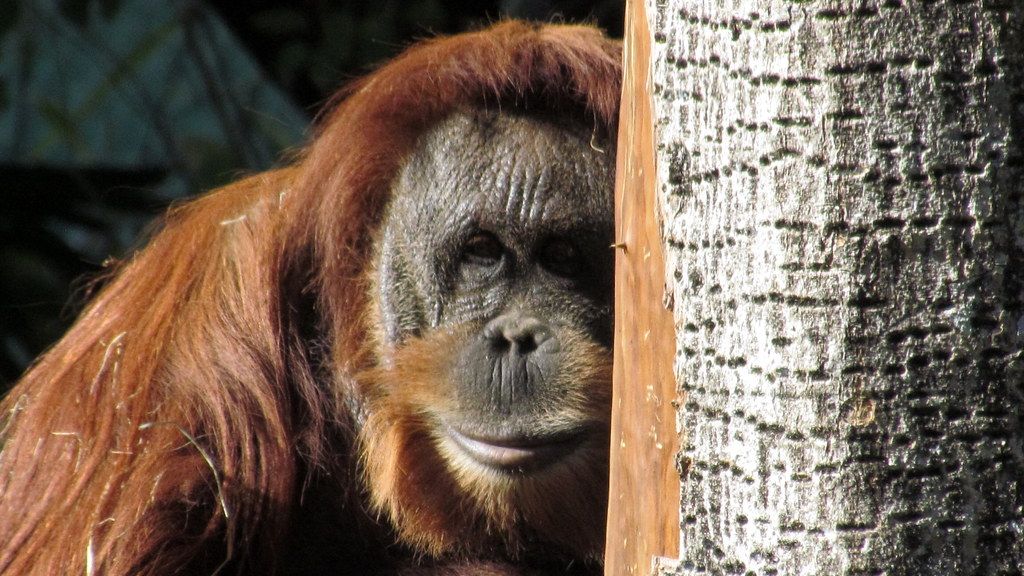
North Sumatra, Indonesia — Conservation teams celebrated a breakthrough moment when a camera trap captured a young male Sumatran orangutan traversing a specially constructed canopy bridge over a bustling local road. The footage emerged two years after experts installed the structure in the Pakpak Bharat district, offering fresh optimism for a species battered by habitat loss.[1][2] This event highlights how targeted interventions can bridge the gap between human infrastructure needs and wildlife survival in fragmented rainforests.
The Captivating Footage
The video showed the orangutan cautiously stepping onto the rope bridge before steadily advancing across its length. Midway, the primate paused, peering down at the road below and glancing toward the camera with apparent curiosity, then continued into the adjacent forest patch.[1] Such behavior demonstrated the animal’s adaptability, a trait essential for arboreal species like orangutans that rarely descend to ground level.
Experts described the scene as a rare validation of their efforts. The recording marked the first documented instance of a Sumatran orangutan utilizing such a wildlife crossing, sparking immediate excitement among the monitoring team.[3]
Origins of the Road Barrier
Local authorities upgraded the Lagan-Pagindar road in 2023 to better connect remote communities with schools, hospitals, and markets. This improvement, while vital for residents, widened a canopy gap that severed forest connectivity for tree-dwelling wildlife.[2] The route now divided an estimated 350 orangutans between the Siranggas wildlife reserve and the Sikulaping protection forest, creating isolated groups vulnerable to decline.
Erwin Alamsyah Siregar, director of the environmental group Tangguh Hutan Khatulistiwa (TaHuKah), noted that natural crossings had become impossible for these animals. In response, conservationists erected the bridge high above the roadway in 2024, using just 200 meters of rope installed over a few days.[1]
Patience Pays Off After Two Years
The Sumatran Orangutan Society (SOS) partnered with TaHuKah and district officials to monitor five such bridges via camera traps. Initial footage revealed usage by smaller species, building anticipation for larger primates.
- Plantain squirrels and black giant squirrels navigated first.
- Long-tailed macaques followed, along with black Sumatran langurs.
- Agile gibbons also crossed confidently.[2]
Helen Buckland, chief executive of SOS, recalled the team’s reaction: “You should have heard the cries of delight from the team. After two long years, it’s finally happened.” This success affirmed the bridges’ design for diverse wildlife.[1]
Fighting Fragmentation’s Long-Term Toll
Sumatran orangutans, one of three species confined to Southeast Asia’s forests, number only about 14,000 in the wild and face critical endangerment status. As the largest tree-dwelling mammals, they spend over 90 percent of their time in the canopy, acting as keystone species that disperse seeds and shape ecosystems.[1][4]
Roads exacerbate fragmentation, trapping populations in small areas prone to inbreeding and genetic bottlenecks. Buckland explained, “Orangutans have a very slow life history, and are really prone to genetic bottlenecks.” Without connectivity, these groups risk functional extinction despite short-term survival.[1]
Franc Bernhard Tumanggor, head of Pakpak Bharat district, emphasized coexistence: “Witnessing a Sumatran orangutan confidently crossing that bridge is living proof that we need not sever the forest’s lifeline in order to build our communities’ own. Modernisation does not have to mean destruction.”[1]
This crossing serves as a model for scalable solutions across Sumatra, where similar projects could safeguard broader biodiversity amid ongoing development. It reminds observers that innovative infrastructure can preserve vital habitats, ensuring these majestic apes endure for future generations.

- Urban Coyotes Show Remarkable Adaptability, Learning to Thrive in City Environments - July 22, 2026
- Beavers Are Nature’s Engineers, Creating Vital Habitats for Other Wildlife Species - July 21, 2026
- The Recovery of the California Condor Offers Hope for Other Critically Endangered Birds - July 21, 2026