

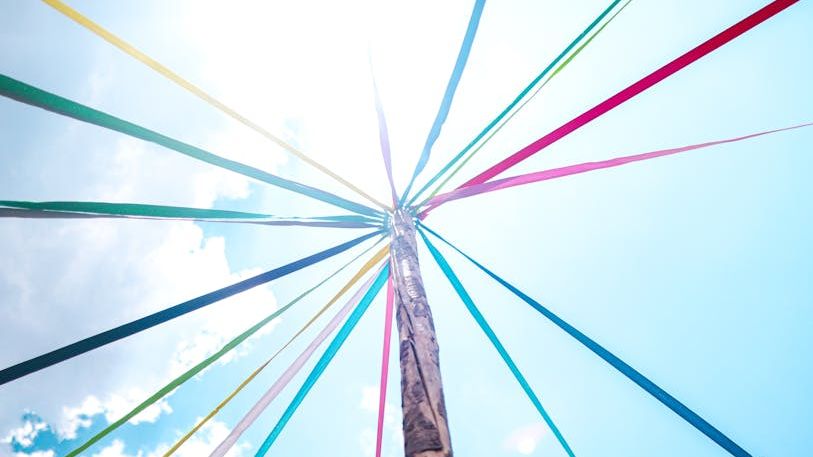
Happy May Day! Today is an astronomy holiday – Image for illustrative purposes only (Image credits: Pexels)
May 1 sits precisely midway between the March equinox and June solstice, marking it as one of the Northern Hemisphere’s four cross-quarter days. This positioning ties the spring festival directly to the sun’s path across the sky, a connection often overlooked amid the festivities. Observed for centuries, May Day blends astronomical precision with cultural rituals that celebrated the lengthening days.
Understanding Cross-Quarter Days
Cross-quarter days fall roughly halfway between the equinoxes and solstices, dividing the year into eight segments aligned with solar cycles. Astronomers note these dates where the sun’s ecliptic path intersects key points relative to Earth’s equator. May 1, in particular, captures the moment when daylight gains momentum toward the summer peak.
The celestial equator’s plane extends from Earth’s equator, while the ecliptic traces the sun’s annual journey. Equinoxes occur at their intersections, but cross-quarter days like May Day highlight midpoints in between. This framework, visualized in astronomical diagrams, underscores how ancient observers tracked time without modern tools.
The Four Key Dates in the Solar Calendar
Each cross-quarter day carried significance in various cultures, linking human activities to cosmic rhythms. February 2, known as Groundhog Day, opens the set; August 1 follows as Lammas; and October 31 aligns with Halloween. Together, they frame the transitions beyond just the solstices and equinoxes.
| Date | Position | Cultural Note |
|---|---|---|
| February 2 | Between winter solstice and vernal equinox | Groundhog Day |
| May 1 | Between vernal equinox and summer solstice | May Day |
| August 1 | Between summer solstice and autumnal equinox | Lammas |
| October 31 | Between autumnal equinox and winter solstice | Halloween |
This table illustrates their even spacing, a testament to early sky-watchers’ accuracy. Such alignments influenced agriculture, festivals, and folklore across Europe and beyond.
Beltane and the Sun’s Rising Power
May Day traces back to the Celtic festival of Beltane, honoring the sun’s increasing strength as summer approached. Communities drove livestock between bonfires and danced in the direction of the sun’s daily arc, rituals meant to purify and invoke prosperity. These practices reflected a deep awareness of seasonal shifts driven by Earth’s tilt.
In England during the Middle Ages, villages competed to erect the tallest maypoles, symbols of the season’s vitality. Smaller towns raised them temporarily for the day’s revelry, while larger cities like London installed permanent ones. The maypole dance, with ribbons weaving patterns, echoed the sun’s spiraling path in the sky.
Global Twists on the Tradition
Hawaii transforms May Day into Lei Day, a vibrant statewide event emphasizing the aloha spirit through flower leis. Participants exchange these garlands, fostering community bonds much like ancient fire rituals fostered protection for herds. This adaptation highlights how solar midpoints inspired diverse expressions worldwide.
Closer to home in the late 20th century, Americans crafted May baskets filled with flowers and treats, left anonymously on doorsteps. Children often participated, adding a personal touch to the day’s joy. Though less common now, these customs offer a chance for revival amid modern distractions.
- Maypole dancing remains a staple in rural English villages, often near historic churches.
- Lei-giving in Hawaii underscores themes of welcome and renewal.
- Basket-making invites simple, heartfelt gestures in neighborhoods.
May Day’s Enduring Sky Connection
Today, on May 1, 2026, the cross-quarter day’s astronomical roots persist even as celebrations evolve. It serves as a reminder of humanity’s longstanding attunement to celestial patterns, bridging past rituals with present observations. Whether through dance, leis, or quiet reflection, May Day invites appreciation for the sun’s steady climb.
As the Northern Hemisphere tilts further into light, this midway milestone encourages pausing to consider the sky’s quiet guidance. Groundhog Day and Halloween share similar ties, yet May Day uniquely heralds spring’s full embrace.

As a little kid, I fell in love with nature, wildlife, and animals. Living in the USA, South Africa, Italy, China and Germany gave me the opportunity to discover the world's Wildlife. My favorite animals are Mountain Gorillas, Siberian Tigers, and Great White Sharks.
I'm a certified PADI Open Water Diver, went to Everest Base Camp and Trekked Gorillas in Uganda. I hold a Master of Science in Economics and Finance.
Please send any feedback to feedback@animalsaroundtheglobe.com
- 13 Most Independent Cat Breeds - July 21, 2026
- 13 Animals That Can Kill Without Venom or Claws - July 21, 2026
- 15 Bear Survival Skills You Need to Know - July 21, 2026