

#1 The scientist who started listening a little closer

The person most associated with this research is Con Slobodchikoff, an emeritus biologist whose work centers on colonies living just outside Northern Arizona University. Slobodchikoff has been studying prairie dogs for over 30 years, focusing primarily on Gunnison’s prairie dogs, whose natural habitat sits just outside the doors of the university where he is a professor emeritus. His interest did not begin with a grand hypothesis about animal language, it began with a much smaller, more practical puzzle.
His work did not begin with grand theories. It started with curiosity about why different alarm calls seemed to produce different behaviors across a colony. That modest question, asked repeatedly and tested carefully over roughly four decades of fieldwork, eventually grew into one of the more debated claims in animal communication research.
#2 Different predators, different calls

The foundational discovery, the one everything else builds on, is fairly straightforward once you see it laid out. From the mid-1980s onward, Slobodchikoff and colleagues reported that Gunnison’s prairie dogs produce acoustically different alarm calls for different kinds of predator, including red-tailed hawks, humans, coyotes, and domestic dogs. That alone separated prairie dog chatter from a generic distress signal.
The real test of whether other prairie dogs actually understand these distinctions, rather than just making them, came later. The clearest test appeared in a 2006 paper in Behavioural Processes by Judith Kiriazis and Slobodchikoff, where live predators drew two qualitatively different escape responses, running to the burrow and diving in for hawks and humans, and standing upright outside the burrow for coyotes and dogs. When the researchers played back recordings of the calls, the colony produced the same escape responses as it had to the live animals. That is a meaningful result, since it shows the sound itself, not the sight of the predator, is what triggers the correct behavior.
#3 Reading color into a rodent’s chirp

If distinguishing a hawk from a coyote sounds impressive, the color experiments push the claim further into strange territory. In one well known study, three similar sized human females walked through a Gunnison’s prairie dog colony wearing each of three different colored shirts, blue, green, and yellow, while researchers recorded the alarm calls. The team then ran statistical comparisons to see if the calls themselves shifted with shirt color.
The results showed that the alarm calls for the blue and the yellow shirts were significantly different, but the green shirt calls were not significantly different from the calls for the yellow shirt. That uneven pattern is not a flaw so much as a clue. Later work suggested distinctive acoustic elements for blue versus yellow apparel and blue versus green, but not for yellow versus green, which prairie dogs cannot distinguish perceptually. In other words, the calls seem to track what the animals can actually see, not some arbitrary human color chart.
#4 Size, shape, and speed folded into a squeak
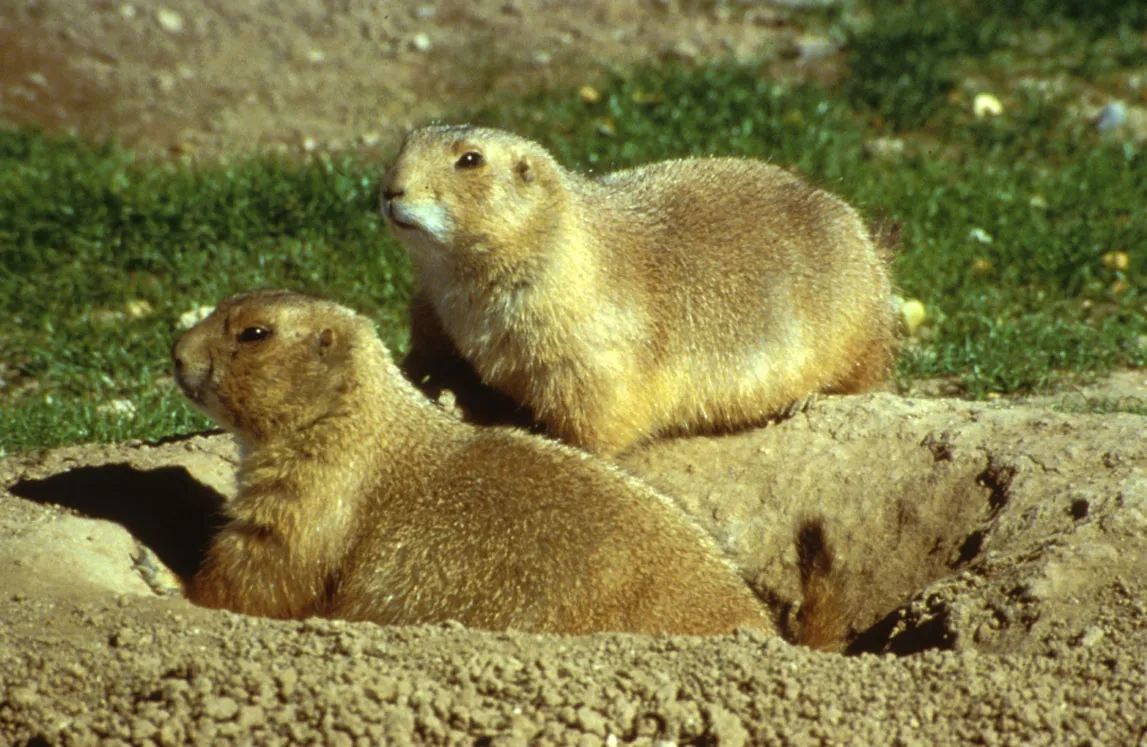
Color was not the only variable researchers tested. To find out whether prairie dogs also encode physical form, the team introduced simple objects instead of people. Slobodchikoff’s experiments extended to shapes as well, and when researchers introduced plywood cutouts of different geometric shapes moving through the colony, prairie dogs produced calls that varied based on whether the shape was a circle, square, or triangle.
A 2009 acoustics paper tried to state the overall pattern plainly rather than dramatically. A 2009 Journal of the Acoustical Society of America abstract by Slobodchikoff, William Briggs and Patricia Dennis summarized the claim directly, that Gunnison prairie dog alarm calls incorporate predator species, and also descriptions of colour and general size. Separate follow up work extended this to size categories as well as shape, reinforcing the idea that the calls are not one size fits all warnings but signals that shift with the details of the threat.
#5 Inventing new sounds for things they have never seen

Perhaps the most striking claim in the entire body of work is that prairie dogs are not limited to a fixed vocabulary of pre-set alarms. This finding suggested that prairie dogs possessed the ability to create new words for novel objects in their environment, a characteristic previously thought unique to human language, and it has fundamentally changed how researchers think about animal communication capabilities. Rather than freezing up or defaulting to a generic call when confronted with something unfamiliar, the animals appear to recombine existing acoustic pieces into something new.
This matters because it hints at a system built from smaller reusable parts rather than a fixed list of alarm sounds memorized one by one. If a colony can describe an object it has never encountered before by mixing known elements, that points toward a more flexible, almost modular structure underneath the chirps. It is exactly this flexibility that has made the research so widely cited, and also so widely scrutinized, in animal cognition circles.
#6 Regional accents across prairie dog towns

Communication systems in humans often carry regional flavor, and it turns out prairie dogs are not so different. Researchers examined the relationship between habitat structure and alarm call characteristics in six colonies of Gunnison’s prairie dogs near Flagstaff, Arizona, and found significant differences in alarm call characteristics between colonies, confirming the existence of alarm call dialects, with differences in frequency components but not temporal components associated with habitat structure.
That pattern is not confined to one species of prairie dog either. A separate study on black-tailed prairie dogs found results consistent with the hypothesis that they have dialects in their alarm calls, showing that the alarm calls of nearby colonies share similar characteristics and are significantly different from the alarm calls of colonies located farther apart. In practical terms, a prairie dog raised in one grassland might sound subtly different from a member of the same species living several valleys over.
#7 What the calls do not prove, and who else is listening in

It is worth pausing on how careful the actual published research is compared to how the story usually gets retold. The argument is that a Gunnison’s prairie dog alarm call carries information not only about what kind of predator is approaching, but, within a given call type, about features such as the intruder’s size, shape, and the colour of a person’s clothing, one of the more striking claims in animal communication research, though also more carefully bounded in the actual papers than the popular retelling suggests. That does not mean every call is a tiny English sentence, it means the call system appears to be referential and descriptive in ways that are unusual among mammals.
The story has also expanded beyond prairie dogs talking only to each other. A study published in Animal Behaviour found that black-tailed prairie dog alarm calls and yips attract attention from long-billed curlews, with researchers from the Smithsonian’s National Zoo and Conservation Biology Institute discovering that the birds eavesdrop on prairie dog alarm calls and adjust their anti-predator behavior accordingly. Add in the colony wide jump-yip display, which spreads through groups like a wave and serves as an all-clear signal after danger passes, and it becomes clear these animals are running a communication network with more moving parts than most casual observers would ever guess.
Final thoughts


- What Hummingbirds Do Before They Vanish for Winter Will Surprise You 18 Behaviours Gardeners Miss - August 13, 2026
- 17 Animals That Bond With One Person for Life and 17 That Never Really Attach at All - August 13, 2026
- 16 Things Your Dying Cat Quietly Asks For in Its Last Weeks That Almost Nobody Recognises - August 13, 2026