


When you look in the mirror, you immediately recognize yourself—your face, your expressions, and your movements. This self-recognition seems so fundamental to human experience that we rarely question its significance. But what about other animals? Do they possess the cognitive capacity to recognize their own reflection? This fascinating question has intrigued scientists for decades, leading to the development of the mirror self-recognition (MSR) test, which has become a standard method for assessing self-awareness in animals. The results of these studies have been surprising, challenging our understanding of animal cognition and blurring the lines we once drew between human and animal consciousness. Let’s explore which animals can recognize themselves in mirrors, how scientists test this ability, and what it might tell us about the evolution of self-awareness.
The Mirror Test: A Window Into Self-Awareness
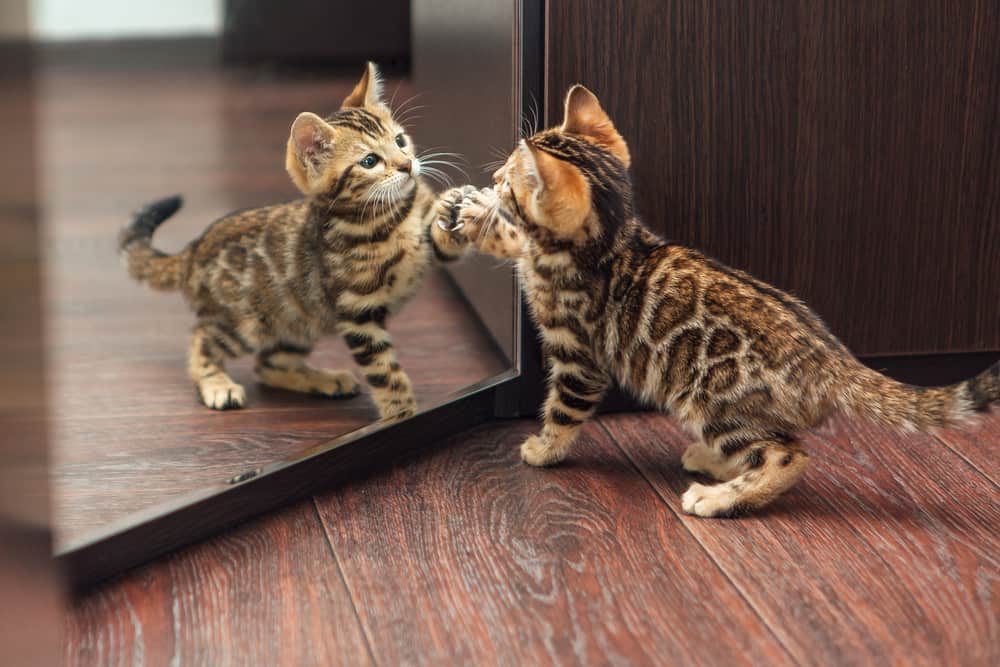
The mirror self-recognition test, first developed by psychologist Gordon Gallup Jr. in 1970, provides a method for determining whether an animal possesses some form of self-awareness. The classic version involves placing a colorful mark on an animal in a location they cannot see without a mirror, such as their forehead.
Researchers then observe whether the animal, when presented with a mirror, attempts to investigate or remove the mark—indicating they understand the reflection represents themselves. Animals that pass this test demonstrate not only that they recognize their mirror image as themselves rather than another animal, but also that they understand the relationship between their body and the environment. This cognitive feat requires a sophisticated understanding of self that was once thought to be uniquely human.
Great Apes: Our Self-Aware Cousins
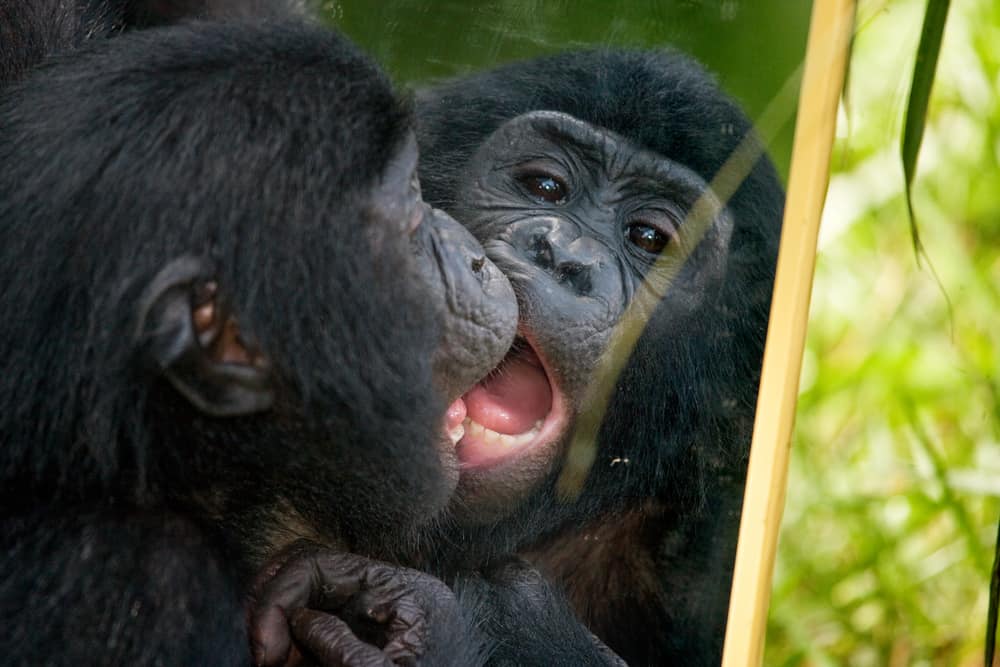
Our closest evolutionary relatives—chimpanzees, bonobos, orangutans, and some gorillas—have consistently demonstrated mirror self-recognition. When marked with odorless dye on their foreheads and presented with mirrors, these apes often touch the mark while looking in the mirror, indicating they understand the reflection represents themselves.
Chimpanzees, in particular, have shown remarkable behaviors during mirror tests, using mirrors to groom parts of their bodies they cannot normally see and making faces at their reflections as if practicing facial expressions. These findings aren’t particularly surprising given the close evolutionary relationship between great apes and humans, but they were groundbreaking when first discovered, as they challenged the notion that self-awareness was uniquely human.
Dolphins: Self-Recognition in the Ocean

Beyond our primate relatives, dolphins have demonstrated compelling evidence of mirror self-recognition. In studies conducted by Diana Reiss and Lori Marino, bottlenose dolphins showed behaviors indicating they recognized themselves in mirrors. When marked with temporary ink on parts of their bodies they couldn’t see directly, dolphins positioned themselves to view the marked areas in mirrors and spent significantly more time examining these regions.
What makes this particularly impressive is that dolphins must translate between entirely different sensory modalities—their primary perception of the world comes through echolocation (sound), yet they can recognize themselves visually in mirrors. This cross-modal self-recognition suggests a highly developed sense of self that transcends specific sensory inputs.
Elephants: Gentle Giants with Self-Awareness
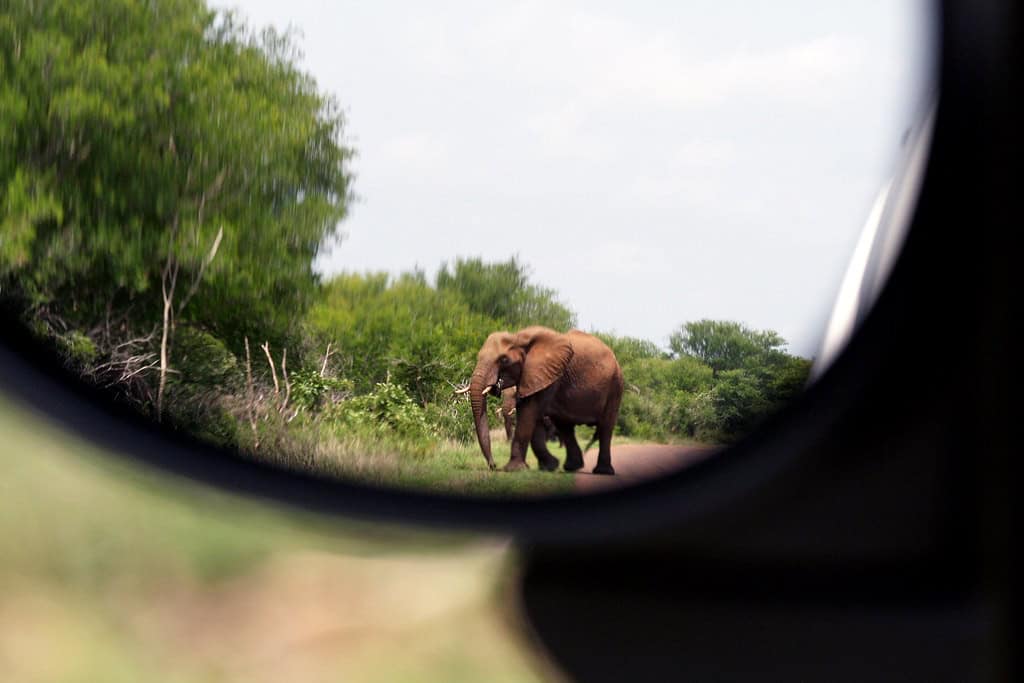
Elephants joined the exclusive club of mirror self-recognizing animals in 2006, when researchers Joshua Plotnik, Frans de Waal, and Diana Reiss conducted mirror tests with Asian elephants. In their study, an Asian elephant named Happy repeatedly touched a white X marked on her forehead while looking in a mirror—the first documented case of mirror self-recognition in a non-primate land mammal.
Elephants’ success at this test aligns with other evidence of their cognitive sophistication, including their complex social structures, apparent empathy, and mourning behaviors. Their large brains—the largest among land animals—likely support these advanced cognitive abilities, including the capacity to recognize themselves.
Birds: Feathered Self-Awareness

Despite having brains structured very differently from mammals, some birds have demonstrated mirror self-recognition, most notably magpies. In a 2008 study, researchers placed colored stickers on magpies’ throats—a place they could not see without a mirror. When presented with mirrors, the birds attempted to remove the stickers using their beaks, indicating they recognized their reflections. This was a surprising discovery, as magpies are evolutionarily distant from primates, suggesting that self-awareness may have evolved independently multiple times through convergent evolution.
More recently, studies have indicated that corvids (the family including crows, ravens, and jays) generally possess remarkable cognitive abilities, including possible self-recognition in some species, challenging our understanding of the neural requirements for self-awareness.
Ants: Tiny Creatures with Surprising Abilities

In a truly unexpected finding, a 2015 study suggested that some ant species might recognize themselves in mirrors. Researchers placed a blue dot on ants and observed that many of them showed cleaning behaviors when they saw themselves in a mirror with the dot, but not without the mirror. While this research remains controversial and requires further confirmation, it raises profound questions about the minimum neural architecture required for self-recognition.
Ants have tiny brains with far fewer neurons than mammals or birds that pass the mirror test, so if they truly possess this ability, it would revolutionize our understanding of self-awareness. Some scientists suggest that rather than true self-recognition, ants might be responding to unfamiliar sensory input, highlighting the challenge of interpreting mirror test results across vastly different species.
Limitations of the Mirror Test

While the mirror test has provided valuable insights into animal cognition, it has significant limitations that have led many researchers to question its universal applicability. The test inherently favors animals that rely heavily on vision and have the physical capability to touch or examine marked areas on their bodies. This creates a bias against species that prioritize other senses like smell or hearing.
Dogs, for instance, primarily navigate their world through scent rather than sight, which may explain their poor performance on visual mirror tests despite their complex social cognition. Similarly, many animals lack the physical anatomy (such as hands, paws, or a flexible neck) to investigate marks on their bodies even if they did recognize themselves. These limitations have prompted scientists to develop modified tests and alternative approaches to assess self-awareness across diverse species.
The Scent-Based Self-Recognition Test

To address the limitations of the visual mirror test, researchers have developed alternative methods to assess self-recognition in animals that rely primarily on other senses. For dogs, whose world is dominated by smell, scientists at Barnard College developed a “smell mirror” test. This innovative approach involved presenting dogs with canisters containing their own urine scent, modified urine scent, and the scent of other dogs.
Dogs spent significantly less time investigating their own unmodified scent compared to other scents, suggesting they recognized it as their own—a form of olfactory self-recognition. Similar approaches have been developed for other species, highlighting that self-awareness may manifest differently across the animal kingdom depending on the primary sensory modalities each species uses to perceive the world.
The Evolution of Self-Awareness

The distribution of mirror self-recognition across the animal kingdom raises fascinating questions about the evolution of self-awareness. Initially, scientists believed self-recognition evolved just once in the common ancestor of humans and great apes. However, its presence in evolutionarily distant species like elephants, dolphins, and magpies suggests either that it evolved independently multiple times through convergent evolution, or that it has a much more ancient evolutionary origin than previously thought.
Most researchers now favor the convergent evolution hypothesis, noting that the species that pass mirror tests tend to share certain traits despite their evolutionary distance: they are highly social, have relatively large brains for their body size, and demonstrate complex problem-solving abilities. This suggests that certain ecological and social pressures may drive the evolution of self-awareness across diverse lineages.
Beyond Self-Recognition: Theory of Mind

Self-recognition represents just one aspect of a broader cognitive capacity known as theory of mind—the ability to attribute mental states to oneself and others. Animals that recognize themselves in mirrors may possess other sophisticated cognitive abilities, including understanding that other individuals have different perspectives, knowledge, or beliefs. For example, chimpanzees will hide food from dominant group members if they believe they’ve been observed, suggesting they understand what others can and cannot see.
Ravens will protect their food caches more vigorously if they’ve observed other ravens stealing food in the past, indicating they can attribute intentions to others. These capabilities hint at a rich inner mental life in many animals that extends far beyond simple self-recognition, suggesting that consciousness exists on a spectrum rather than being an all-or-nothing phenomenon unique to humans.
Self-Awareness and Animal Welfare

The discovery that many animals recognize themselves in mirrors has profound implications for animal welfare and ethics. If an animal possesses self-awareness, it likely has a sense of its own existence over time—what philosophers call a “biographical life” rather than merely a biological one. This raises important questions about how we treat these cognitively complex creatures. For example, keeping self-aware animals in captivity, particularly in isolation or barren environments, may cause psychological suffering beyond mere physical discomfort.
Several countries have begun to legally recognize the personhood of highly intelligent animals like great apes and dolphins based partly on evidence of their self-awareness. These legal protections acknowledge that self-aware animals have interests that extend beyond basic survival needs and deserve special consideration in how humans interact with them.
Conclusion: Redefining the Cognitive Divide

The question of whether animals can recognize themselves in mirrors has led to profound discoveries that continue to reshape our understanding of animal cognition. From great apes and elephants to dolphins and magpies, the diversity of species demonstrating self-recognition challenges the once-sharp distinction between human and animal consciousness. As our methods for studying animal cognition become more sophisticated and tailored to different species’ sensory worlds, we may discover that self-awareness is even more widespread than currently recognized.
This growing body of evidence suggests that consciousness and self-awareness likely evolved gradually along multiple evolutionary pathways, rather than appearing suddenly in humans. By continuing to explore the cognitive capacities of our fellow creatures, we not only gain insight into the evolution of our own minds but also develop a deeper appreciation for the complex inner lives of the animals with whom we share our planet.

From exploring the marine wonders in the Azores and witnessing the vast savannas of Kenya, to delving deep into the rich biodiversity of South Africa and traversing iconic landscapes in Australia and the US like Yellowstone, Chris's experiences are vast.
With a penchant for diving alongside sharks, the ocean holds a special place in his heart.
Through his academic insights, he champions wildlife conservation, striving with 'Animals Around The Globe' to cultivate a profound connection between humans and animals, enhancing our mutual appreciation.
Connect with him at Feedback@animalsaroundtheglobe.com.
- This Monkey Has a Mustache - July 21, 2026
- How Steve Irwin Changed the World’s View of Wildlife - July 21, 2026
- The Catfish That Caused Earthquakes in Japanese Folklore - July 21, 2026