

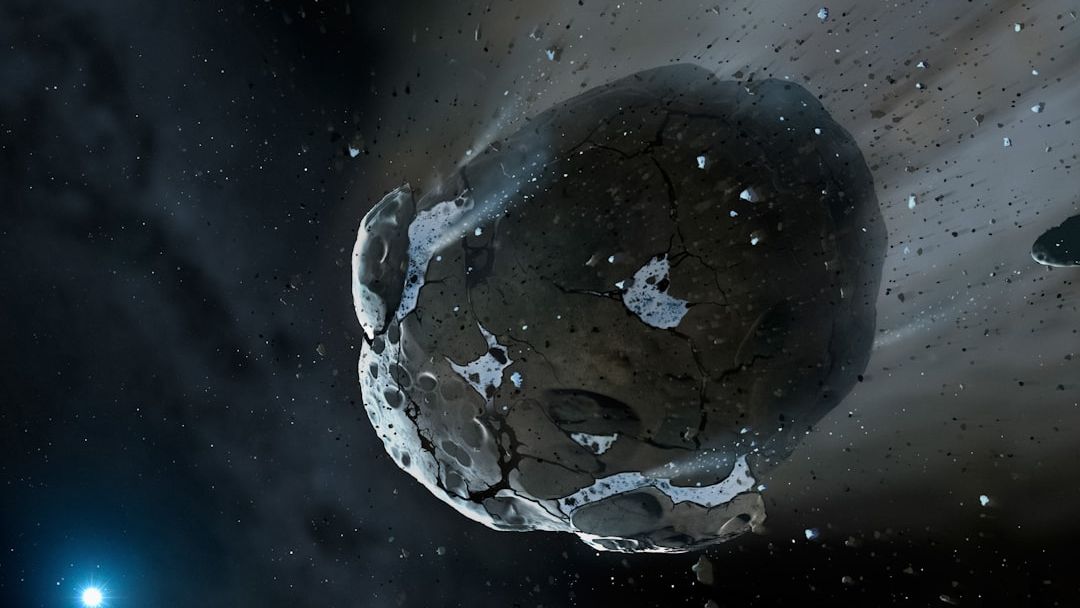
Ancient asteroid craters may have sparked Earth’s oxygen-producing life – Image for illustrative purposes only (Image credits: Unsplash)
Hapcheon, South Korea – Researchers examining an ancient impact site have identified layered structures that point to a possible connection between asteroid strikes and the emergence of oxygen-generating microbes on early Earth. The findings center on fossil-like formations inside the Hapcheon crater, where conditions created by the collision appear to have supported microbial activity. This work adds a new dimension to understanding how Earth transitioned from an oxygen-poor world to one capable of sustaining complex life.
The Hapcheon Site and Its Microbial Clues
The crater, formed by a long-ago asteroid collision, contains stromatolites – distinctive layered deposits created by communities of ancient microbes. These structures formed in what scientists describe as warm, mineral-rich waters that filled the depression after the impact. Their presence suggests the crater acted as a sheltered basin where early life could take hold and begin producing oxygen through photosynthesis.
Stromatolites serve as some of the oldest evidence of biological activity on the planet. In this case, their location within an impact feature raises the possibility that such craters offered repeated opportunities for microbial communities to develop across different periods of Earth’s history. The South Korean example stands out because it preserves these formations in a setting directly tied to an extraterrestrial event.
How Impacts Could Have Created Favorable Conditions
Asteroid strikes release enormous energy, vaporizing rock and generating heat that can persist in the resulting crater for extended periods. This process often leads to the formation of lakes or ponds enriched with nutrients leached from shattered minerals. Such environments would have provided both warmth and chemical resources that microbes could exploit for growth and energy production.
Over time, these crater lakes may have functioned as isolated laboratories for evolution. Microbes thriving there could have released oxygen as a byproduct, gradually altering the surrounding atmosphere. The Hapcheon discovery illustrates one concrete instance where this sequence appears to have occurred, though researchers note that similar processes likely played out at other impact sites worldwide.
Broader Implications and Remaining Questions
The idea that asteroid impacts contributed to Earth’s oxygenation challenges earlier views that focused mainly on volcanic or oceanic sources. Instead, it highlights how sudden, violent events could have created localized havens that accelerated biological innovation. Multiple craters scattered across the geologic record may hold comparable evidence, offering a wider window into this critical transition.
Uncertainty remains about the exact timing and scale of these contributions. Not every impact would have produced lasting lakes or suitable chemistry, and dating the stromatolites precisely requires further analysis. Scientists continue to examine whether the oxygen output from crater-based microbes was significant enough to influence global atmospheric changes or remained more localized at first.
Key points from the research: Asteroid impacts can form nutrient-rich lakes; stromatolites in the Hapcheon crater indicate microbial oxygen production; similar sites may exist elsewhere; precise dating and global comparisons are still needed.
Further fieldwork at Hapcheon and comparable craters will help clarify how frequently these impact-driven ecosystems arose. Each new finding refines the picture of how Earth’s early biosphere responded to cosmic events and ultimately produced the oxygen-rich atmosphere that supports life today.

As a little kid, I fell in love with nature, wildlife, and animals. Living in the USA, South Africa, Italy, China and Germany gave me the opportunity to discover the world's Wildlife. My favorite animals are Mountain Gorillas, Siberian Tigers, and Great White Sharks.
I'm a certified PADI Open Water Diver, went to Everest Base Camp and Trekked Gorillas in Uganda. I hold a Master of Science in Economics and Finance.
Please send any feedback to feedback@animalsaroundtheglobe.com
- 10 Animals Most Likely to Take over the World if Humans Dissappeared - July 26, 2026
- 12 Extinct Giants of North America - July 26, 2026
- 11 Most Unexpected Predator Prey Friendships - July 26, 2026