


Throughout human history, certain animals have been elevated beyond their biological existence to become symbols of divinity, power, and mystery. Among these creatures, few have maintained such a consistent sacred status across diverse civilizations as the domestic cat. From the sun-drenched temples of ancient Egypt to the mystical traditions of Norse mythology, cats have padded silently through humanity’s religious consciousness, leaving their paw prints on our cultural understanding of the divine. This enduring connection between felines and the sacred reveals not just our ancestors’ reverence for these enigmatic creatures, but also provides a fascinating window into how ancient societies conceptualized their relationship with the natural and supernatural worlds.
The Deification of Cats in Ancient Egypt

Perhaps no civilization is more famously associated with cat worship than ancient Egypt. Beginning around 3100 BCE, cats gained their sacred status initially through practical means—they were invaluable protectors of grain stores from rodents in an agricultural society dependent on stored harvests. However, this utilitarian relationship soon evolved into religious veneration.
By the Second Dynasty (c. 2890-2686 BCE), cats had become associated with the goddess Bastet, initially a fierce lioness deity who gradually transformed into a more domestic cat goddess representing home, fertility, and protection. At her temple in Bubastis (modern-day Tell Basta), thousands of cat mummies were discovered, testament to the extraordinary lengths Egyptians went to honor these animals. Killing a cat—even accidentally—was considered a capital offense in ancient Egypt, and when a family cat died, household members would shave their eyebrows as a sign of mourning.
Cats as Psychopomps in Ancient Egyptian Afterlife Beliefs
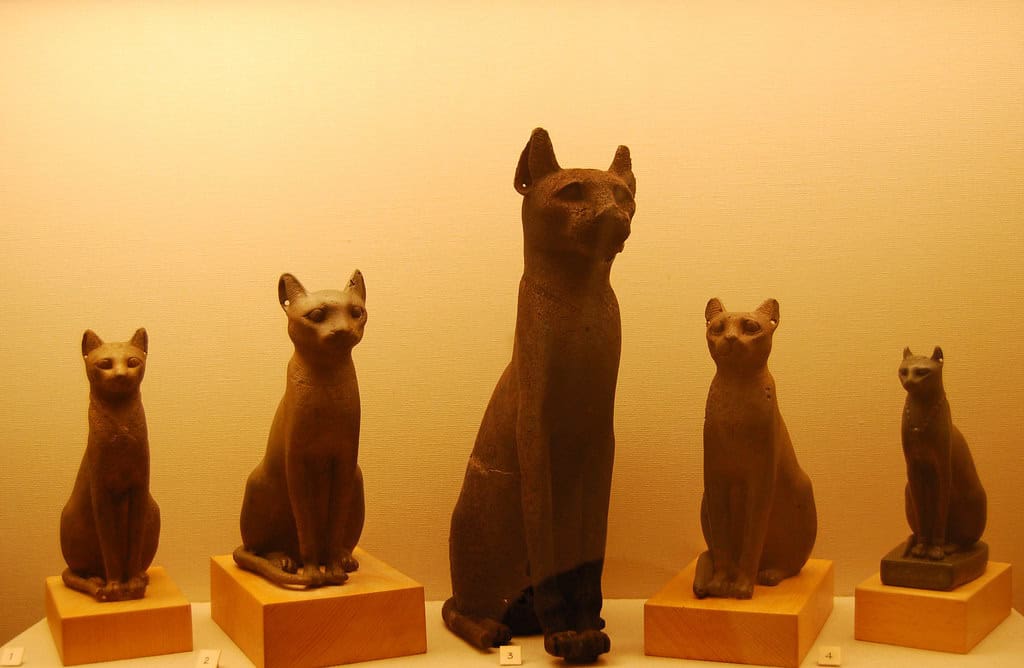
Beyond their earthly veneration, cats played a crucial role in Egyptian conceptions of the afterlife. The Egyptian Book of the Dead depicts the Great Cat of Re (Ra), who battles the serpent Apophis each night to protect the sun god on his journey through the underworld. This mythological role established cats as psychopomps—creatures that guide souls between the worlds of the living and the dead.
In tomb paintings, cats are often shown beneath the chairs of their owners or directly participating in scenes depicting the weighing of the heart ceremony, where the deceased’s moral worth was judged. Archaeological evidence from various Egyptian tombs reveals cats buried with jewelry, food offerings, and even their own miniature sarcophagi, indicating they were expected to continue their protective roles in the afterlife. This spiritual dimension elevated cats from mere household helpers to essential guardians of cosmic order.
Feline Deities in Ancient Near Eastern Cultures

Egypt was not alone in its reverence for cats. Throughout the ancient Near East, feline deities occupied important positions in various pantheons. In Mesopotamia, the goddess Ishtar was occasionally depicted with cat-like features or accompanied by felines, symbolizing her aspects of fertility and warfare. The Hittites associated cats with their own fertility goddess, Shaushka.
Archaeological evidence from sites in modern-day Turkey, Syria, and Iraq has uncovered cat figurines dating back to as early as 7000 BCE, suggesting that feline veneration predated even Egyptian practices. Particularly notable is the limestone sculpture found at ‘Ain Ghazal in Jordan, depicting a human with feline features, dating to approximately 6500 BCE. These discoveries indicate that cat worship was not an isolated Egyptian phenomenon but part of a broader regional pattern of feline sacralization that spanned multiple cultures and millennia in the cradle of civilization.
Cats in Greek and Roman Religious Traditions
As Egyptian influence spread throughout the Mediterranean, so too did aspects of cat veneration, albeit in modified forms. In Greek mythology, cats were associated with Artemis, goddess of the hunt and wilderness. While not as central to Greek religious practice as they were in Egypt, cats were nonetheless respected as symbols of independence and feminine mystery. When Romans encountered Egyptian culture, they incorporated elements of cat worship into their own religious systems.
The goddess Diana (the Roman equivalent of Artemis) became associated with cats, and Roman households often kept cats as both practical pest controllers and symbols of domestic fortune. Archaeological findings from Pompeii and Herculaneum reveal numerous cat-themed mosaics and household items, suggesting that while not deified to the extent seen in Egypt, cats maintained spiritual significance in Greco-Roman domestic religion. Roman legionaries even brought cats to outposts throughout Europe, simultaneously spreading both feline populations and cultural associations of cats with protection and mystical power.
The Sacred Cats of Ancient Asia

Across the Asian continent, cats enjoyed varied but consistently significant spiritual status. In ancient China during the Song Dynasty (960-1279 CE), cats were believed to ward off evil spirits and were often kept in Buddhist temples as living embodiments of tranquility and meditation. The Japanese Maneki-neko (beckoning cat) tradition, which continues today, originated from beliefs that cats could attract good fortune and prosperity. In India, the goddess Shashti, protector of children, was often depicted riding a cat, while the vehicle (vahana) of the goddess Shashthi was a cat, symbolizing independence and maternal protection.
Archaeological evidence from the Indus Valley Civilization (3300-1300 BCE) includes cat figurines that suggest early religious significance. Throughout Southeast Asia, particularly in Thailand and Burma (Myanmar), white cats were considered especially sacred and were often kept in temples where they received offerings and special treatment. This pan-Asian reverence for cats demonstrates how feline sacralization transcended cultural boundaries, adapting to local religious frameworks while maintaining core associations with protection, fortune, and spiritual power.
Celtic and Norse Cat Worship

In Northern Europe, cats held a complex sacred status within both Celtic and Norse traditions. The Norse goddess Freyja, associated with love, fertility, and war, traveled in a chariot pulled by two large cats, believed to be Norwegian Forest cats. These divine felines represented the dual nature of Freyja herself—both nurturing and fierce. Celtic mythology featured Caith Sith, a fairy cat believed to steal souls, suggesting that Celtic peoples viewed cats with a mixture of reverence and caution.
Archaeological discoveries throughout Scandinavia and the British Isles have uncovered cat remains in ritual contexts, including cats buried at crossroads and threshold spaces, indicating their perceived connection to liminal realms between the physical and spiritual worlds. The Vikings, in particular, respected cats for their independence and hunting prowess, considering them good luck for farmers and essential companions for witches and seers who practiced seiðr (Norse magic). This northern European tradition of feline veneration demonstrates how cats’ natural behaviors—their independence, mystery, and hunting abilities—translated into spiritual significance across vastly different cultural contexts.
The Dark Ages and Medieval Shift in Cat Perception

The sacred status of cats underwent a dramatic transformation during Europe’s transition from paganism to Christianity. As the Church sought to eradicate pagan practices, animals associated with pre-Christian deities often suffered demotion or demonization. Cats, with their nocturnal nature and association with pagan goddesses like Freyja, became particularly suspect. By the 13th century, Pope Gregory IX’s papal bull Vox in Rama explicitly connected cats with heresy and Satanic worship, particularly black cats. This religious reframing had devastating consequences; cats were routinely killed in various ritualistic ways, especially during festivals and public ceremonies.
Ironically, this decimation of European cat populations may have contributed to the spread of the Black Death, as rodent populations flourished without their natural predators. Despite official Church positions, many rural communities maintained protective folk beliefs about cats, secretly continuing aspects of their earlier sacred status. Archaeological evidence from medieval monasteries reveals that some religious communities continued to keep cats, suggesting a disconnect between official doctrine and practical reality. This period represents not a complete erasure of cats’ sacred status but rather its suppression and transformation into a more complex, ambivalent cultural position.
Cats in Islamic Tradition and Folklore

While cats were falling from grace in medieval Christian Europe, they were simultaneously gaining profound religious significance in the Islamic world. The Prophet Muhammad was known to be fond of cats, and numerous hadith (traditional sayings) attest to his gentle treatment of them. One famous story recounts how Muhammad cut off the sleeve of his prayer robe rather than disturb his cat Muezza who was sleeping on it. This established a lasting Islamic tradition of treating cats with respect and kindness. In medieval Islamic societies from Spain to Indonesia, cats were welcomed into mosques and libraries, where they protected precious manuscripts from rodents.
The city of Istanbul became particularly famous for its revered street cats, a tradition that continues to this day. Archaeological evidence from medieval Islamic cities reveals specialized feeding areas for community cats and even cat-specific architecture to allow their free movement through urban spaces. The 9th-century Baghdad physician Ibn Bakhtishu wrote extensively about the medical benefits of keeping cats, further elevating their status. This Islamic reverence for cats served as an important counterbalance to their demonization in parts of Christian Europe, preserving aspects of their sacred status during a historically challenging period for feline-human relations.
The Archaeological Evidence of Cat Sacralization

Archaeological discoveries continue to expand our understanding of cats’ sacred status across ancient civilizations. The 2004 excavation at Hierakonpolis in Egypt uncovered a cat cemetery dating to 3700 BCE, predating previously known evidence of Egyptian cat veneration by nearly 2,000 years. In Cyprus, a carefully arranged 9,500-year-old joint burial of a human and cat suggests that feline sacralization may be even older than previously thought. Ground-penetrating radar surveys at multiple temple sites in the Mediterranean have revealed dedicated cat burial grounds adjacent to human cemeteries, indicating their elevated status.
Isotope analysis of cat remains from various sacred sites shows that many temple cats received diets richer in protein than their feral counterparts, confirming their privileged position. Particularly compelling is the evidence from Bubastis, where over 300,000 mummified cats were discovered, many with CT scans revealing elaborate internal arrangements of amulets and jewelry. Archaeologists working in Japan have uncovered numerous cat figurines at Shinto shrine sites dating back to the Jomon period (14,000-300 BCE), suggesting that cat veneration in East Asia has deeper roots than previously recognized. These ongoing discoveries continue to push back the timeline of cat sacralization and broaden our understanding of its geographic scope.
Sacred Cat Breeds and Their Cultural Significance

Certain cat breeds have maintained stronger connections to their sacred heritage through selective breeding and cultural preservation. The Egyptian Mau, with its spotted coat pattern matching depictions of cats in ancient Egyptian art, is considered by some to be the most direct descendant of the sacred temple cats of Egypt. The Japanese Bobtail, featured in the Maneki-neko tradition, was historically kept in Buddhist temples and continues to be associated with good fortune. In Thailand, the Khao Manee (“White Gem”) cat was exclusively owned by royal and noble families for centuries, believed to bring prosperity to their households.
The Norwegian Forest Cat, likely descendant of the cats that pulled Freyja’s chariot in Norse mythology, maintained semi-sacred status in Scandinavian countries well into the Christian era. The Turkish Van, sometimes called the “swimming cat,” features in Islamic folklore as one of the animals saved on Noah’s Ark, blessing it with its distinctive markings. The genetic histories of these breeds, confirmed through modern DNA analysis, reveal how human reverence for sacred cats influenced breeding patterns over millennia. These living connections to ancient traditions demonstrate how the sacred status of cats has been physically preserved in the animals themselves, not just in cultural memory.
The Psychological and Sociological Underpinnings of Cat Worship

The cross-cultural veneration of cats invites analysis of the psychological and sociological factors that have contributed to their sacred status. Cats possess several characteristics that seem to universally trigger human recognition of the numinous or sacred. Their ability to see in near-darkness has associated them with supernatural perception across cultures. Their independent yet cooperative relationship with humans—neither fully wild nor fully domesticated—positions them as natural liminal beings, existing at the threshold between human and wild spheres. Ethological studies reveal that cats’ facial expressions trigger the same nurturing responses in humans as human infants, creating powerful emotional bonds.
Archaeological evidence suggests that cats largely self-domesticated, choosing human proximity rather than being deliberately tamed, which may have contributed to perceptions of them as autonomous spiritual agents rather than subordinate animals. Anthropological research indicates that in agricultural societies, the practical value of cats as protectors of food stores often preceded their religious significance, demonstrating how utilitarian relationships can evolve into sacred ones. The consistent pattern of cat sacralization across diverse cultures suggests that something intrinsic to feline nature resonates with human religious impulses, making cats particularly suitable vessels for spiritual projection and veneration.
Modern Echoes of Ancient Cat Veneration

While formal religious worship of cats has largely disappeared, numerous modern practices retain echoes of ancient cat veneration. Internet culture’s obsession with cat images and videos—often referred to as “cat worship” in popular discourse—represents a secular continuation of humanity’s fascination with felines. In Japan, cat shrines continue to receive offerings, with the famous cat shrine on Tashirojima Island drawing visitors from around the world. In Egypt, organizations like the Bastet Cat Museum work to preserve awareness of cats’ sacred history while providing care for street cats.
Istanbul’s community cats, protected by both tradition and modern law, continue a centuries-old practice of treating cats as communal treasures with semi-sacred status. Contemporary witchcraft and neopagan movements have reclaimed cats as familiar spirits and magical companions, explicitly drawing on ancient traditions. Even seemingly mundane superstitions, such as considering black cats lucky or unlucky depending on cultural context, preserve fragments of older sacred beliefs. Archaeological sites featuring ancient cat worship have become popular tourist destinations, with locations like the cat mummy gallery at the Cairo Museum attracting thousands of visitors annually. These modern manifestations demonstrate how deeply the sacred cat has embedded itself in human cultural consciousness, evolving rather than disappearing with the advent of secularization.
Conclusion: The Enduring Legacy of Sacred Felines
The ancient history of cats as sacred animals weaves a remarkable narrative spanning continents, millennia, and diverse religious traditions. From their exalted status in ancient Egypt to their complex position in medieval European and Islamic societies, cats have consistently occupied a unique position in humanity’s spiritual landscape. This enduring sacred status reveals much about both feline nature and human psychology—how cats’ independence, mystery, and practical value combined to elevate them beyond ordinary animal status in the human imagination.
Archaeological discoveries continue to expand our understanding of this relationship, pushing back its origins and broadening its geographic scope. As we continue to welcome cats into our homes and communities today, we participate in one of humanity’s oldest continuous relationships with another species, one tinged with ancient reverence and spiritual significance that transcends mere companionship. In studying the sacred history of cats, we gain insight not just into our ancestors’ religious practices, but also into the enduring power of these enigmatic creatures to bridge the ordinary and the extraordinary in human experience.

From exploring the marine wonders in the Azores and witnessing the vast savannas of Kenya, to delving deep into the rich biodiversity of South Africa and traversing iconic landscapes in Australia and the US like Yellowstone, Chris's experiences are vast.
With a penchant for diving alongside sharks, the ocean holds a special place in his heart.
Through his academic insights, he champions wildlife conservation, striving with 'Animals Around The Globe' to cultivate a profound connection between humans and animals, enhancing our mutual appreciation.
Connect with him at Feedback@animalsaroundtheglobe.com.
- The Real Dolphin That Played Flipper—and Where He Came From - July 28, 2026
- The Ethics of Keeping Exotic Pets: What You Need to Know - July 27, 2026
- If You Think a Shih Tzu Makes a Good Lap Dog, These 14 Are Better - July 27, 2026