


In the vast theater of animal migration, one remarkable performer outshines all others with its extraordinary journey. The Arctic tern (Sterna paradisaea) undertakes the longest migration of any animal on Earth, traveling from pole to pole in a perpetual chase of summer. What makes this feat even more astounding is that these birds accomplish this marathon journey with minimal sleep, challenging our understanding of avian physiology and endurance. As they trace their zigzagging path across the globe, Arctic terns witness more daylight than any other creature, living a life perpetually bathed in the glow of summer. Let’s explore the remarkable story of these tireless travelers and the mysteries of their epic migration.
The Arctic Tern: A Record-Breaking Traveler

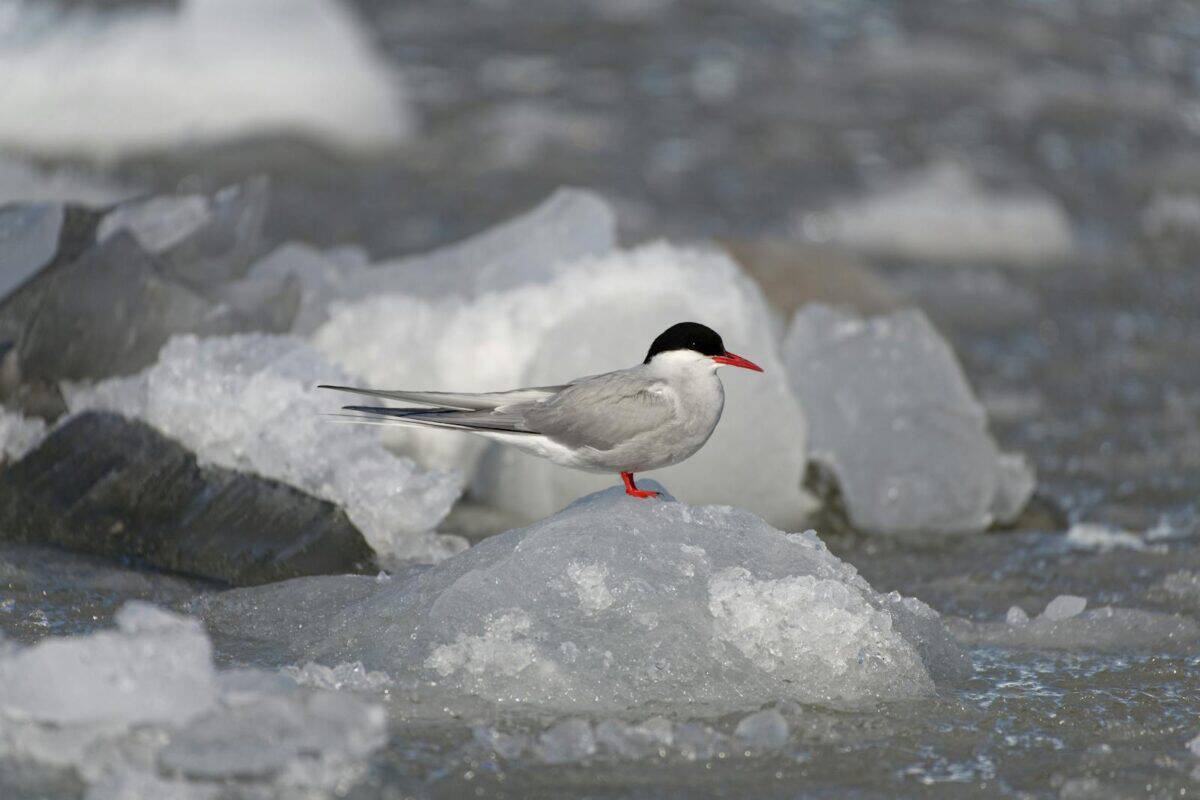
The Arctic tern holds the undisputed title for the longest migration of any known animal. These slender, graceful birds with distinctive forked tails and red beaks travel approximately 44,000 miles (71,000 kilometers) annually as they migrate between their Arctic breeding grounds and Antarctic feeding areas. To put this distance in perspective, the Earth’s circumference at the equator is roughly 24,901 miles, meaning Arctic terns fly the equivalent of going around the world 1.8 times every year.
Recent tracking studies using lightweight geolocators have revealed that some terns follow an even longer route, with recorded journeys exceeding 56,000 miles (90,000 kilometers). Over its lifetime, which can span 30 years, a single Arctic tern might travel a distance equivalent to going to the Moon and back three times—about 1.5 million miles. This remarkable migratory achievement is even more impressive considering the bird’s modest size, weighing only 3.5 to 4.5 ounces (100-125 grams) with a wingspan of about 31 inches (80 centimeters).
The Pole-to-Pole Journey

Arctic terns breed in the circumpolar Arctic and sub-Arctic regions of North America, Europe, and Asia during the northern summer months (May to August). After raising their young, they embark on their southward journey in August and September, traveling along the coastlines of North and South America or Europe and Africa. Rather than taking a direct route, the birds follow a complex, S-shaped migration path that takes advantage of global wind systems to conserve energy.
By October or November, the terns reach the Antarctic, where they spend the southern summer (November to March) feeding in the productive waters around the ice edge. Come March, they begin their northward journey again, completing the annual cycle. This strategic movement means Arctic terns experience more daylight than any other creature on Earth—about two-thirds of their lives are spent in continuous daylight, as they follow summer between the poles. This perpetual summer-chasing ensures access to abundant food resources year-round.
The Mystery of Sleepless Flight

One of the most fascinating aspects of the Arctic tern’s migration is how they manage sleep during their long-distance flights. Unlike humans, who require consolidated periods of sleep, Arctic terns appear to have evolved specialized sleep mechanisms that allow them to rest while remaining airborne. Researchers believe these birds employ a strategy known as unihemispheric slow-wave sleep (USWS), in which one half of the brain sleeps while the other half remains alert.
This remarkable adaptation allows Arctic terns to navigate, maintain flight awareness, and watch for predators while still obtaining necessary rest. During USWS, one eye remains open (connected to the awake hemisphere) while the other closes (connected to the sleeping hemisphere). The birds periodically switch which hemisphere sleeps, ensuring both sides of the brain receive adequate rest. This biological wonder enables Arctic terns to remain in almost continuous flight for days or even weeks during critical migration phases, stopping only briefly to feed on fish and other marine prey.
Aerial Efficiency: Flight Adaptations

Arctic terns possess specialized physical and behavioral adaptations that make their marathon migrations possible. Their lightweight bodies, long, narrow wings, and streamlined shape create an aerodynamically efficient design perfect for sustained flight. These birds are masters at using wind patterns to their advantage, often riding prevailing winds to reduce energy expenditure. During migration, Arctic terns frequently employ dynamic soaring, a flight technique that harnesses energy from wind gradients over ocean surfaces.
Their flying efficiency is truly remarkable—scientists have calculated that Arctic terns expend only slightly more energy during migration than they would during normal daily activities at their breeding or wintering grounds. They also make extensive use of thermals (rising warm air currents) over land and upwellings over oceans to gain altitude without flapping, further conserving precious energy. These flight strategies, combined with their ability to feed on the wing by plunge-diving for fish, make Arctic terns perfectly adapted for their global journeys.
Tracking Technology Reveals Migration Secrets

Until recently, the exact migration routes of Arctic terns remained largely a mystery. Traditional bird banding studies provided only limited information, revealing departure and arrival points but little about the journey in between. The development of lightweight tracking technology has revolutionized our understanding of Arctic tern migration. Modern geolocators weighing less than a gram can now be attached to these small birds without affecting their flight performance, providing unprecedented insights into their global movements.
A groundbreaking 2010 study by researchers from the British Antarctic Survey first revealed the full extent of the terns’ migration, showing their S-shaped route and documenting their amazing distances. Subsequent studies have mapped population-specific routes, revealing that different breeding colonies follow slightly different migration paths. These tracking studies have also documented previously unknown stopover areas, highlighting critical feeding locations that require conservation attention. As tracking technology continues to improve, scientists anticipate learning even more about the timing, altitude, and behavioral aspects of these remarkable journeys.
Metabolic Marvels: Fueling the Journey

The metabolic adaptations of Arctic terns are as impressive as their navigational abilities. These birds must store enough energy to power their intercontinental flights while remaining light enough to fly efficiently. Before migration, Arctic terns enter a state of hyperphagia—increased feeding behavior that allows them to build up fat reserves that will fuel their journey. Unlike some migratory birds that double their body weight before departure, Arctic terns increase their weight only moderately, relying instead on feeding opportunities along their route.
Their digestive system shows remarkable flexibility, expanding during intensive feeding periods and shrinking during long flight segments to reduce unnecessary weight. Studies have shown that Arctic terns can adjust their metabolic rate during different phases of migration, burning energy more efficiently during long stretches over open ocean. They also possess specialized fat storage and utilization mechanisms that prioritize the use of energy-dense fats for long-distance flight while preserving proteins essential for muscle function.
Navigation: Finding Their Way Across Oceans
How Arctic terns navigate across vast oceans with remarkable precision remains one of ornithology’s most fascinating questions. Research suggests these birds employ multiple navigation systems working in concert. Like many migratory birds, Arctic terns appear to use the Earth’s magnetic field as a compass, sensing magnetic inclination and intensity through specialized cells containing magnetite crystals. This built-in magnetic compass helps them maintain their general direction during long oceanic crossings.
Visual cues also play a crucial role in their navigation strategy. Arctic terns have excellent vision and can use celestial navigation, orienting by the position of the sun during day and stars at night. They may also recognize distinct oceanic features, such as productivity boundaries where cold and warm waters meet, creating visible color differences and concentrations of prey. Some research suggests they might even detect infrasound—low-frequency sounds that travel thousands of miles through the atmosphere, potentially providing acoustic landmarks that help guide their journey between hemispheres.
Life on the Wing: Breeding and Survival

Despite spending most of their lives on the wing, Arctic terns maintain complex social structures and breeding behaviors. They typically begin breeding at 3-4 years of age and often form monogamous pairs that can last for multiple seasons. During the brief Arctic summer, they establish colonies on coastal areas, islands, or tundra near water. Their nests are simple scrapes in the ground, sometimes lightly lined with vegetation, where females lay 1-3 camouflaged eggs that both parents incubate for about 21-27 days.
After hatching, chicks develop rapidly, reaching flight stage within 21-28 days—an adaptation to the short Arctic breeding season. Parent terns are fiercely protective, diving aggressively at any potential predators that approach their nests, including much larger animals and humans. Despite their small size, Arctic terns can live remarkably long lives, with some individuals documented to reach over 30 years of age. This longevity means a single bird might fly over 1.5 million miles during its lifetime—an almost incomprehensible distance for a creature weighing less than a smartphone.
Climate Change Challenges

Arctic terns face growing challenges from climate change, which is altering both their breeding and wintering habitats. Rising temperatures in the Arctic are changing the availability and timing of the fish populations they depend on for feeding their young. Studies have documented shifts in prey species composition and breeding success rates in several Arctic tern colonies, with some experiencing significant population declines. Sea level rise threatens many of their low-lying coastal breeding sites, particularly on islands and atolls.
Changes in ocean temperatures and currents may also disrupt the productive feeding areas Arctic terns depend on during migration. Additionally, altered wind patterns could increase the energy requirements of their long-distance flights. Research suggests that while Arctic terns show some flexibility in adjusting their migration timing, there are limits to how quickly they can adapt to rapidly changing environmental conditions. Conservation efforts now focus on protecting key breeding colonies and identifying critical stopover sites that may require special protection to ensure the continued success of these remarkable migrants.
Cultural Significance and Human Connections

Throughout human history, Arctic terns have held special significance for cultures across their vast range. To Inuit and other Arctic peoples, the arrival of these birds has traditionally signaled the return of spring and the end of the harsh winter season. In maritime folklore, terns were sometimes considered good luck for sailors, their presence indicating productive fishing grounds. Their extreme migration has captured human imagination and inspired countless poets, writers, and artists fascinated by their tenacity and seeming tirelessness.
Today, Arctic terns serve as powerful symbols in conservation education, highlighting the interconnectedness of global ecosystems and the importance of international cooperation in wildlife protection. Bird-watching tourism focused on Arctic tern colonies provides economic benefits to remote coastal communities while raising awareness about these remarkable birds. Their pole-to-pole journey dramatically illustrates how actions in one part of the world can affect species that depend on healthy habitats across multiple continents and oceans.
Sleep Adaptations in Other Long-Distance Migrants

The Arctic tern’s ability to function with minimal sleep during migration is not entirely unique in the animal kingdom, though it represents perhaps the most extreme example. Other long-distance migrant birds show similar adaptations. The bar-tailed godwit, which flies non-stop for 9-11 days over the Pacific Ocean from Alaska to New Zealand, also appears to utilize unihemispheric sleep. Great frigatebirds can stay aloft for up to two months during oceanic wanderings, sleeping for only 42 minutes per day in brief 12-second microsleeps while circling in rising air currents.
These sleep adaptations challenge our understanding of sleep’s fundamental purpose. While humans and most mammals require consolidated periods of unconsciousness for brain restoration and memory consolidation, these migratory birds demonstrate that alternative sleep strategies can meet physiological needs under extreme circumstances. Neuroscientists studying these adaptations hope to gain insights that might eventually help address human sleep disorders or develop strategies for maintaining cognitive function during extended periods of reduced sleep. The Arctic tern’s sleep patterns remain among the most remarkable in nature, representing an evolutionary solution to the competing demands of constant movement and necessary rest.
The Enduring Mystery of the Arctic Tern

Despite advances in tracking technology and biological research, the Arctic tern continues to hold many mysteries. The precise mechanisms that allow these birds to maintain their demanding lifestyle without suffering the physical and cognitive effects of sleep deprivation that would debilitate humans remain incompletely understood. Scientists are particularly interested in how Arctic terns maintain muscle function and avoid the oxidative stress typically associated with extended physical exertion. The neurological adaptations that enable their specialized sleep patterns represent a fascinating frontier in sleep research, potentially offering insights applicable to human health and performance.
The incredible precision of their navigation system also presents ongoing questions. While we understand some of the components of their navigational toolkit, how these birds integrate multiple sensory inputs to maintain their course across featureless oceans remains unclear. Perhaps most remarkably, juvenile Arctic terns undertake their first migration without guidance from adults, suggesting an innate navigational program that must be encoded genetically. As research technologies continue to advance, these magnificent travelers will undoubtedly reveal more secrets about the outer limits of animal endurance, navigation, and adaptation.
A Testament to Nature’s Ingenuity

The Arctic tern stands as one of nature’s most extraordinary achievements, embodying the remarkable adaptability of life on Earth. Their annual pole-to-pole migration represents not just a feat of physical endurance but a triumph of evolutionary problem-solving, with specialized adaptations for flight efficiency, navigation, energy management, and sleep regulation working in concert to enable their global journeys. As these birds trace their path across oceans and continents year after year, they connect ecosystems separated by thousands of miles, serving as living reminders of our planet’s interconnectedness.
In an age when human technology allows us to circumnavigate the globe in hours, the Arctic tern’s ancient migration pattern offers a humbling perspective on our place in the natural world. These birds were perfecting their remarkable lifestyle long before humans first ventured beyond their immediate horizons, and their continued success despite mounting environmental challenges speaks to their resilience. As we work to understand and protect these extraordinary migrants, we honor not just a remarkable species but the enduring power of natural selection to produce solutions that continue to inspire and amaze even our most advanced scientific minds.

From exploring the marine wonders in the Azores and witnessing the vast savannas of Kenya, to delving deep into the rich biodiversity of South Africa and traversing iconic landscapes in Australia and the US like Yellowstone, Chris's experiences are vast.
With a penchant for diving alongside sharks, the ocean holds a special place in his heart.
Through his academic insights, he champions wildlife conservation, striving with 'Animals Around The Globe' to cultivate a profound connection between humans and animals, enhancing our mutual appreciation.
Connect with him at Feedback@animalsaroundtheglobe.com.
- The Brightest Animal Lives in the Sea - June 30, 2026
- This Ocean Creature Moves the Slowest—but Lives the Longest - June 30, 2026
- 12 Biggest Dinosaur Fossils Ever Found - June 30, 2026