


The Baja California peninsula stretches down from Southern California like nature’s outstretched finger, separating the Pacific Ocean from the Sea of Cortez in a marine paradise that Jacques Cousteau famously called “the world’s aquarium.” This remarkable 775-mile stretch of coastline hosts some of the most spectacular marine wildlife on Earth, making it a bucket-list destination for animal enthusiasts and adventure seekers alike.
Picture yourself on a boat at dawn, watching the sun paint the water in shades of gold and turquoise, when suddenly a massive whale surfaces just meters away from your vessel. Or imagine floating peacefully in crystal-clear waters as curious sea lions playfully swim circles around you, their whiskered faces filled with intelligence and mischief. These aren’t fantasy scenarios – they’re everyday occurrences in the waters surrounding Baja California.
Blue Whale – The Gentle Giant of the Deep

The blue whale holds the incredible distinction of being the largest animal to have ever lived on Earth, bigger than even the mighty dinosaurs, growing up to 110 feet in length and weighing as much as 174 tons. Blue whales can be seen everywhere in Baja, even around Cabo, but the best chance at spotting them is in La Paz during expeditions from November to June. Loreto has earned a well-deserved reputation as a superb base for blue whale watching, particularly during February and March when people come from around the world for the chance to see these creatures that are equivalent to 24 adult elephants in mass, feeding almost exclusively on tiny krill. These magnificent animals can consume up to 6 tons of krill per day by straining massive amounts of ocean water through their baleen plates. They are protected as an Endangered Species with population estimates ranging from 10,000 to 25,000 animals worldwide. When you witness a blue whale breach the surface, releasing a towering spout of mist into the air, you’re experiencing one of nature’s most humbling spectacles.
California Sea Lion – The Playful Performers

Sometimes overlooked compared to their larger whale cousins, sea lions deserve more love as they make up for being smaller and less spectacular by being a guaranteed sighting and incredibly fun to dive with, acting like underwater dogs that are so curious and playful. Loreto has two main sea lion colonies, with the primary one located on Coronado Island, where their numbers can reach 250 individuals in winter compared to just a few during the mating season from June to August. Visitors can experience magical encounters at the sea lion sanctuary on tiny islands past Isla Espiritu Santo and Isla Partida, where families of sea lions can be observed with mothers watching little babies play in the shallows, and the highlight often involves meeting and playing with curious baby sea lions that are like little puppies, nipping at fins and wanting to wrestle and have fun. These intelligent marine mammals are known for their acrobatic abilities both in and out of the water. Their sleek bodies and powerful flippers make them incredibly agile swimmers, and they often approach divers and snorkelers with genuine curiosity, creating unforgettable underwater encounters.
Gray Whale – The Gentle Ambassador

The gray whale is a kind of baleen whale found in the Pacific Ocean between Alaskan and Baja California waters, weighing 15 to 33 tons and measuring about 13 to 15 meters in length, feeding on small crustaceans called krill that live on the seabed, and is a beautiful and amazing animal to observe due to its large size with movements that are quite slow. The best time to spot gray whales is usually between November and May. Baja California is famous for its ‘friendly’ gray whales, which actively seek human interaction, a behavior unique to Baja. Each winter, between 300 and 400 gray whales arrive at lagoons like San Ignacio to mate and give birth, making it a global benchmark for responsible ecotourism. These remarkable creatures undertake one of the longest migrations in the animal kingdom, traveling over 12,000 miles round trip between their feeding grounds in Alaska and breeding lagoons in Baja. What makes the Baja gray whales truly special is their curious nature – mothers will often bring their calves close to boats, seemingly as eager to observe humans as we are to watch them.
Humpback Whale – The Acrobatic Superstar

Humpback whales are found in numbers around Cabo San Lucas and can be seen all around Baja California from November to mid-April, and they happen to have one of the longest migrations of any mammal on the planet. Humpback whales can reach up to 50 feet in length, with females usually longer and heavier than males, weighing 30 tons or equivalent to 70,000 pounds, and these curious creatures are capable of acrobatic aerials as well as swimming on their backs. They feast on fish and krill using a special technique where they dive quickly upon spotting prey, go underneath them and blow air through their airhole to send up lots of air bubbles which help trap and confuse their prey, then literally go in for the kill with their mouths wide open. Humpback whales are very acrobatic and spectacular to observe, photograph, and listen to with underwater microphones. Their haunting songs can be heard underwater for miles, and witnessing a 40-ton humpback launch itself completely out of the water in a spectacular breach is an experience that will leave you speechless and reaching for your camera.
Whale Shark – The Gentle Filter-Feeder
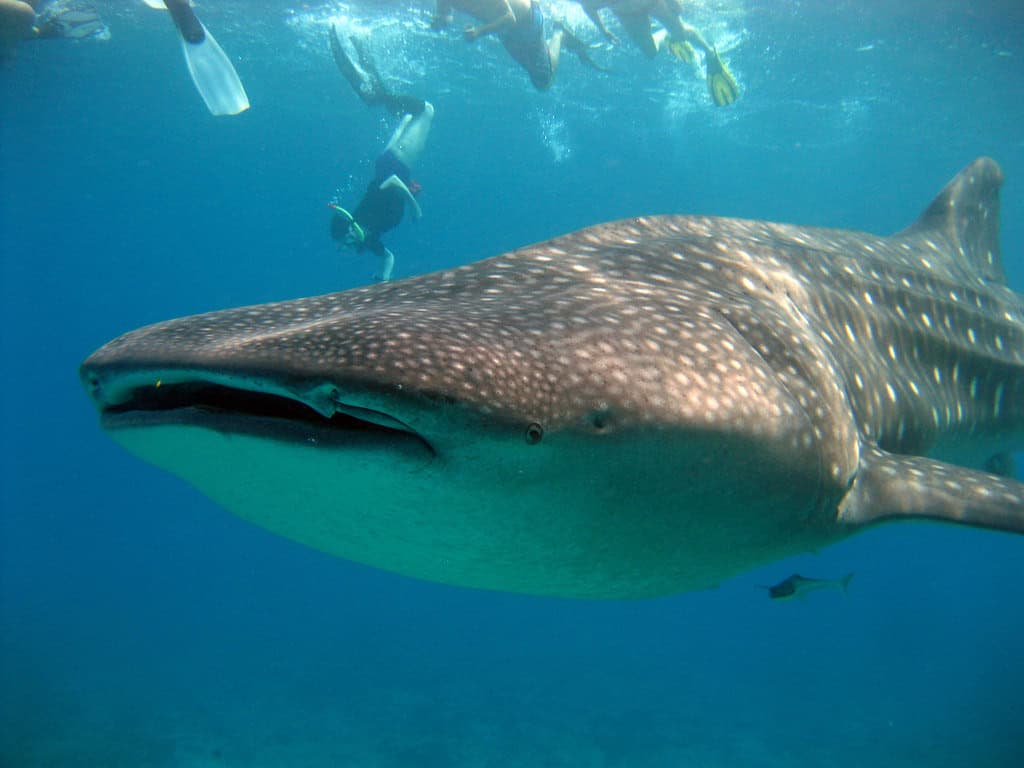
The whale shark can be spotted in La Paz from November to June, with juveniles present until April, and the largest whale shark specimens tend to be seen in a shorter period from April to June when they migrate through the Sea of Cortez. Despite their name, these magnificent creatures are actually the world’s largest fish, not whales at all. These gentle giants can grow up to 40 feet in length and weigh as much as 20 tons, yet they feed primarily on plankton, small fish, and krill by filter-feeding. Visitors may even have the opportunity to swim alongside whale sharks while recording their behavior and photographing the distinctive patterns around their dorsal fins to help identify individual sharks, and the valuable data collected helps shed light on how tourism influences whale shark behavior. Swimming alongside a whale shark is like floating next to a gentle, spotted bus that glides effortlessly through the water. Their mouths can open to nearly 5 feet wide, but they’re completely harmless to humans, often allowing snorkelers to swim peacefully beside them as they feed near the surface.
Mobula Ray – The Flying Devils
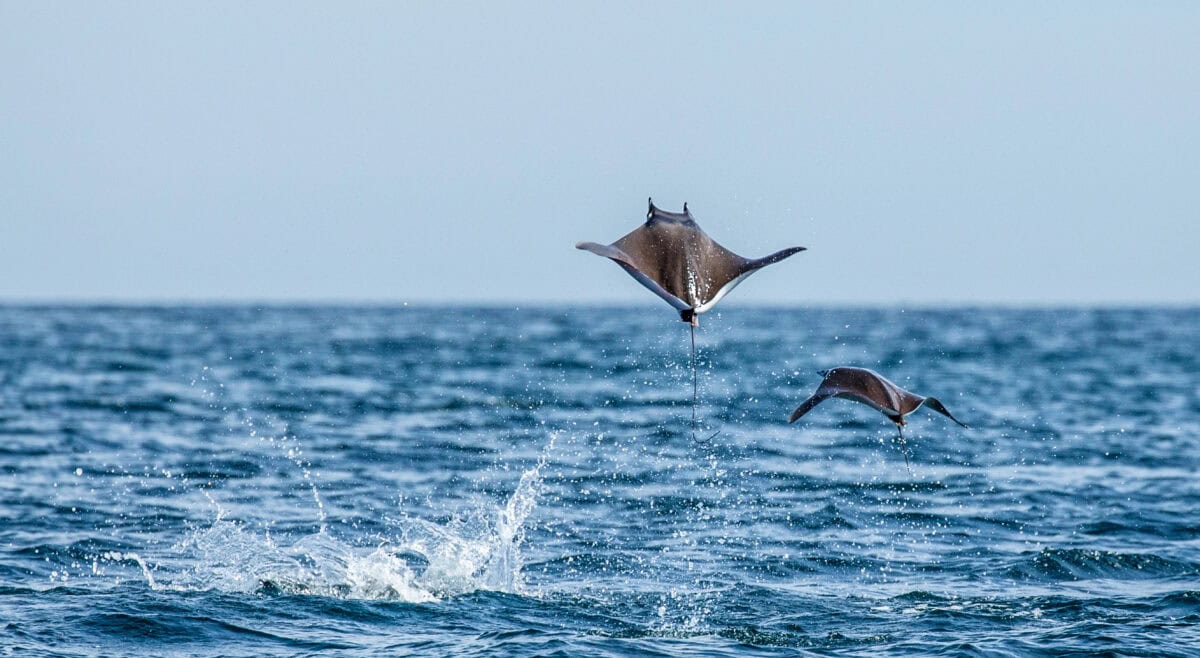
The Mobula Munkiana is a type of ray that belongs to the Mobulidae family with genetic similarities to the famous giant manta ray, appearing to ‘fly’ midwater using their pectoral fins, and they use propulsion to launch themselves out of the water before making a large slapping noise as they crash down to the surface. The Mobula ray migration occurs from late May to August in Baja California, with June and July being the best months to swim with the devil rays in Cabo San Lucas. Massive schools of mobulas can be seen from the end of March through early July, and getting in the water with one of these massive schools of 4 to 5 foot rays is a truly special experience. Seeing such a remarkable number of mobula rays is thrilling and a once in a lifetime opportunity for snorkelers and free divers. These acrobatic rays are famous for their spectacular aerial displays, launching themselves up to 10 feet out of the water in synchronized jumps that can involve hundreds or even thousands of individuals at once. The Mobula Munkiana is a highly migratory species that tends to aggregate in huge schools and is commonly found in the eastern Pacific Ocean along the coast of Baja California in Mexico.
Orca – The Ocean’s Apex Predator

The killer whale is the largest member of the dolphin family, with males weighing around 8 tons and growing up to 23 feet long while females reach a maximum length of 21 feet. Orcas are frequent visitors to the Loreto Bay National Park, and while not much is known about their traveling patterns, they are spotted regularly in Loreto all year round, and although considered rare sightings, they are reported every month. Orcas can be encountered during expeditions in La Paz from April to June. These are not the “killer whales” that TV had wanted us to believe, as they are actually as curious and playful as dolphins to humans, and one can safely swim with them if the opportunity arises. The sight of those sleek black dorsal fins slicing through the water when orcas make an appearance is truly unforgettable, and experienced operators from Alaska to Socorro Island have had the privilege of respectfully interacting with these magnificent creatures. These highly intelligent marine mammals live in complex family groups called pods and are known for their sophisticated hunting strategies and remarkable social bonds.
Sea Turtle – Ancient Ocean Wanderers

Five of the world’s seven marine turtle species can be found off the coast of the Baja California peninsula, and all are endangered. The Sea of Cortez and Baja California peninsula are home to five species of sea turtles: Hawksbill, Loggerhead, Leatherback, Green Turtle and Olive Ridley – all of which are endangered. The most abundant species in the region is the olive ridley, typically two feet long and 100 pounds, named for the olive-green color of their heart-shaped carapace, and these social turtles gather in huge numbers to lay eggs on beaches in incredibly synchronized nestings called “arribadas,” having roamed the seas for 100 million years. Late August until early December is considered turtle season in Baja when the turtles come home to lay their eggs. The iconic green turtle, named for the green hue of its body fat rather than the color of its shell, can weigh over 300 pounds and is found all around the tip of Baja, primarily eating seagrasses and seaweeds which gives their fat its greenish color. These ancient mariners have been navigating the world’s oceans for millions of years, using magnetic fields and ocean currents to guide their incredible journeys across thousands of miles of open water.
Giant Manta Ray – The Graceful Filter-Feeder

Near Cabo San Lucas, you can encounter oceanic manta rays, mostly in La Reina Reef off Cerralvo Island, with the Oceanic Manta being the largest type of manta ray in the Sea of Cortez, characterized by a deep dark dorsal surface with a clear T-shaped white spot on the head, and the maximum disc width can reach up to 30 feet. The main attraction of La Reina is the visitation of oceanic giant manta rays that grace the waters from around mid-June to mid-October. Giant manta rays disappeared from the area completely in 2003 but in recent years have started to make a slow comeback, albeit in fewer numbers than were seen in the late 1990s. The first time you ever see a giant manta ray is breathtaking, as its sheer size and graceful beauty impresses even the most experienced divers. These magnificent creatures can have wingspans of up to 30 feet, yet they glide through the water with an almost ethereal grace that seems to defy their massive size. Unlike their smaller mobula cousins, giant mantas often approach divers with curiosity, sometimes staying in the area for extended periods, allowing for incredible close encounters. Their intelligence is evident in their behavior, and many divers report feeling a profound connection when looking into the eyes of these gentle giants.
Bottlenose Dolphin – The Intelligent Entertainers

The common bottlenose dolphin is the most common and widespread species of the more than thirty that make up the dolphin family, and in the wild, bottlenose dolphins live in groups of about 12 to 15, though they can be found in groups of hundreds or in pairs. Dolphins have little seasonality in Loreto and can be seen all year round in almost every trip, with local operators reporting dolphin sightings in 80% of trips. There are several varieties of dolphin that can be seen off the coast of California’s Pacific Ocean, and capable of swimming as fast as 30-35 mph, they are considered some of the fastest marine mammals. Bottlenose dolphins have a regular presence in the area along with occasional sightings of humpback whales and orcas, and more regular presence of California sea lions. These highly social and intelligent mammals are known for their playful behavior, often riding the bow waves of boats and performing acrobatic leaps out of the water. Their complex social structures, problem-solving abilities, and use of tools make them one of the most fascinating marine species to observe. Dolphins communicate through a sophisticated system of clicks, whistles, and body language, and each individual has a unique signature whistle that acts like a name.
Conclusion

The waters off Baja California represent one of the last great wildlife sanctuaries on our planet, where ancient migration routes still guide magnificent creatures through pristine marine ecosystems. From the thunderous breach of a humpback whale to the gentle curiosity of a sea turtle, each encounter in these waters offers a profound reminder of the incredible diversity and beauty of marine life. Whether you’re floating alongside the world’s largest fish or watching playful sea lions perform underwater acrobatics, Baja California delivers wildlife experiences that will stay with you long after you’ve returned to dry land.
The magic of Baja lies not just in the individual species you might encounter, but in the pristine marine environment that supports such an incredible array of life. According to UNESCO World Heritage Foundation, Baja California is home to nearly 40% of the world’s marine mammal species and nearly 900 species of fish. As climate change and human activities continue to impact marine ecosystems worldwide, places like Baja California become even more precious as refuges for wildlife and windows into the natural world.
What would you have guessed was the most surprising encounter waiting in these turquoise waters?

As a little kid, I fell in love with nature, wildlife, and animals. Living in the USA, South Africa, Italy, China and Germany gave me the opportunity to discover the world's Wildlife. My favorite animals are Mountain Gorillas, Siberian Tigers, and Great White Sharks.
I'm a certified PADI Open Water Diver, went to Everest Base Camp and Trekked Gorillas in Uganda. I hold a Master of Science in Economics and Finance.
Please send any feedback to feedback@animalsaroundtheglobe.com
- 10 Animals That Embody the Zodiac Sign of Capricorn - July 21, 2026
- 25 Dangerous U.S. Lakes & Rivers Where Swimming Could Be Risky – Don’t Ignore #1 - July 21, 2026
- 13 Creatures That Survive Extreme Cold - July 21, 2026