

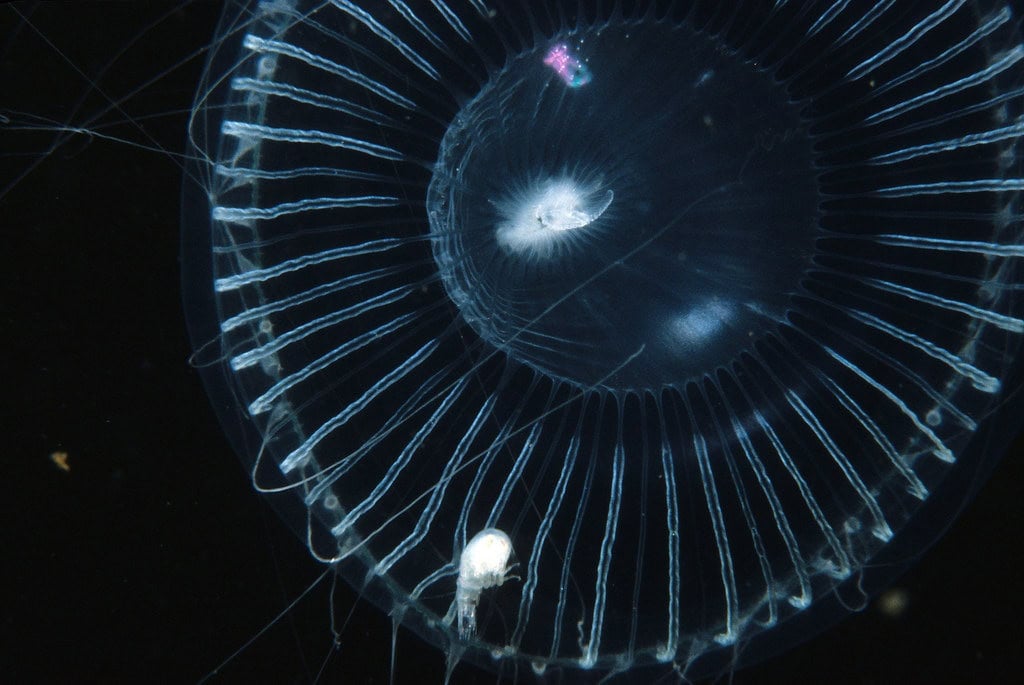
The ocean’s depths harbor one of nature’s most mesmerizing phenomena: bioluminescence, the biological production of light. In the perpetual darkness of the deep sea, where sunlight cannot penetrate, numerous marine creatures have evolved the remarkable ability to produce their own light. This adaptation serves multiple purposes, from attracting prey and mates to deterring predators or camouflaging themselves against the faint downwelling light. These living light shows transform the ocean’s darkest reaches into an otherworldly display of blues, greens, and reds. Let’s dive into the fascinating world of 12 underwater animals that create their own illumination in the darkness of the deep.
12. Anglerfish The Deep Sea’s Deceptive Lurer

Perhaps the most iconic luminescent deep-sea creature, the female anglerfish possesses a modified dorsal spine that extends over its head like a fishing rod, complete with a bioluminescent lure at the tip. This biological lantern, called an esca, contains light-producing bacteria that live symbiotically with the fish. The anglerfish uses this glowing appendage to attract curious prey in the pitch-black waters between 3,000 and 16,000 feet below the surface. When smaller fish approach the enticing light, the anglerfish—with its enormous mouth and needle-like teeth—strikes with remarkable speed. What’s particularly fascinating about this system is that the anglerfish cannot produce light independently; rather, it harbors bacteria that do the illumination work, establishing one of the deep sea’s most effective hunting partnerships.
11. Crystal Jellyfish The Transparent Illuminator

The crystal jellyfish (Aequorea victoria) is a relatively small, transparent jellyfish that inhabits the Pacific Ocean off the west coast of North America. What makes this creature scientifically significant is its production of green fluorescent protein (GFP) and aequorin, a blue light-emitting protein. When disturbed or agitated, the crystal jellyfish’s ring of tentacles emits a stunning blue-green glow. Beyond its natural beauty, this jellyfish made scientific history when researchers isolated GFP from its tissues—work that eventually earned a Nobel Prize. Today, GFP is used extensively in biomedical research as a marker to study protein expression and cellular processes. The crystal jellyfish demonstrates how nature’s adaptations can sometimes lead to groundbreaking scientific applications that extend far beyond marine biology.
10. Flashlight Fish Nature’s Living Torchlight

Flashlight fish, particularly the Anomalops katoptron species, possess one of the most distinctive bioluminescent adaptations in the ocean. Below each eye, these fish harbor specialized organs filled with bioluminescent bacteria that produce a constant blue-green light. Unlike many deep-sea creatures, flashlight fish live in relatively shallow waters of tropical coral reefs but become most active at night. They can control their light emission by either covering the light organ with a lid-like structure or by rotating the organ into a pouch. This control allows them to create a blinking pattern, which they use for several purposes: attracting plankton for feeding, communicating with other flashlight fish, confusing predators through disorientation, and illuminating potential prey. Their ability to essentially “switch” their lights on and off makes them unique among bioluminescent creatures and has earned them the nickname “nature’s living torchlight.”
9. Atolla Jellyfish The Burglar Alarm of the Deep
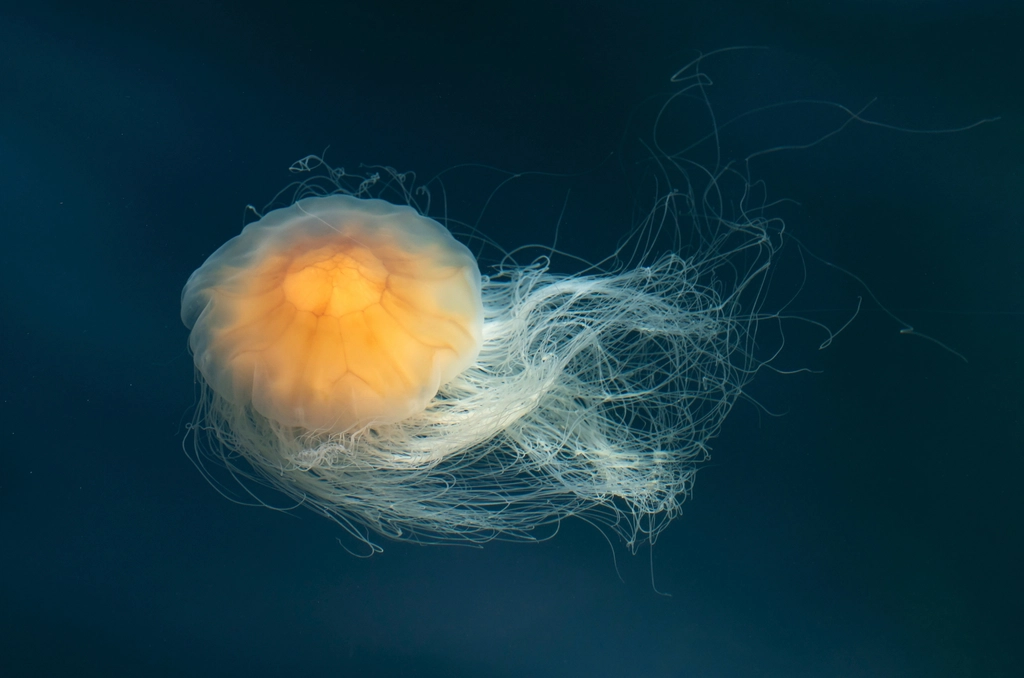
The Atolla jellyfish, sometimes called the coronate medusa, lives in the ocean’s midnight zone at depths of 1,000 to 4,000 meters. This deep-sea dweller has developed a fascinating defensive bioluminescent strategy often referred to as the “burglar alarm” response. When attacked by a predator, the Atolla jellyfish produces a spectacular circular display of blue bioluminescent light that ripples around its body. However, this isn’t meant to scare off the immediate attacker—it’s a desperate last resort that serves to attract even larger predators in the area. The logic is brilliantly simple yet effective: by drawing attention to itself and consequently to the predator currently attacking it, the Atolla jellyfish hopes that this secondary, larger predator will target its attacker, allowing the jellyfish to escape in the ensuing chaos. This unique defense mechanism illustrates the complex ecological relationships and survival strategies that have evolved in the deep ocean’s food web.
8. Vampire Squid The Ruby-Eyed Glowmaster
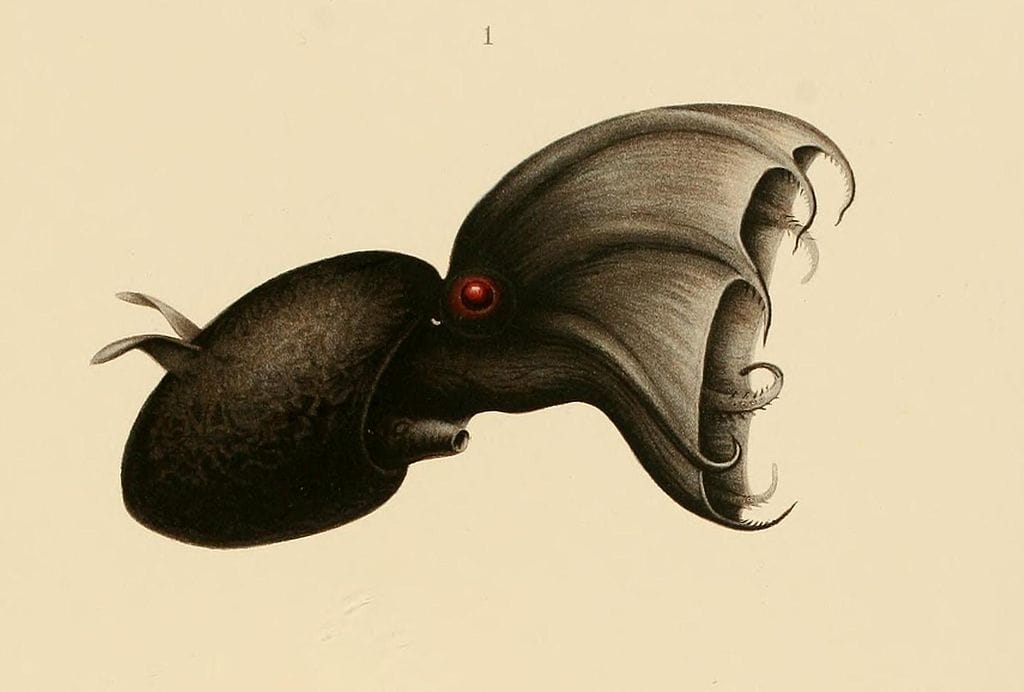
Despite its ominous name, the vampire squid (Vampyroteuthis infernalis, which translates to “vampire squid from hell”) is neither a vampire nor a true squid, but rather belongs to its own order of cephalopods. This ancient species has remained relatively unchanged for millions of years and inhabits the oxygen-minimum zones at depths of approximately 600 to 900 meters. The vampire squid possesses large, complex eyes that appear ruby red in light and has light-producing organs called photophores scattered across its body. When threatened, it can perform a unique defensive display: rather than expelling ink like other cephalopods, it secretes a cloud of bioluminescent mucus that can glow for up to 10 minutes, confusing predators while the vampire squid escapes. Additionally, it can alter the pattern of its photophores or turn them off entirely to become virtually invisible in the darkness. Perhaps most remarkably, the tips of its arms are equipped with light-producing organs that it can use to “draw” patterns of light in the water, creating diversionary tactics that few other sea creatures can match.
7. Comb Jellies The Rainbow Light Dancers

Comb jellies, or ctenophores, are among the most enchanting bioluminescent creatures in the ocean. Unlike true jellyfish, these gelatinous animals propel themselves through the water using rows of cilia—tiny hair-like structures arranged in “combs” along their bodies. When light strikes these cilia, it diffracts and creates rainbow-like patterns. But the true magic happens in darkness, where many comb jelly species produce a blue-green bioluminescent glow when disturbed. What’s particularly special about comb jellies is that they combine both bioluminescence (light they produce) and iridescence (light that’s refracted) to create a mesmerizing display that resembles an underwater light show. Scientists believe some species use this illumination to startle predators, while others may use it to attract prey. These delicate creatures are found throughout the world’s oceans, from surface waters to the deep sea, and despite their fragile appearance, they’re voracious predators of small planktonic organisms, using their light displays as part of their hunting strategy.
6. Dragonfish The Infrared Strategist

The deep-sea dragonfish, particularly the barbeled dragonfish (Idiacanthus), represents one of the most sophisticated users of light in the ocean depths. These fearsome predators possess multiple light-producing photophores along their bodies, including a prominent chin barbel that dangles beneath their mouth like a glowing lure. What truly sets the dragonfish apart, however, is its unique ability to produce red bioluminescence—a rare trait in the deep sea. Most marine bioluminescence appears blue or green because these wavelengths travel furthest in water. Since most deep-sea creatures cannot see red light, the dragonfish essentially uses “invisible” illumination to hunt, illuminating prey without being detected. This adaptation functions like a natural infrared spotlight. Adding to their arsenal of adaptations, dragonfish have enormous fang-like teeth that are transparent, making them nearly invisible even when prey is close enough to detect them. These multiple adaptations make the dragonfish one of the most efficient and specialized hunters in the deep ocean environment.
5. Sea Fireflies The Ocean’s Living Sparks

Sea fireflies, or marine ostracods, are tiny crustaceans typically measuring only 1-2 millimeters in length. Despite their diminutive size, these creatures create one of the most spectacular bioluminescent displays in shallow coastal waters. Unlike many other bioluminescent organisms that glow when disturbed, male sea fireflies actively secrete a cloud of blue luminescence as part of their mating ritual. In places like the Seto Inland Sea of Japan, they create what locals call “the sea of stars” or “blue tears.” Each species of sea firefly has a distinctive light pattern that females can recognize, allowing them to identify suitable mates of their own species. The chemical responsible for their glow, called luciferin, is expelled from their body along with an enzyme called luciferase that triggers the light reaction when it comes in contact with oxygen in the water. The resulting display appears as thousands of tiny blue sparks moving through shallow waters—a phenomenon that has inspired cultural traditions and folklore in coastal communities throughout Asia for centuries.
4. Tomopteris The Swimming Light Worms
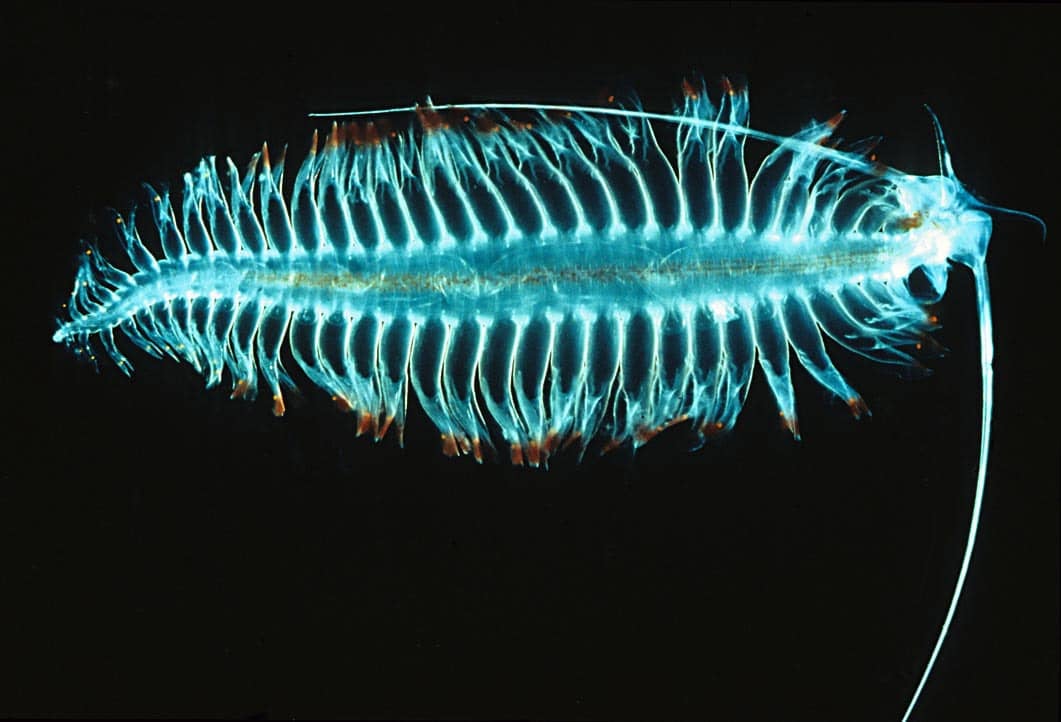
Tomopteris worms are transparent, swimming polychaete worms that inhabit the open ocean from surface waters down to significant depths. Unlike many bioluminescent creatures that produce blue or green light, Tomopteris are among the few marine animals that produce yellow bioluminescence—a particularly unusual color in the underwater world. These segmented worms have paddle-like parapodia (leg-like appendages) along their bodies, and when disturbed, they can emit bright yellow flashes from these structures. Scientists believe this unique yellow bioluminescence may serve as a warning to potential predators, signaling that the worm might be unpalatable or toxic. Measuring between 1-10 centimeters, these nearly transparent creatures are difficult to spot until they activate their bioluminescence. Research on Tomopteris has revealed that their light-producing chemistry differs significantly from that of other marine organisms, suggesting they evolved their bioluminescent capabilities independently—a fascinating example of convergent evolution in the deep sea ecosystem.
3. Brittle Stars The Glowing Starfish Cousins

Brittle stars, members of the class Ophiuroidea, are relatives of starfish that have taken bioluminescence to remarkable levels of sophistication. Unlike their more famous five-armed cousins, brittle stars have five long, thin, highly flexible arms extending from a central disk. Certain species, particularly those in the deep sea, have evolved extensive bioluminescent capabilities. When threatened, these brittle stars can emit light along their arms in pulsing waves or patterns, creating a disorienting effect for predators. Some species can even detach glowing arm segments as a defensive tactic—the predator is distracted by the illuminated, writhing arm piece while the brittle star escapes. This ability to autotomize (self-amputate) glowing body parts represents one of the most dramatic uses of bioluminescence as a defensive strategy. Additionally, scientists have discovered that some brittle star species use their light-producing capabilities to communicate with potential mates or to warn others of their species about nearby dangers, suggesting a level of social signaling previously underestimated in these animals.
2. Clusterwink Snail The Light Amplifier

The clusterwink snail (Hinea brasiliana) has developed one of the most unique applications of bioluminescence in the marine world. This small sea snail, native to the shallow coastal waters of the South Pacific, has evolved a remarkable adaptation: its shell is not just a protective home but a sophisticated light-diffusing system. When disturbed, the snail produces brief, bright blue flashes of light from a small area of its body. What makes this bioluminescence extraordinary is how the snail’s shell interacts with this light. Rather than being an impediment, the shell’s microstructure actually diffuses and amplifies the light, making the entire shell glow and making the snail appear much larger than it actually is. This “burglar alarm” effect potentially deters predators by making the snail suddenly appear too large to be worthwhile prey. The shell functions essentially as a natural optical fiber system, evenly distributing light through its structure. This sophisticated interaction between bioluminescence and physical structure demonstrates how even seemingly simple animals can evolve remarkably complex defense mechanisms.
1. Dinoflagellates The Ocean’s Living Blue Sparkles

Perhaps the most widespread bioluminescent organisms in the world’s oceans are dinoflagellates—single-celled plankton that can occur in such immense numbers that they create some of nature’s most spectacular light shows. Species like Noctiluca scintillans (commonly called sea sparkle) are responsible for the phenomenon known as “bioluminescent bays” in Puerto Rico, Jamaica, and other locations globally. When agitated by wave action, swimming, or boat movement, these microscopic organisms produce a brief blue flash, a response thought to have evolved to startle potential micro-predators or to attract the predators of their predators. What makes dinoflagellate bioluminescence particularly captivating is its cascading effect—one organism’s light triggers others nearby, creating waves of blue light that follow movement through the water. The chemistry behind this light production is among the best understood of all bioluminescent reactions, involving a substrate called luciferin and an enzyme called luciferase, which are contained in specialized organelles called scintillons. Despite their small size—typically less than 1 millimeter—these organisms create some of the most accessible and widely observed bioluminescent displays, enchanting beachgoers and scientists alike.
Conclusion: The Illuminating World of Deep-Sea Bioluminescence

The ocean’s bioluminescent creatures represent one of nature’s most fascinating evolutionary adaptations—the ability to create light in an environment where darkness typically rules. From the strategic hunting techniques of the anglerfish to the defensive displays of the Atolla jellyfish, each species has developed unique ways to utilize bioluminescence for survival in the challenging deep-sea environment. These natural light shows not only illustrate the incredible diversity of life in our oceans but also highlight how different selective pressures can lead to similar adaptations across widely divergent species. As scientists continue to explore the ocean depths, more glowing creatures and new applications for their light-producing chemistry are likely to be discovered, potentially offering innovations in medical imaging, sensor technology, and our understanding of life in extreme environments. The next time you look out at the seemingly dark ocean at night, remember that beneath the surface, an entire world of living light is performing its ancient, luminous dance.

As a little kid, I fell in love with nature, wildlife, and animals. Living in the USA, South Africa, Italy, China and Germany gave me the opportunity to discover the world's Wildlife. My favorite animals are Mountain Gorillas, Siberian Tigers, and Great White Sharks.
I'm a certified PADI Open Water Diver, went to Everest Base Camp and Trekked Gorillas in Uganda. I hold a Master of Science in Economics and Finance.
Please send any feedback to feedback@animalsaroundtheglobe.com
- 11 Most Endangered Insects Buzzing in America Today - July 22, 2026
- 10 Most Frequently Googled Animal Birth Facts - July 22, 2026
- 10 Incredible Migration Journeys in the Animal Kingdom - July 22, 2026