


In the vast complexity of nature, animals have developed fascinating relationships that transcend species boundaries. While competition and predation receive much attention in discussions of animal interactions, cooperation between different species represents one of nature’s most remarkable phenomena. These mutualistic relationships demonstrate how evolution can favor collaboration as much as competition, resulting in partnerships that benefit all involved parties. From the ocean depths to forest canopies, interspecies cooperation has emerged independently countless times, creating living examples of how diverse organisms can support each other’s survival. These 14 remarkable examples showcase nature’s capacity for creating unlikely alliances, challenging our understanding of animal behavior and revealing the interconnectedness of all living things.
Cleaner Fish and Their Clients

In the vibrant world of coral reefs, an extraordinary relationship has evolved between cleaner fish (primarily from the wrasse and goby families) and larger fish species. The cleaner fish operate what scientists have termed “cleaning stations,” where larger fish deliberately visit to have parasites, dead skin, and other debris removed from their bodies. The small cleaner fish gain a reliable food source, while their “clients” receive valuable grooming services that improve their health by removing harmful parasites. What makes this relationship particularly remarkable is that predatory fish will suspend their hunting instincts during these cleaning sessions, allowing the small cleaners to swim safely inside their mouths and gills. Research has shown that reef fish deprived of access to cleaning stations show higher levels of stress hormones and increased parasite loads, demonstrating the vital importance of this cooperation to the reef ecosystem.
Honeyguides and Humans

One of the most fascinating examples of cooperation between humans and wild animals occurs in parts of Africa between the greater honeyguide bird (Indicator indicator) and human honey hunters. The honeyguide has evolved a specific behavior to lead humans to beehives hidden in trees or rock crevices. The bird attracts human attention with distinctive calls and flight patterns, then guides people to honey sources. After the humans use smoke and tools to access the hive, the birds feast on the beeswax and larvae left behind—foods they are specially adapted to digest. This relationship benefits both species: humans gain access to valuable honey they might not otherwise find, while the birds receive access to food they couldn’t reach without human help. Studies in northern Mozambique have shown that honey hunters are over three times more successful at finding honey when following honeyguides than when searching alone. This relationship represents one of the few documented cases of wild animals actively cooperating with humans for mutual benefit.
Oxpeckers and Large Mammals
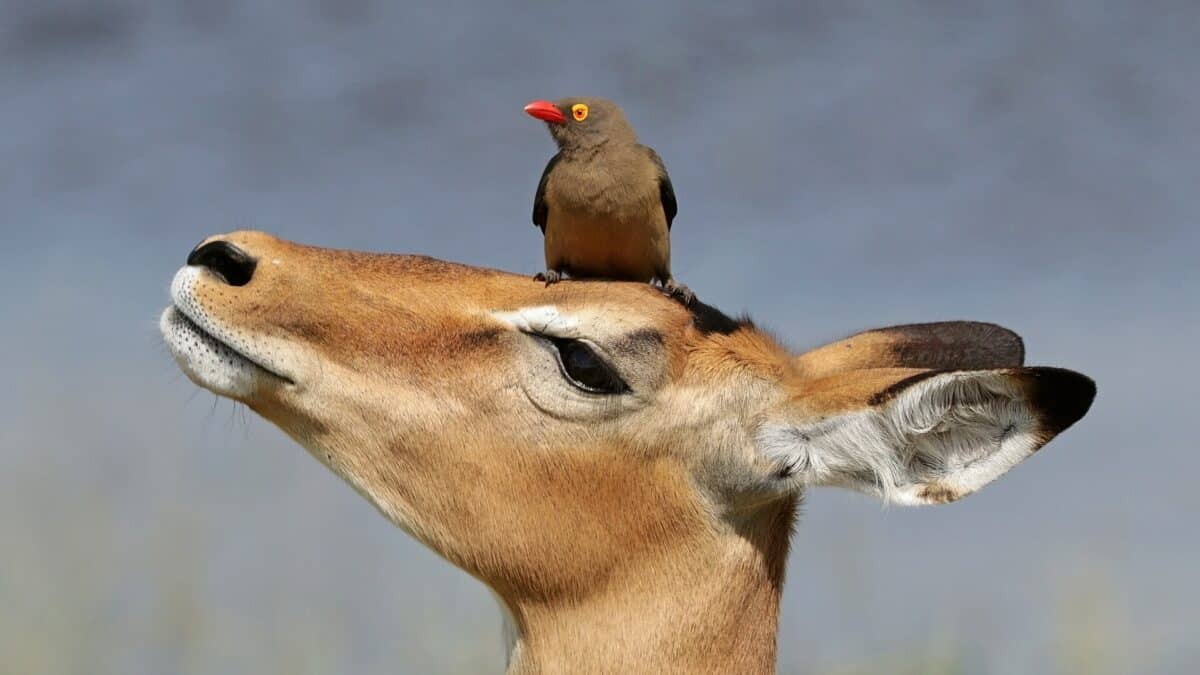
The relationship between red-billed and yellow-billed oxpeckers (Buphagus species) and large African mammals represents a complex form of interspecies cooperation. These birds perch on animals such as rhinoceroses, giraffes, cape buffalo, and various antelope species, where they feed on ticks, flies, and other parasites that plague their hosts. Beyond pest removal, oxpeckers provide an additional benefit as a living alarm system. With their elevated position and keen vision, they quickly alert their hosts to approaching predators or humans with distinctive alarm calls. Their hosts benefit from parasite removal and early warning of dangers, while the birds receive a steady food supply and safe perches above ground predators. However, this relationship has some complexity—research has shown that oxpeckers sometimes pick at wounds, potentially delaying healing. Despite these occasional conflicts of interest, the relationship persists because the overall benefits to both species outweigh the costs, making it a fascinating example of nature’s balance between cooperation and exploitation.
Clownfish and Sea Anemones

The iconic partnership between clownfish (Amphiprioninae) and sea anemones stands as one of nature’s most visually striking examples of interspecies cooperation. The tentacles of sea anemones contain powerful stinging cells (nematocysts) that deter most fish, yet clownfish have evolved a special mucus coating that prevents these stings from being triggered. This immunity allows clownfish to make their homes among the anemone’s tentacles, gaining protection from predators that dare not venture near the stinging tentacles. In return, the anemone benefits in multiple ways: clownfish aggressively defend their host against anemone-eating fish, provide nutrients through their waste, and may enhance water circulation around the anemone by swimming among its tentacles. Some studies suggest the fish’s bright coloration might even attract prey for the anemone. This relationship is so specialized that many clownfish species can only partner with specific anemone species, creating a diverse range of mutualistic partnerships throughout tropical coral reef environments. The interdependence has become so strong that in some areas, both populations suffer when one partner declines.
Crocodiles and Plover Birds

One of nature’s most surprising partnerships occurs between Nile crocodiles and Egyptian plover birds, sometimes called “crocodile birds.” When crocodiles bask with their mouths open, plovers boldly enter these fearsome jaws to feed on leeches, bits of food, and parasites lodged between the reptile’s teeth. This cleaning service benefits the crocodile’s dental hygiene while providing the birds with an easy meal. What makes this cooperation remarkable is the incredible restraint shown by the crocodiles, which could easily snap their jaws shut and consume the birds but instead allow them to perform their cleaning service undisturbed. Though this relationship was documented by Herodotus in ancient times and appears in numerous natural history accounts, modern scientific documentation of this specific behavior is surprisingly limited. Nevertheless, similar relationships between plovers and crocodiles have been observed in various regions, demonstrating how cooperation can emerge even between species with drastically different sizes and ecological roles.
Pistol Shrimp and Goby Fish

Deep in the sandy bottoms of tropical coral reefs, an extraordinary partnership has evolved between pistol shrimp (family Alpheidae) and goby fish (family Gobiidae). The nearly blind pistol shrimp excavates and maintains a burrow that serves as shelter for both animals. While the industrious shrimp works, the goby fish stands guard at the entrance, maintaining constant physical contact with the shrimp using its tail. When the goby detects danger, it signals the shrimp with specific tail movements, and both animals retreat quickly into their shared burrow. This arrangement provides the shrimp with crucial protection from predators it cannot see, while the goby gains a safe home it could not build itself. The relationship is so interdependent that in many cases, neither species is found without its partner in the wild. Through evolution, some species pairs have become so specialized that particular goby species will only partner with specific shrimp species, creating a diverse array of partnerships throughout tropical waters. This remarkable example of cooperation demonstrates how species with complementary abilities can form alliances that enhance survival for both partners.
Ravens and Wolves

The relationship between common ravens (Corvus corax) and gray wolves (Canis lupus) represents one of the most fascinating examples of cooperation between avian and mammalian predators. Ravens have learned to follow wolf packs and alert them to potential prey through distinctive calls. When wolves make a kill, ravens benefit by scavenging the remains that would otherwise be inaccessible to them, particularly in winter when carcasses are frozen. For their part, wolves appear to respond to raven calls that indicate potential prey, using the birds’ superior aerial perspective to locate animals they might have missed. Studies in Yellowstone National Park have shown that ravens can obtain up to one-third of their winter food from wolf kills. Interestingly, ravens appear to distinguish between different wolf packs and form specific associations with particular groups. Some researchers have even observed ravens playfully pulling wolves’ tails or dropping twigs for wolves to investigate, suggesting a relationship that extends beyond mere feeding opportunities to include elements of social interaction. This partnership demonstrates how intelligence and behavioral flexibility can create beneficial relationships between very different species.
Acacia Trees and Ants

In the African savannas, certain acacia species (particularly Vachellia drepanolobium) have developed a remarkable defensive partnership with several species of ants in the genus Crematogaster. These “ant-plants” have evolved specialized hollow thorns that serve as perfect homes for ant colonies, while also producing nectar from special glands specifically to feed their ant protectors. In return for this accommodation and food, the ants aggressively defend their host tree against herbivores—both insects and larger animals like giraffes and elephants. When herbivores begin feeding on the tree’s leaves, the ants swarm out to bite and sting the intruders, often deterring further damage. Some ant species go beyond mere defense and will actively attack neighboring plants that might compete with their host tree, clearing a competitive-free zone around their acacia. Research has shown that acacias lacking their ant defenders suffer significantly more herbivore damage and grow more slowly than those with ant colonies. This relationship has become so specialized through coevolution that both partners now depend on each other for survival, with some acacia species rarely found without their specific ant partners in the wild.
Coyotes and Badgers

The hunting partnership between coyotes (Canis latrans) and American badgers (Taxidea taxus) demonstrates how predators with different hunting strategies can benefit from cooperation. These unlikely allies hunt together in prairie ecosystems, targeting ground squirrels and other burrowing rodents. The badger, with its powerful digging capabilities, can pursue prey underground, while the faster coyote can chase down animals that escape across open ground. Research has shown that both species catch significantly more prey when hunting together than when hunting alone—up to 33% more for coyotes and 100% more for badgers. When a ground squirrel sees a badger digging toward its burrow, it often flees aboveground, where the waiting coyote has a better chance of catching it. Conversely, when fleeing from a coyote, prey animals often dive into burrows, where they may encounter the badger. Wildlife biologists have observed that these two predators even appear to coordinate their hunting, traveling together between hunting sites and taking turns chasing prey. While not a constant association, this partnership demonstrates how species with complementary hunting abilities can benefit from temporary alliances.
Zebras, Wildebeests, and Ostriches

On the African savanna, an impressive multispecies alliance forms between plains zebras (Equus quagga), blue wildebeests (Connochaetes taurinus), and ostriches (Struthio camelus). Each species brings different sensory strengths to this partnership: zebras have excellent vision, wildebeests have a keen smell, and ostriches combine height with sharp eyesight. By traveling and grazing together, these animals create a powerful collective defense system against predators like lions and hyenas. When one species detects danger, its alarm reactions alert the others, giving the entire mixed herd a better chance of early predator detection. Beyond the security benefits, these species often migrate together following seasonal grazing patterns, with different feeding preferences that reduce competition—zebras prefer longer grass.
Hermit Crabs and Sea Anemones

Hermit crabs face a perpetual housing crisis, needing to find increasingly larger shells as they grow. Several species have developed a fascinating solution by forming partnerships with sea anemones. The hermit crab will carefully transfer sea anemones from its old shell to its new home, sometimes using its claws to gently encourage the anemone to detach. Once placed on the new shell, the anemone attaches itself and grows, providing the crab with camouflage and protection through its stinging tentacles. In return, the anemone gains mobility it wouldn’t otherwise have, accessing new feeding grounds as the crab travels. The anemone also benefits from food particles generated during the crab’s messy feeding. In some partnerships, such as between the hermit crab Dardanus pedunculatus and the anemone Calliactis parasitica, the relationship has become so specialized that neither is commonly found without its partner in the wild. Some hermit crabs even use their anemone partners as weapons, waving them at potential threats or competitors. This relationship demonstrates how two very different organisms can form long-term partnerships that transform both species’ ecological capabilities.
Algae and Fungi in Lichens

Perhaps the most seamless example of interspecies cooperation exists in lichens, which represent one of nature’s most successful partnerships between fungi and algae (or cyanobacteria). So complete is this integration that lichens were long thought to be single organisms until Swiss botanist Simon Schwendener discovered their dual nature in 1867. In this remarkable relationship, the fungus provides structure, protection from harsh environments, and mineral nutrients, while the photosynthetic partner produces carbohydrates through photosynthesis. This cooperation allows lichens to colonize extreme environments where neither partner could survive alone, from scorching deserts to the frigid Antarctic. Some lichen partnerships have become so specialized through millions of years of coevolution that the fungal partners cannot survive without their specific algal counterparts. The success of this ancient partnership is evident in the estimated 20,000 lichen species worldwide, covering about 6% of Earth’s land surface. Lichens demonstrate how cooperation between fundamentally different organisms can create entities with entirely new properties and ecological capabilities, allowing them to thrive in environments that would be uninhabitable for either partner alone.
Colombian Lesserblack Tarantulas and Microhylid Frogs

In the forests of South America, particularly in Peru and Colombia, a fascinating relationship exists between certain tarantula species (such as Xenesthis immanis) and tiny microhylid frogs (particularly Chiasmocleis ventrimaculata). These thumbnail-sized frogs live in the tarantula’s burrow, often directly alongside a predator that could easily make a meal of them. The partnership benefits both species: the frogs consume small insects like ants and termites that might prey on the tarantula’s eggs or young, while gaining protection from their own predators by living with the imposing arachnid. Research has shown that tarantulas with frog partners have higher reproductive success than those without. The tarantulas appear to recognize their tiny partners, showing remarkable restraint by not attacking them even when physical contact occurs. Scientists have observed that the frogs have developed chemical signatures that may help the tarantulas identify them as partners rather than prey. This relationship demonstrates how evolutionary pressures can create unlikely alliances between predator and potential prey when mutual benefits outweigh the predatory instinct.
Conclusions: The Evolutionary Significance of Interspecies Cooperation

These fourteen examples of interspecies cooperation reveal the remarkable complexity of ecological relationships that extend beyond competition and predation. Such partnerships demonstrate that natural selection has repeatedly favored collaboration across species boundaries when mutual benefits outweigh the costs of cooperation. These relationships challenge simplistic views of nature as merely “red in tooth and claw,” revealing that interdependence and symbiosis are fundamental aspects of evolution alongside competition. The diversity of these partnerships—spanning all major animal groups, plants, and microorganisms—suggests that cooperation represents a fundamental biological principle rather than an evolutionary anomaly. As human activities increasingly threaten biodiversity worldwide, understanding and preserving these intricate ecological relationships becomes vital, as the loss of one partner species can trigger cascading effects that imperil entire ecosystems. These cooperative networks remind us that in nature, as in human societies, some of the most successful survival strategies involve working together rather than going it alone.

From exploring the marine wonders in the Azores and witnessing the vast savannas of Kenya, to delving deep into the rich biodiversity of South Africa and traversing iconic landscapes in Australia and the US like Yellowstone, Chris's experiences are vast.
With a penchant for diving alongside sharks, the ocean holds a special place in his heart.
Through his academic insights, he champions wildlife conservation, striving with 'Animals Around The Globe' to cultivate a profound connection between humans and animals, enhancing our mutual appreciation.
Connect with him at Feedback@animalsaroundtheglobe.com.