


Tigers are magnificent apex predators known for their stealth, power, and hunting prowess. But these skills aren’t innate—they’re meticulously taught by mother tigers to their cubs through a complex educational process spanning nearly two years. This remarkable journey from helpless newborns to efficient hunters represents one of nature’s most impressive examples of maternal teaching. The relationship between tiger mothers and their cubs during this learning period is characterized by patience, discipline, and progressive skill-building that prepares young tigers for independent survival in challenging environments.
The First Weeks: Complete Dependence

Tiger cubs are born blind, helpless, and entirely dependent on their mothers. Weighing just 2-3 pounds at birth, newborn cubs cannot see for their first 10-14 days and are unable to regulate their body temperature. During this critical period, the mother rarely leaves the den, providing constant warmth, protection, and nourishment through her milk, which is rich in nutrients and antibodies essential for building the cubs’ immune systems.
This period of complete dependence establishes the deep bond between mother and cubs that will form the foundation of the educational relationship to come. The mother’s attentive care during these early weeks ensures the cubs survive their vulnerable beginning. Cubs grow rapidly during this time, gaining approximately 100 grams per day, preparing their bodies for the physical demands of learning to hunt in the coming months.
Early Sensory Development

Between two and six weeks of age, tiger cubs undergo crucial sensory development that lays the groundwork for future hunting abilities. As their eyes open and hearing sharpens, cubs begin to develop depth perception and sound localization—skills essential for tracking prey. Mother tigers stimulate this development by making various vocalizations that cubs learn to recognize and differentiate, from soft chuffs indicating safety to sharp growls signaling potential danger.
The mother also introduces cubs to various scents by bringing prey items back to the den, allowing the young tigers to familiarize themselves with the smells they’ll eventually track. This sensory education continues as cubs begin to explore the immediate vicinity of the den under their mother’s watchful eye. Studies of tiger behavior indicate that this early sensory imprinting is crucial to developing the acute senses needed for successful hunting in adulthood.
The First Explorations Beyond the Den

Around six to eight weeks of age, tiger cubs take their first tentative steps outside the security of the den. These initial explorations are carefully supervised by the mother, who selects times when threats from predators and competing male tigers are minimal. These outings serve multiple educational purposes—cubs begin developing their coordination on varied terrain, learn to identify potential dangers, and start observing their surroundings with growing awareness.
During these excursions, the mother demonstrates vigilance behaviors that cubs instinctively mimic, such as freezing at unfamiliar sounds and scanning the environment regularly. Research from tiger reserves in India has documented how these early walks progressively extend in both duration and distance as cubs grow stronger and more confident. By three months of age, cubs regularly accompany their mother on journeys up to a mile from the den, building the stamina and environmental knowledge they’ll need as hunters.
Introduction to Meat and Prey Recognition

Between two and three months of age, tiger cubs begin their transition from an exclusively milk-based diet to consuming meat. This critical dietary shift coincides with important learning about prey recognition. The mother brings partially consumed kills back to the den area, allowing cubs to taste meat while simultaneously teaching them to identify prey species by sight and smell. Cubs initially show little interest in hunting these dead animals, instead treating them as curious objects to investigate and occasionally play with.
The mother’s choice of prey during this introductory phase is strategic—typically starting with smaller, more manageable animals that cubs can easily approach without fear. Wildlife biologists studying tiger families in Nepal have observed how mothers consistently present the same species of prey multiple times, reinforcing recognition patterns. By six months, cubs can identify major prey species on sight and have developed a strong preference for meat, though they continue nursing occasionally until around eight months of age.
Play-Fighting: Developing Crucial Motor Skills
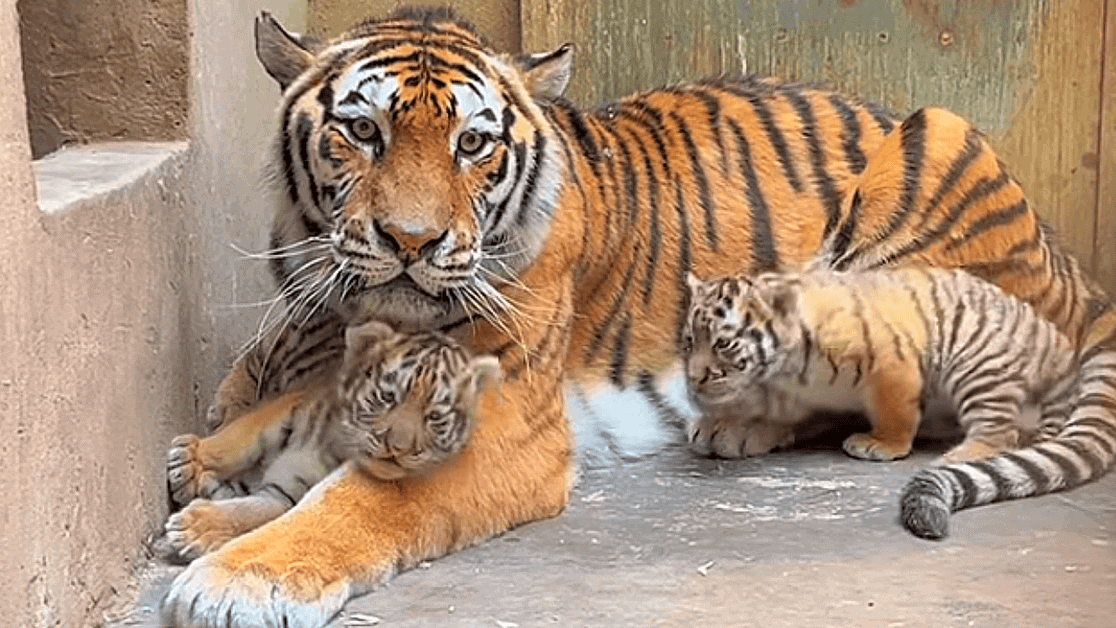
One of the most visibly charming yet functionally essential aspects of tiger cub development is play-fighting. Beginning around three months and intensifying until cubs reach about one year of age, these mock battles between siblings serve as critical practice for hunting techniques. Cubs pounce on each other, practice stalking, and engage in wrestling matches that develop the precise coordination needed to take down prey. The mother occasionally participates, carefully modulating her strength to provide an appropriate challenge without risking injury.
Research on captive tiger families has demonstrated the direct correlation between play-fighting behaviors and hunting success in adulthood. Cubs raised without siblings or with limited play opportunities show measurably decreased proficiency in hunting techniques. Through these playful interactions, cubs develop the muscle memory for crucial moves like the neck bite used to dispatch prey, along with the agility and balance required for successful hunts. Tiger cubs typically engage in play-fighting for several hours each day, with sessions becoming increasingly sophisticated as they mature.
First Hunting Observations

Around six to seven months of age, tiger cubs begin accompanying their mother on actual hunting expeditions, though they initially remain at a safe distance. The mother strategically positions her cubs downwind from potential prey, where they can observe her hunting techniques without being detected. During this observational phase, cubs learn critical lessons about selecting appropriate prey, assessing vulnerability, and choosing optimal attack positions. They watch intently as their mother demonstrates the stalking crouch, the measured approach, and the explosive sprint that characterizes a tiger’s hunting style.
Research from the Sundarbans Tiger Reserve indicates that mother tigers deliberately slow their normal hunting pace during these educational outings, providing cubs with clearer demonstrations of technique. Cubs typically observe between 15-25 hunts before being allowed to participate, and during this time, they learn to recognize subtle body language signals from their mother that coordinate family movements. These observation sessions include both successful hunts and failures, teaching cubs the persistence needed when hunting attempts don’t succeed—an important lesson as wild tigers typically succeed in only one of every ten to twenty hunt attempts.
First Participation in Hunting

Between eight and ten months of age, tiger cubs begin actively participating in hunts rather than merely observing. This participation starts with simple tasks—the mother may position cubs at strategic points to block escape routes or drive prey toward her waiting ambush. These early participatory experiences teach cubs about hunt coordination, spatial awareness, and the importance of patience. The mother communicates positions through subtle vocalizations and body language that cubs have learned to interpret through months of observation.
Cubs initially make many mistakes during these participatory hunts—breaking cover too early, approaching from incorrect angles, or failing to maintain the necessary stealth. The mother responds to these errors with remarkable patience, often using soft correction growls or physically repositioning cubs with gentle guidance. Researchers tracking tiger families in Russia’s Far East have documented how mothers gradually increase cubs’ responsibilities with each hunt, carefully matching challenges to developing abilities. By one year of age, cubs are regularly contributing to family hunts, though still relying heavily on their mother’s experience and strength for successful kills.
Learning to Make the Kill

The most dangerous aspect of hunting—the actual killing of prey—is taught with particular care, typically beginning when cubs reach 12-14 months of age. Mother tigers first demonstrate the precise neck bite technique on smaller prey that poses minimal threat to inexperienced cubs. This specialized bite, targeting the cervical vertebrae to cause rapid death, requires extreme precision. Cubs initially practice on prey that has been weakened or partially immobilized by their mother, allowing them to develop the technique with reduced risk.
The progression to larger prey follows a methodical pattern, with mothers selecting increasingly challenging targets as cubs’ strength and confidence grow. Wildlife biologists have observed how mother tigers appear to assess each cub’s readiness individually, sometimes allowing more advanced cubs to attempt kills while holding back less developed siblings. Fatal errors during this learning phase are not uncommon—cubs may approach from incorrect angles or fail to maintain a sufficient grip—and mothers must sometimes intervene to prevent injury or complete unsuccessful attempts. This aspect of hunting education demonstrates the fine balance between allowing cubs to learn through experience and ensuring their safety.
Mastering Different Hunting Techniques

Tiger hunting education isn’t limited to a single approach—mothers teach cubs various techniques adapted to different prey and environments. In wetland areas like the Sundarbans, cubs learn specialized techniques for hunting in water, including silent swimming approaches and ambushes from partially submerged positions. In more open terrain, they master the art of using minimal cover effectively and judging longer sprint distances. For arboreal prey, cubs learn to scan treetops and position themselves to catch animals that might drop from branches during escape attempts.
Seasonal variations in hunting strategy are also taught, with mothers demonstrating how to adapt techniques to changing conditions. During monsoon seasons, cubs learn to use flooded areas to their advantage, while in drier periods, they’re taught to patrol near water sources where prey concentrates. Research from camera trap studies in Thailand has documented how tiger families consistently modify their hunting approaches based on prey type, with distinct strategies employed for deer species versus wild boar or larger prey like gaur. This diverse tactical education ensures cubs can adapt to the varied challenges they’ll face as independent hunters.
Solo Hunting Attempts

Between 14 and 18 months of age, tiger cubs begin making their first solo hunting attempts under their mother’s distant supervision. These independent trials represent a crucial step toward self-sufficiency and typically target smaller, less dangerous prey like young deer or wild pigs. The mother observes these attempts from a distance, intervening only if cubs face serious danger. Success rates for these initial solo hunts are notably low—often below 5%—but each attempt builds crucial experience and confidence.
The emotional dynamics during this phase are particularly interesting, as documented by researchers in India’s Kanha Tiger Reserve. Cubs that fail in solo attempts often return to their mother displaying distinct behaviors that researchers interpret as frustration or disappointment. Mothers typically respond with reassurance behaviors such as grooming and occasionally leading cubs to easier hunting opportunities following failures. Successful solo hunts, conversely, are often marked by visible excitement from cubs and reinforcing behaviors from mothers, creating a natural reward system that encourages persistence despite the inevitable failures that characterize a predator’s life.
Gradual Independence and Territorial Awareness

As cubs approach 18-20 months of age, their hunting education expands to include critical lessons about territory and interacting with other tigers. Mothers begin taking cubs on boundary patrols, demonstrating scent-marking techniques and appropriate responses to the markings of other tigers. These lessons in territorial awareness are essential for cubs’ future survival, as establishing and defending territory will be crucial for access to prey and, eventually, mating opportunities. Cubs learn to distinguish between markings that indicate potential mates versus dangerous rivals.
During this phase, the mother gradually increases the cubs’ independence, sometimes leaving them alone for extended periods while she hunts separately. These separations build self-reliance and allow cubs to practice hunting without supervision. Research using GPS collars on tiger families in Russia has shown how mothers strategically expand the area where cubs are allowed to roam independently, carefully introducing them to different sections of her territory. This gradual expansion of their known world prepares cubs for the eventual dispersal that will occur when they reach full independence, typically between 20-24 months of age.
The Final Lessons Before Separation

In the final months before family separation, tiger mothers focus on refining their cubs’ hunting skills while gradually withdrawing support. Cubs now regularly hunt independently but still share territory with their mother. During this transition phase, mothers become increasingly reluctant to share kills with their nearly adult offspring, encouraging them to provide entirely for themselves. This seemingly harsh shift actually represents a crucial final lesson—cubs must learn to sustain themselves completely before facing the challenges of establishing their own territories.
The precise timing of family separation varies based on environmental factors and individual development. In areas with abundant prey, separation typically occurs earlier (around 18-20 months) than in regions where resources are scarcer (where families may remain together for up to 28 months). The separation process itself is generally gradual rather than abrupt, with cubs spending increasing time away from their mother before permanently establishing independent ranges. Female cubs sometimes inherit portions of their mother’s territory, while males typically disperse over longer distances. This final phase completes the educational journey from helpless newborn to self-sufficient predator—a process that represents one of nature’s most thorough and effective teaching relationships.
Nature’s Ultimate Apprenticeship: The Legacy of Maternal Teaching

The tiger mother’s educational role represents one of the most comprehensive teaching relationships in the natural world. Over approximately two years, cubs progress from complete helplessness to capable predatory independence through a carefully structured curriculum that balances innate development with experiential learning. This educational investment by tiger mothers highlights the critical importance of knowledge transfer in species where survival depends on complex hunting skills. The success of this teaching relationship directly impacts tiger conservation, as cubs that receive complete maternal education show significantly higher survival rates when establishing their own territories.
As human development continues to fragment tiger habitat and reduce prey availability, the challenges facing mother tigers as educators grow increasingly complex. Conservation efforts must consider not just the preservation of tiger numbers but the protection of the conditions that allow this crucial knowledge transfer to occur unimpeded. The relationship between tiger mothers and cubs reminds us that the survival of this magnificent species depends not only on protecting individual tigers but on safeguarding the ancient educational processes that transform vulnerable cubs into the powerful, skilled predators that have captured human imagination for millennia. This remarkable apprenticeship—perfected over countless generations—stands as a testament to the sophisticated teaching capabilities that exist beyond human society.

- 21 Scary Creatures You Might Run Into While Hiking In The U.S - June 3, 2026
- The Difference Between Turtles and Tortoises—Explained - June 3, 2026
- What Makes Owls the Silent Predators of the Night? - June 3, 2026