

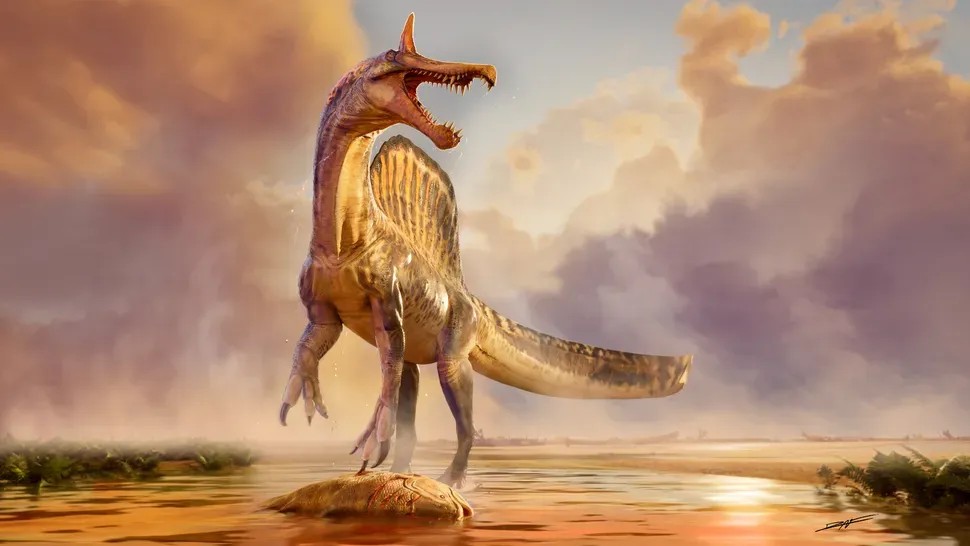
Imagine a creature so bizarre, so unlike anything alive today, that scientists are still piecing together what it actually looked like after more than a century of study. The Spinosaurus has long captured the imagination of paleontologists and dinosaur enthusiasts alike, and honestly, every new discovery seems to make it even stranger than before.
Now, a stunning fossil find is reshaping everything we thought we knew about this ancient predator. A newly described skull reveals features so dramatic and unexpected that they sound almost mythological. Let’s dive in.
A Skull Unlike Anything Seen Before
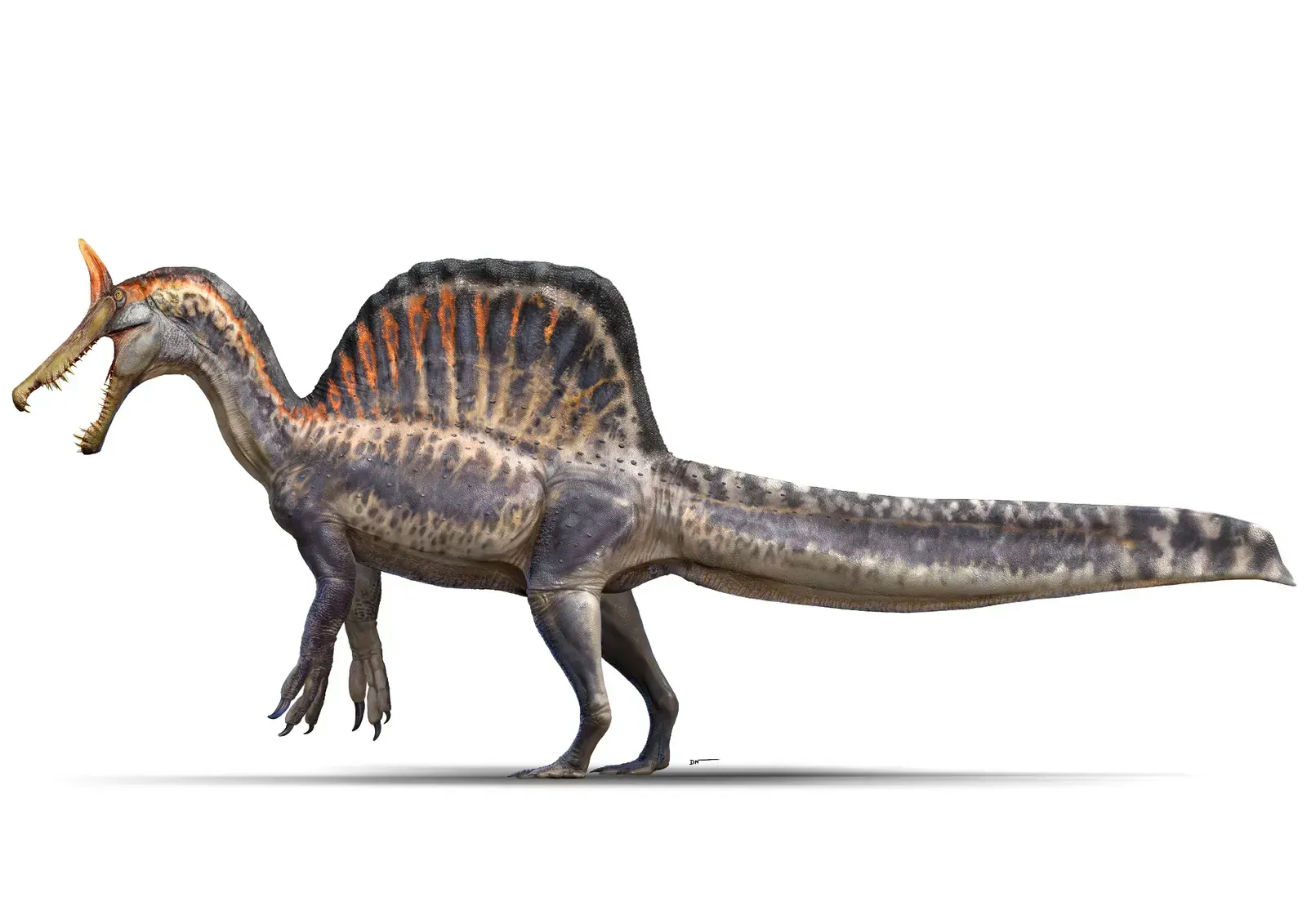
Here’s the thing about Spinosaurus – it was never going to be a simple story. The latest fossil specimen, dating back roughly 95 million years, has revealed a head crest shaped like a curved scimitar blade, sweeping dramatically over the animal’s skull in a way no one had predicted. This isn’t a subtle ridge or a minor bump. It’s a bold, sweeping structure that would have made this creature look genuinely unlike any other dinosaur on the planet.
The crest appears to have run along the top of the skull, arching backward in a curved form reminiscent of the ancient curved sword it’s now named after. Researchers believe it may have played a role in visual display, species recognition, or possibly even temperature regulation, though it’s hard to say for sure. What’s undeniable is that it transforms our entire mental image of Spinosaurus from a large crocodile-like predator into something far more theatrical and imposing.
The Sahara Was Once a Lush River Wonderland
It’s almost impossible to picture today, but 95 million years ago, the Sahara Desert was nothing like the scorching, barren landscape we know. The region was crisscrossed by massive river systems, dense vegetation, and an ecosystem teeming with life, something like a prehistoric version of the Amazon – but wilder and far less forgiving.
Spinosaurus lived right in the heart of this ancient river world, what paleontologists call the Kem Kem ecosystem of what is now Morocco and Algeria. The environment was packed with enormous fish, crocodilians, and other large predators, making it one of the most dangerous ecosystems in Earth’s history. Honestly, the Sahara during the Cretaceous period sounds less like a place and more like a nightmare.
Wading Like a “Hell Heron” Through Ancient Waters
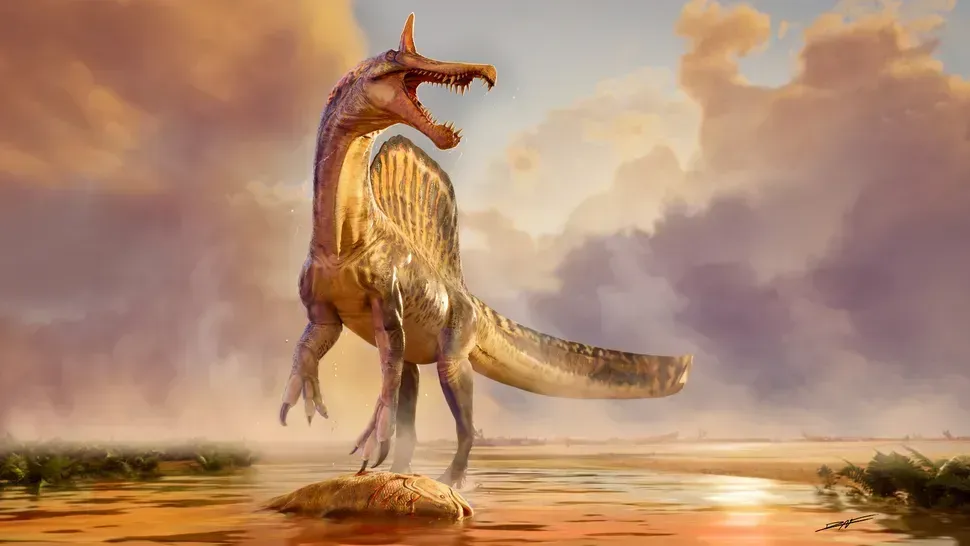
The comparison to a heron might sound almost charming at first, until you consider that this particular “heron” was potentially the longest predatory dinosaur to ever walk the Earth. Researchers have used the term “hell heron” to describe how Spinosaurus likely hunted, wading into rivers with its elongated snout submerged just below the surface, waiting to snap up massive fish in a flash of movement.
This feeding strategy is strikingly similar to how modern herons hunt at the water’s edge – patient, still, and then explosively fast. Scale that behavior up to an animal that could exceed 45 feet in length, equipped with curved, interlocking teeth perfectly shaped to grip slippery prey, and you start to understand why this creature deserves every dramatic description it gets. Still, the elegance of the comparison is surprisingly fitting for something so monstrous.
What the New Fossil Specimen Actually Revealed
The specimen at the center of this discovery is a partial skull that was painstakingly analyzed by an international team of researchers. The bones preserved enough detail to reconstruct the crest, study the structure of the snout, and gain deeper insight into how this animal’s head was actually proportioned during life. These kinds of well-preserved cranial fossils are extraordinarily rare for Spinosaurus, which makes this find particularly significant.
Prior to this discovery, a lot of what we thought we knew about Spinosaurus skull anatomy was extrapolated from fragmentary remains or close relatives. Having a more complete look at the skull changes the reconstruction in meaningful ways. The scimitar crest in particular was completely unknown before this specimen, suggesting that even now, after decades of research, Spinosaurus still has surprises left to reveal.
The Ongoing Mystery of How Spinosaurus Moved
One of the most contentious debates in paleontology over the past decade has centered on whether Spinosaurus was primarily aquatic or spent significant time on land. Some researchers have argued that its bone density and limb proportions suggest it was well-adapted to life in and around water, behaving almost like a giant, bipedal crocodile. Others have pushed back, arguing the evidence points to a more terrestrial lifestyle with occasional aquatic foraging.
The new skull evidence doesn’t definitively resolve this debate, but it does add weight to the idea of a highly specialized, semi-aquatic predator. The overall anatomy supports a creature that was deeply integrated into a riverine lifestyle rather than simply visiting the water to drink or cool down. Let’s be real – an animal with this skull, those teeth, and that body shape was built for the water in ways that most dinosaurs simply were not.
Spinosaurus in Context: A Giant Among Giants
To truly appreciate how remarkable Spinosaurus was, you have to consider the ecosystem it shared with other massive predators. The Kem Kem beds of North Africa have yielded fossils of enormous carcharodontosaurid dinosaurs, giant sawfish, and colossal crocodylomorphs all living in the same region at roughly the same time. It was, without exaggeration, one of the most predator-dense ecosystems ever documented in the fossil record.
Spinosaurus likely occupied a distinct ecological niche from the other large theropods of its time, leaning heavily into aquatic prey in a way that reduced direct competition. This kind of ecological partitioning is seen in modern ecosystems too – think of lions and crocodiles sharing an African waterhole, each dominating a different zone. The new crest discovery reinforces the idea that Spinosaurus was not just a large predator, but a highly specialized one with unique adaptations that set it apart from every other dinosaur of its era.
What This Discovery Means for Future Research
Every major Spinosaurus discovery tends to open more questions than it answers, and this one is no different. The scimitar crest raises immediate questions about sexual dimorphism – did males and females differ in crest size? – and about how this feature evolved relative to other spinosaurids like Baryonyx or Irritator. There’s a whole family tree here that deserves closer examination in light of this new anatomy.
Beyond the crest itself, the specimen is prompting researchers to revisit older Spinosaurus material with fresh eyes. Sometimes a single new fossil can reframe an entire field of study, and that appears to be exactly what’s happening here. The image of Spinosaurus wading through prehistoric Saharan rivers, its scimitar-shaped crest catching the Cretaceous sun, is both scientifically revised and somehow more vivid than ever before.
Conclusion: A Prehistoric Monster, Reimagined
Every time scientists think they have Spinosaurus figured out, the fossil record throws another curveball. The scimitar crest is not just a cool anatomical feature – it’s a reminder that even the most studied creatures from deep time still hold genuine surprises. I think that’s one of the most exciting things about paleontology: the past is not static. It keeps changing as we dig deeper.
The image of a massive, crest-bearing predator wading through a lush, river-rich Sahara 95 million years ago is both humbling and thrilling. It rewrites the poster of what Spinosaurus looked like and reminds us how much stranger reality can be than imagination. What other secrets do you think are still buried beneath the ancient rocks of North Africa?

- Urban Coyotes Show Remarkable Adaptability, Learning to Thrive in City Environments - July 22, 2026
- Beavers Are Nature’s Engineers, Creating Vital Habitats for Other Wildlife Species - July 21, 2026
- The Recovery of the California Condor Offers Hope for Other Critically Endangered Birds - July 21, 2026