

Most people assume that the world’s most vibrant, crystal-clear turquoise waters are strictly reserved for the Maldives or the Mediterranean. However, you don’t need a passport or a ten-hour flight to witness nature’s most surreal color palettes. Research into North American geology reveals that a specific combination of glacial flour, limestone deposits, and extreme depths has created a handful of bodies of water that appear digitally altered to the naked eye. In many cases, these domestic wonders actually outshine their international counterparts in pure clarity. Here’s what the geological data actually says.
#16 — Colchuck Lake, Washington

You might think someone dumped a gallon of neon blue food coloring into this alpine basin, but the reality is much more scientific. Located in the Enchantments of the Cascsade Mountains, Colchuck Lake maintains its staggering hue due to its high elevation and the massive granite peaks that reflect sunlight directly into its depths.
The water is so clear that you can often see submerged logs and boulders dozens of feet below the surface. Geologists note that the lake’s color is primarily influenced by “rock flour”—extremely fine particles of silt ground down by glaciers. This silt stays suspended in the water, scattering light in the blue-green spectrum.
While influencers flock here for the photos, many seasoned hikers argue that the grueling 8-mile trek makes this the most “earned” view in the Pacific Northwest. It’s a literal shimmering emerald set against jagged grey stone. But as impressive as this mountain gem is, the “glass-bottom” effect of our next lake is even more disorienting…
#15 — Flathead Lake, Montana

Flathead Lake is famous for a terrifying optical illusion: the water is so transparent that boats often appear to be hovering in mid-air above the lake bed. As the largest natural freshwater lake by surface area west of the Mississippi, it contains some of the lowest levels of phosphorus in the country, which prevents the growth of algae that usually clouds inland waters.
On a calm day, visibility in Flathead Lake can exceed 30 feet, making the rocky bottom look like it is only inches away. Locals frequently warn tourists about jumping in, as the “shallow” looking rocks are often deep enough to swallow a boat’s anchor.
Some biologists argue that the introduction of invasive species has actually increased the clarity over the decades, though at a high ecological cost. It remains one of the cleanest large lakes in the populated world. You’ll think your eyes are failing you here, but wait until you see the prehistoric “blood-red” hues found at #14…
#14 — Mono Lake, California

Mono Lake looks like it belongs on a different planet, specifically one with a much harsher atmosphere. This ancient saline soda lake is famous for its “tufa towers,” which are eerie, knobby limestone columns that rise out of the water like drowned skeletons. These structures are actually formed by underwater springs rich in calcium mixing with the lake’s carbonate-heavy water.
Because the lake has no outlet, salts and minerals have concentrated over thousands of years. The water in Mono Lake is nearly three times saltier than the ocean and incredibly alkaline, creating a chemical environment that supports billions of brine shrimp.
While the average tourist finds the salty smell off-putting, photographers consider this the “Holy Grail” of high-contrast landscapes. It’s a masterclass in “ugly-beautiful” aesthetics that defies every standard definition of a lake. However, the serene, tropical-blue secrets of the Missouri Ozarks at #13 are much easier on the eyes…
#13 — Johnson’s Shut-Ins, Missouri
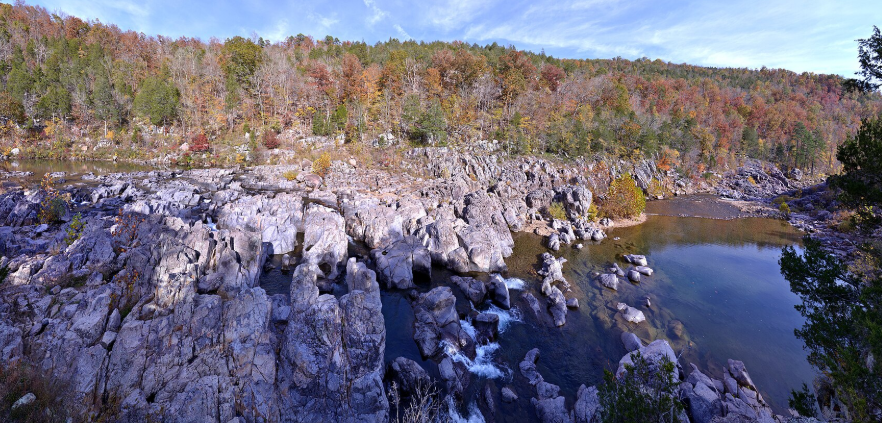
Hidden deep within the St. Francois Mountains, this doesn’t look like the Missouri most people imagine. The “Shut-Ins” are a series of natural turquoise pools carved into billion-year-old volcanic rock. The water here is remarkably clear, filtered through igneous rhyolite and granite that doesn’t erode into the murky silt found in most Midwestern rivers.
What makes this lake-like series of pools so shocking is the “rushing turquoise” effect created by the Chert rock beds beneath the surface. It looks more like a Caribbean lagoon than a canyon in the middle of America.
While Missouri locals treat this as a premier summer swimming hole, many travel experts claim the sheer density of the crowds during July actually ruins the “untouched” vibe of the geological formations. If you want the visuals without the crowds, you’ll have to head north to the “Hidden Caribbean” at #12…
#12 — Torch Lake, Michigan
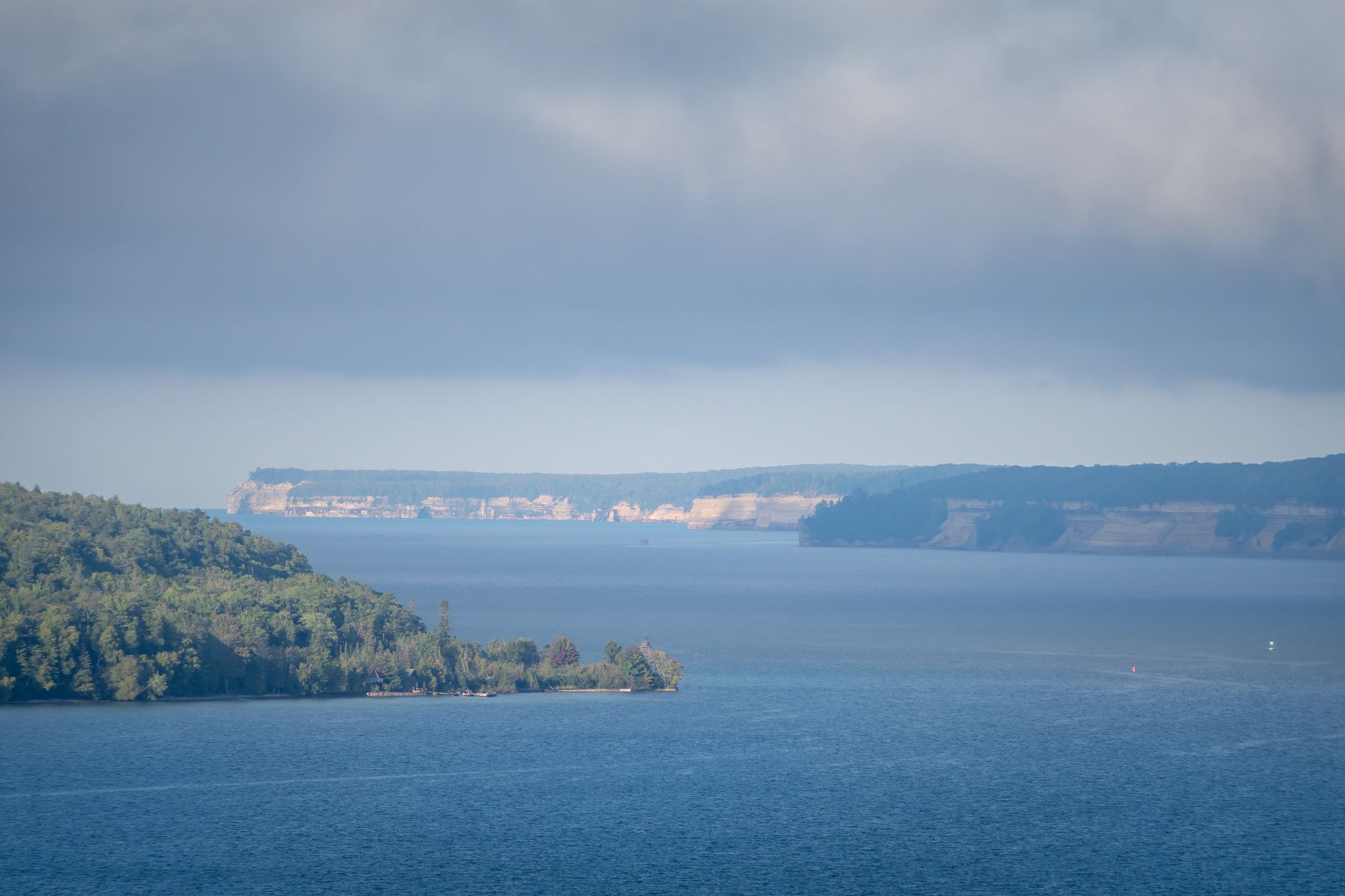
If you showed a photo of Torch Lake to a stranger, they would bet their life savings it was taken in the Bahamas. This glacial lake is famous for its distinct, multi-shaded blue water that transitions from a pale white-sand turquoise to a deep sapphire. This happens because the lake is a “fjord-like” formation with a very deep center and a very shallow limestone shelf.
The white “sand” at the bottom of Torch Lake is actually pulverized marl—a calcium carbonate-rich mud that reflects light with nearly 100% efficiency. This creates a glowing effect that is visible even on overcast days.
Despite being one of the most beautiful lakes in the world, it is notoriously private; many of the best views are blocked by million-dollar estates. It’s a high-society playground that feels almost too polished to be natural. But for a lake that literally looks like a crater from a sci-fi movie, you need to see #11…
#11 — Crater Lake, Oregon

Crater Lake is the deepest lake in the United States, and its color is a blue so intense it looks like it has been saturated in a photo editing app. There are no rivers flowing into or out of the lake; it is filled entirely by direct snowfall and rain. Because there is no sediment runoff, the water is some of the purest on the planet.
The lake is nearly 2,000 feet deep, and because the water is so pure, light waves can penetrate deeper, scattering only the blue end of the spectrum back to the surface. This creates a “True Blue” color that is scientifically unique to this specific location.
While most people just look from the rim, the real “Photoshopped” views are found at the water’s edge via the Cleetwood Cove Trail. It is a surreal, dark blue abyss that feels bottomless. Yet, as deep as Crater Lake is, the “floating” feeling of the desert oasis at #10 is arguably more jarring…
#10 — Blue Hole, New Mexico

Located in the middle of a literal desert in Santa Rosa, the Blue Hole is a geological anomaly that defies logic. It is a bell-shaped cienega, or “hidden spring,” that maintains a constant 62-degree temperature and a legendary sapphire color. In an area surrounded by red dust and brown rock, this pool of water looks like a glitch in the Matrix.
The Blue Hole is an artesian spring that flows at a staggering rate of 3,000 gallons per minute, which means the entire body of water is completely cycled and refreshed every few hours. This constant turnover prevents any stagnation or cloudiness.
Scuba divers use this as a training ground because the visibility is essentially infinite. It’s a tiny, perfect circle of blue in a world of orange. If you think a desert pool is weird, wait until you see the lake in #9 that looks like a giant bowl of milk…
#9 — Diablo Lake, Washington

The water in Diablo Lake isn’t just blue; it’s an opaque, milky turquoise that looks like someone mixed paint into the reservoir. This is a man-made reservoir, but the color is entirely natural. It is the result of the surrounding glaciers grinding rocks into a fine powder known as “glacial flour.”
When the sun hits these microscopic silt particles suspended in the water, they reflect a startling green-blue light that stays consistent even in the shade. The contrast against the dark green evergreens of the North Cascades is so sharp it creates an “outline” effect around the water.
Many visitors claim the best viewpoint is from the overhead bridge, where the water looks dense enough to walk on. It is a hauntingly beautiful, cold, and vibrant scene. But it lacks the “tropical” transparency of the Great Lakes’ best-kept secret at #8…
#8 — Lake Huron (Bruce Peninsula), Michigan/Ontario

Technically bordering the US and Canada, the waters around the Bruce Peninsula and the Mackinac region of Lake Huron are often mistaken for the Virgin Islands. The water here is incredibly clear because the lake bed is composed largely of dolomite and limestone, which doesn’t cloud the water like organic soil does.
Because the water is so cold and nutrient-poor, it lacks the plankton and algae that turn most Great Lakes water a murky olive green. On a sunny day, you can see shipwrecks at the bottom of the lake from a drone 100 feet in the air.
While the water looks inviting enough for a tropical swim, the temperature rarely breaks 60 degrees. It’s a visual trick that lures you in, only to freeze you solid. However, if you want “Photoshopped” colors that are actually warm, you have to see #7…
#7 — Grand Prismatic Spring, Wyoming
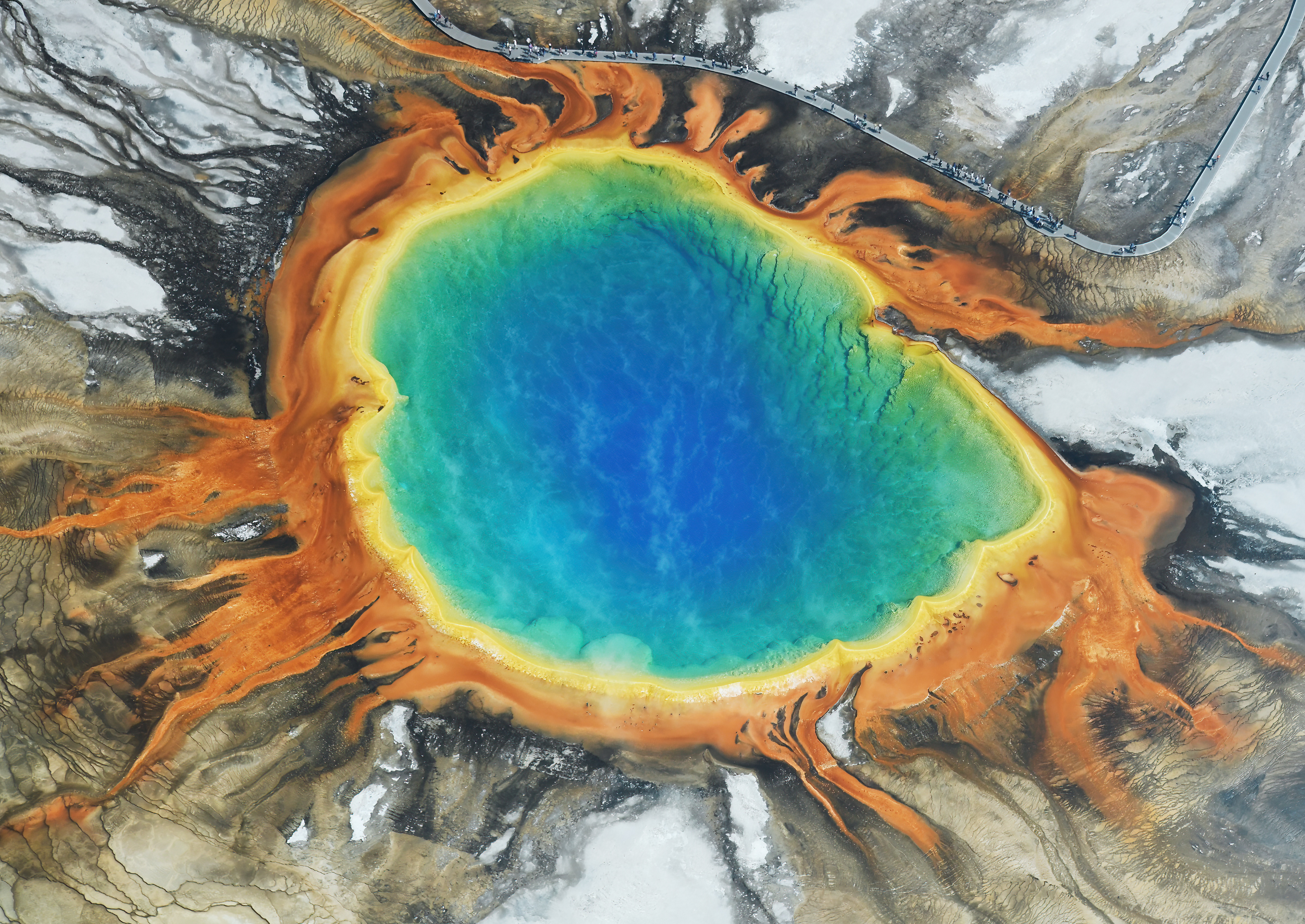
While technically a thermal pool rather than a traditional lake, the Grand Prismatic Spring in Yellowstone is the third largest spring in the world and undoubtedly the most colorful. The center is a deep, boiling blue, surrounded by rings of brilliant yellow, orange, and red.
These “technicolor” rings are actually created by different species of thermophilic (heat-loving) bacteria that thrive at specific temperature gradients. The blue center is too hot to support life, so you are seeing the pure, uninhibited color of deep water.
It is perhaps the most photographed “water feature” in the country, and yet every person who sees it in person claims the photos don’t capture the sheer neon luminosity. It looks like a portal to another world. Now, compare that to the stark, haunting clarity of the “Dead Forest” lake at #6…
#6 — Lake Tahoe, California/Nevada
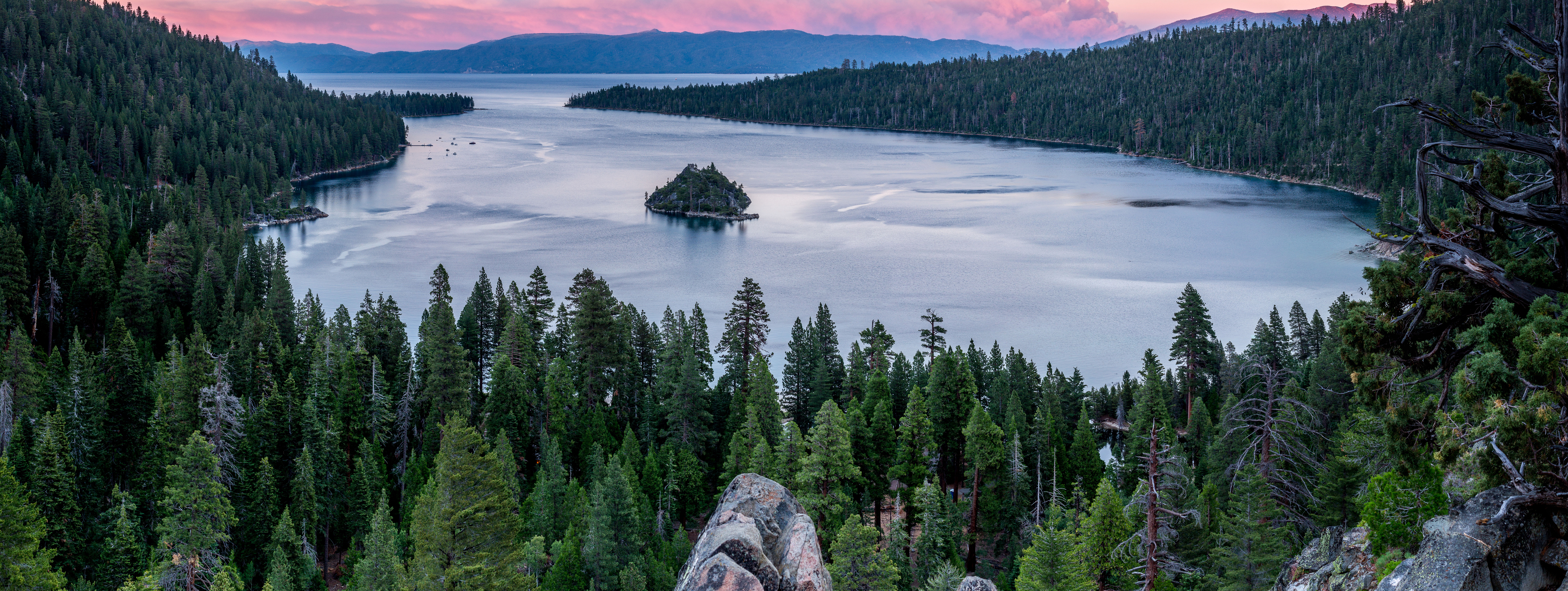
Lake Tahoe is the crown jewel of the Sierras, famous for its “Tahoe Blue” clarity. For decades, researchers have been obsessed with maintaining the lake’s Secchi disk measurements (a measure of transparency). Currently, you can see to a depth of roughly 70 to 80 feet in many parts of the lake.
The secret to Tahoe’s beauty isn’t just the water—it’s the giant, smooth granite boulders that sit beneath the surface in the shallow “coves,” creating a variegated turquoise pattern. The lack of fine sediment prevents the water from looking “milky,” keeping it sharp and crisp.
While the South Shore is famous for parties, the East Shore’s “Bonsai Rock” area is where the water looks most like a digital rendering. Even so, the sheer “mirror” quality of #5 makes Tahoe look like a muddy pond by comparison…
#5 — Convict Lake, California

Tucked away in the Sherwin Range of the Sierra Nevada, Convict Lake is known for its intense blue water and the dramatic, swirling geological patterns of Mount Morrison that tower above it. The lake was carved by glaciers, leaving behind a deep, cold basin that reflects the sky with eerie precision.
The “Photoshopped” element here is the water’s stillness; because it is tucked into a deep canyon, it often acts as a perfect liquid mirror for the multicolored sedimentary rock of the mountain. The orange and grey streaks of the mountain appear perfectly inverted in the water.
It’s a favorite for landscape photographers who want that “double image” look without using Photoshop. But if you want to see water that is so clear it actually causes vertigo, you have to head to #4…
#4 — Bear Lake, Utah/Idaho

Known as the “Caribbean of the Rockies,” Bear Lake straddles the border of Utah and Idaho. Its unique turquoise-blue color is caused by the presence of suspended calcium carbonate (limestone) particles in the water. Unlike many other lakes, Bear Lake is incredibly old—over 250,000 years—and has developed a unique chemical composition.
The water is so rich in minerals that it creates a natural “shimmer” that isn’t found in most freshwater lakes. Because the lake is quite shallow near the shores, the turquoise color is especially vivid and bright.
While it’s a popular spot for motorized boating, environmentalists warn that the lake’s unique ecosystem is fragile and sensitive to runoff. It remains a staggering desert jewel. But for sheer “hidden” mystery, #3 is the one the government almost kept to itself…
#3 — Green’s Point (The Blue Hole), West Virginia

Deep in the hills of West Virginia lies a spot so vibrant that locals thought it was contaminated for years. The “Blue Hole” at Green’s Point is a natural swimming hole where the water turns a startling, opaque teal. This isn’t from pollution, but from the way the river interacts with the local geology.
As the water flows through the limestone-rich mountains, it picks up minerals that scatter light in a way that creates a “milky” blue appearance during the spring and summer months. It is a stark contrast to the dark, leafy green of the surrounding Appalachian forest.
It’s one of the most Instagrammed spots in the state, yet it remains difficult to find without a local guide. But as beautiful as this is, the “impossible” clarity of the underwater forest at #2 is even more jarring…
#2 — Clear Lake, Oregon

Don’t let the generic name fool you—Clear Lake is perhaps the most surreal body of water in the lower 48. Formed approximately 3,000 years ago when a lava flow dammed a mountain stream, the lake is so cold (near freezing year-round) that it has preserved an entire forest of trees underwater.
Because the water is volcanic-filtered and exceptionally cold, the trees at the bottom of the lake have not decayed; they still stand upright, visible through 100 feet of crystal-clear water. Paddling a kayak over a 3,000-year-old forest is a disorienting, haunting experience.
It feels like you are floating in the air above a ghost forest. It is high-definition nature at its most extreme. However, there is one lake that looks so much like a fantasy novel cover that most people refuse to believe it’s real until they touch it…
#1 — Hanging Lake, Colorado

Suspended on the edge of a cliff in Glenwood Canyon, Hanging Lake is a geological “impossible” feat. The lake was formed by a travertine deposition, which created a natural “rim” that holds the water in place on the side of a mountain. The water is a luminous, high-saturation emerald green.
The lake’s color and the travertine “spouts” that feed it are so delicate that it is strictly forbidden to touch the water; the oils from human skin can disrupt the chemical balance and kill the lake’s color-producing minerals. It looks like a lush, tropical oasis accidentally dropped into the middle of the rocky Colorado mountains.
It is currently one of the most regulated hiking spots in America, requiring permits months in advance to even see. It is the definition of “too good to be true,” and yet, it is 100% natural.
The Bottom Line
America’s “Photoshopped” lakes are a testament to the power of unique geology—from glacial flour and limestone deposits to volcanic filtration and saline concentration. While these destinations look like something out of a dream, they are fragile ecosystems that often require strict protection to maintain their surreal appearance. From the “ghost forest” of Clear Lake to the neon rings of Yellowstone, the data proves that nature is the best editor.
Which of these lakes would you risk a freezing swim in just to say you were there? Or is there a “hidden gem” in your home state we totally forgot? Drop a comment below and let us know!
