

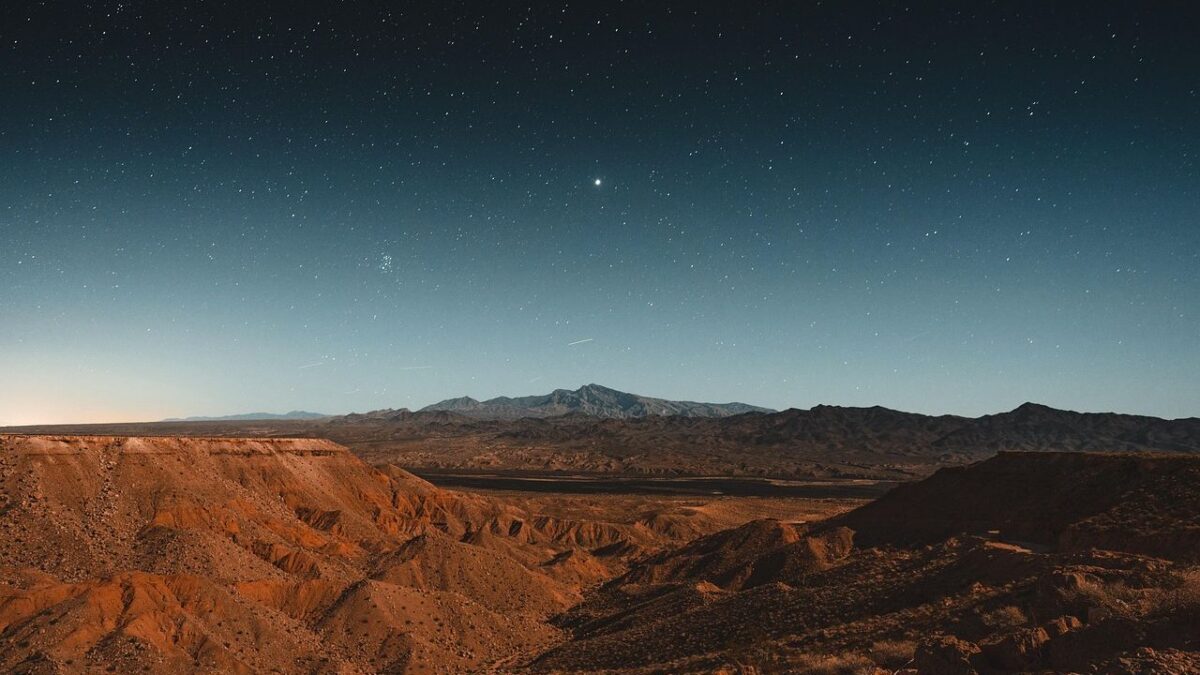
3 planets will put on a sky show in May – when and how to see them – Image for illustrative purposes only (Image credits: Pixabay)
As twilight fades in early May 2026, the western sky offers a captivating view for casual observers and dedicated astronomers alike. Venus blazes as the brightest evening beacon, while Jupiter holds a steady position higher overhead, drawing eyes toward the constellation Gemini. By month’s end, Mercury joins the scene low on the horizon, creating a striking three-planet lineup that requires little more than clear skies and patience.[1][2]
Venus Leads the Evening Parade
Venus dominates the early evening sky throughout May, shining at magnitude -4.0 from its position in the west-northwest. This makes it about seven times brighter than Jupiter and unmistakable even in twilight. Observers will notice its moderately low stance, with the planet appearing as a small gibbous disk through binoculars or small telescopes, roughly 84 percent illuminated by midmonth.[1]
The planet’s steady glow provides a reliable marker for locating other celestial objects. It slowly creeps upward toward Jupiter as the weeks progress, setting the stage for tighter groupings later in the month. Telescopic views reveal subtle details, though the phase limits dramatic contrasts.
Jupiter’s Steady Presence Near Gemini
Jupiter anchors the western sky one-third of the way from horizon to zenith at dusk, positioned near the bright twins Pollux and Castor in Gemini. At magnitude -1.9, it outshines most stars and offers crisp views of its cloud bands and four largest moons through telescopes until it sets around midnight. This marks one of the last chances for such detailed observations before September.[1]
The gas giant’s higher elevation makes it accessible earlier in the evening compared to Venus below. Skywatchers can use it to navigate Gemini’s outlines, enhancing the month’s stargazing experience. Its gradual descent toward Venus builds anticipation for their upcoming close approach in June.
Mercury Emerges for the Grand Finale
Mercury remains elusive until late May, following its superior conjunction with the sun on May 14. By May 22, it reaches magnitude -1.4, lingering about 55 minutes after sunset some 10 degrees from the sun in the west-northwest. Binoculars help spot it initially, low near the horizon a quarter-hour post-sundown.[1]
Conditions improve rapidly: by May 25, at magnitude -1.1, it becomes naked-eye visible, resembling a bright star. At month’s end, Mercury stands clear about 45 minutes after sunset, roughly a fist-width above the horizon. This peak visibility precedes its greatest elongation in mid-June.
Moon Pairings Add Celestial Drama
The moon enhances the planetary show with close encounters that frame Venus and Jupiter beautifully. On May 18, a slender 7 percent illuminated crescent sits 2.5 degrees to Venus’s right, glowing with earthshine for a three-dimensional effect visible to the naked eye or binoculars. Jupiter hovers nearby, completing a picturesque trio.[1][3]
Two nights later, on May 20, a 24 percent crescent moon appears 7 degrees lower right of Jupiter. These alignments occur shortly after sunset in the west, lasting a couple of hours as darkness deepens. Early morning pairings with Mars on May 14 and Saturn on May 13 offer additional challenges for dawn observers.[2]
Prime Viewing Tips and Bonus Events
To catch the three-planet display, focus on late May evenings from locations with unobstructed western horizons, such as hills or open fields. Begin observations 30 to 45 minutes after sunset when Mercury rises into view, with Jupiter highest, Venus to its lower right, and Mercury hugging the horizon. Naked eyes suffice for all three under clear conditions; binoculars reveal moon details and Mercury’s position.[1]
- Best dates: May 25-31 for the full trio.
- Avoid light pollution; face west 40-60 minutes post-sunset.
- Northern latitudes see lower Mercury; southern views improve elevation.
- Track progress nightly to witness Venus closing on Jupiter.
Beyond planets, the Eta Aquarid meteor shower peaks May 5-6 before dawn, potentially delivering dozens of swift streaks from Aquarius despite moonlight interference. May bookends with full moons: the Flower Moon on May 1 and a rare Blue Moon on May 31, the latter also a micromoon at apogee.[4][3]
These May skies remind us of the solar system’s quiet dance, accessible to anyone who steps outside. With minimal equipment needed, the planetary trio and lunar accents deliver moments of wonder that linger long after sunset.

- The Only US State Where This Wolf Runs Free - June 6, 2026
- Trump Administration Bans Bison Grazing on Federal Land for Montana Nonprofit ( Allows Tribes) - May 15, 2026
- The Worst Ice Storm That Shut Down Indiana - May 11, 2026