

Worried about unexpected vet bills?
Pet insurance can cover thousands in unexpected vet costs. Get a free quote from Lemonade in under 2 minutes.
Get My Free Quote →Sponsored · Opens Lemonade.com
For centuries, humans have pondered whether animals experience emotions similar to our own. Among these questions, one has captured particular fascination: do elephants actually mourn their dead? Stories of elephant funerals and grieving behaviors have circulated throughout history, from ancient folklore to modern wildlife documentaries. This emotional complexity challenges our understanding of animal consciousness and blurs the lines between human and animal experiences. As our scientific methods advance and field observations become more sophisticated, we’re uncovering compelling evidence that suggests these magnificent creatures may indeed experience grief and loss in ways surprisingly similar to humans. Let’s explore the fascinating world of elephant mourning behaviors and what they tell us about animal emotions.
The Historical Observations of Elephant Grief

Accounts of elephants showing interest in their dead date back centuries. Early explorers, hunters, and naturalists documented behaviors that seemed ritualistic and purposeful. In 1889, explorer Henry Stanley described watching elephants cover dead companions with branches and earth. Colonial-era accounts tell of elephants standing vigil over fallen herd members, sometimes for days.
These historical observations, while sometimes romanticized or anthropomorphized, nevertheless formed the foundation for scientific inquiry. What makes these accounts particularly compelling is their consistency across different cultures, time periods, and geographical locations. Even before modern scientific study, the patterns of behavior around elephant death seemed to suggest something beyond mere instinct—something that resembled reverence, care, or what humans might recognize as grief.
Modern Scientific Understanding of Elephant Emotions

Modern neuroscience has revealed that elephants possess highly developed limbic systems—the emotional centers of the brain. An elephant’s brain contains three times as many neurons as a human brain, and their hippocampus (associated with emotion and memory) is proportionally larger than ours. Research by neurobiologists like Dr. Paul Manger has shown that elephants possess von Economo neurons, specialized brain cells previously only found in humans, great apes, and some cetaceans.
These neurons are linked to social awareness, empathy, and self-recognition—key components for experiencing grief. Additionally, elephants have demonstrated mirror self-recognition, a rare cognitive ability shared by only a few species, suggesting they possess a level of self-awareness that would enable them to comprehend the permanence of death. This neurological foundation provides the biological basis for complex emotional experiences, including mourning.
Documented Behaviors Around Dead Elephants
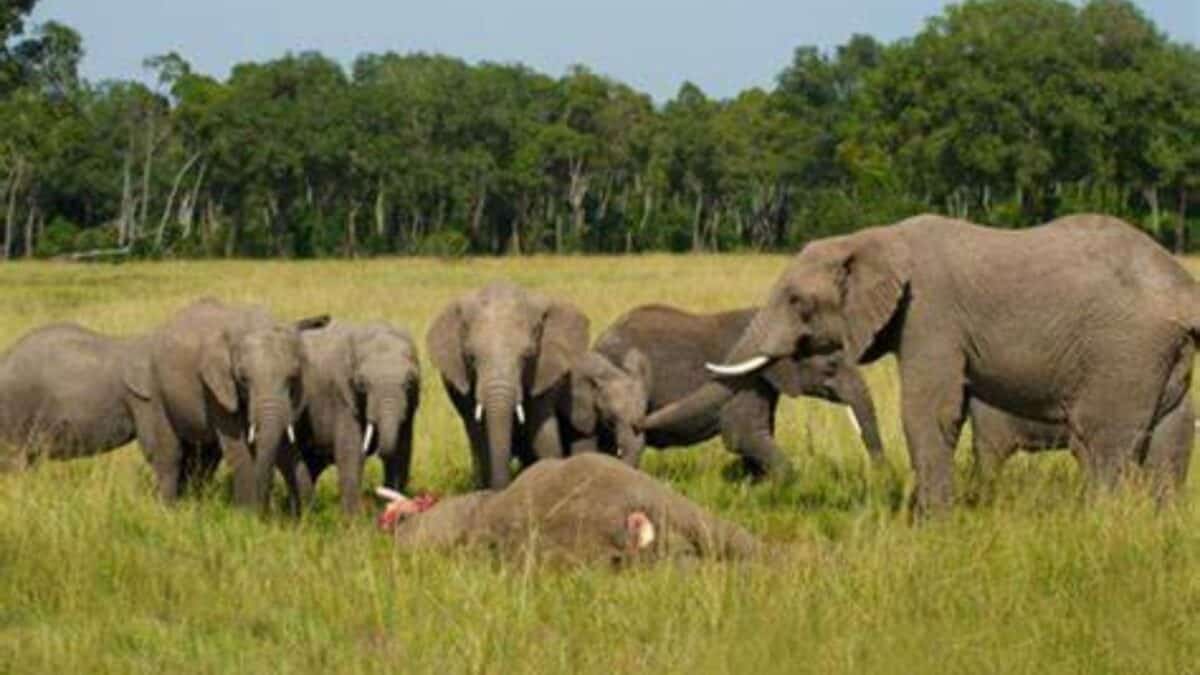
Field researchers have meticulously documented specific behaviors that elephants display around their dead. These include touching the remains with their trunks, often focusing on the head and tusks; standing guard over the body, sometimes for days; attempting to lift or revive the fallen elephant; covering the body with branches and vegetation; returning to the death site or remains for years afterward; and collecting and carrying bones of the deceased.
Cynthia Moss, who has studied elephants in Kenya for over 40 years, recorded instances where elephants would return to the exact location where a family member died, even years later, and spend time quietly investigating any remaining bones. In some cases, elephants have been observed taking the tusks or bones of the deceased and carrying them for miles before carefully placing them elsewhere—behavior that has no obvious survival advantage and suggests a deeper emotional connection.
The Science of Elephant Family Bonds

Elephant society is built on deep, enduring family bonds that last throughout their 60-70 year lifespan. Female elephants typically remain with their natal herd for life, creating multi-generational matriarchal societies. These tight social structures are maintained through complex communication systems including tactile contact, vocalizations (both audible and infrasonic), and chemical signals. Dr. Joyce Poole, who has studied elephant communication for decades, has documented over 70 distinct vocalizations that elephants use to maintain social cohesion.
Elephants can recognize up to 100 different individuals and remember relatives they haven’t seen for years. They nurse their young for 3-5 years and invest heavily in offspring care, with allomothering (care from females other than the mother) common in herds. This extraordinary social intelligence and long-term bonding creates the emotional foundation that makes grief not only possible but perhaps inevitable when these bonds are severed by death.
Case Studies: Famous Incidents of Elephant Mourning

Several well-documented cases have become landmark examples in the study of elephant grief. In 2003 in Kenya’s Samburu National Reserve, a matriarch known as Eleanor collapsed. Another matriarch from a different family, Grace, was documented trying to lift Eleanor to her feet multiple times. After Eleanor’s death, Grace remained with the body for hours, and elephants from five different families visited the body over the following week.
In 2016 in Botswana, researchers documented an elephant mother carrying her dead calf for days, refusing to leave it behind despite the decomposition that had begun. Perhaps most compelling was a 2014 incident at South Africa’s Kruger National Park where researchers observed a herd encountering the remains of a matriarch who had died of natural causes. The elephants processed slowly past the body, many touching it gently with their trunks in what appeared to be a ceremonial “viewing.” These cases demonstrate behaviors that serve no obvious survival function but closely resemble human mourning practices.
Differentiating Between Instinct and Emotion

A critical question in understanding elephant mourning is distinguishing between instinctual responses and genuine emotional experiences. Skeptics suggest that what appears to be grief might be survival-oriented behaviors—investigating a potential threat, learning about death to avoid similar fates, or simply curiosity about changes in their environment. However, several factors suggest emotional responses beyond mere instinct.
The selective nature of elephant responses (showing more interest in familiar versus unfamiliar dead elephants), the persistence of these behaviors long after any survival benefit would be relevant, and the energetic cost of behaviors like standing vigil or returning to death sites all indicate something more complex than instinct alone. Dr. Karen McComb’s research found that elephants showed greater interest in the bones of their own species compared to other animals, and particularly in the skulls and tusks of elephants—the most individually identifying features—suggesting recognition and not just general investigation.
Cross-Species Comparison: Mourning in Other Animals

Elephants aren’t alone in displaying behaviors that resemble mourning. Primates, particularly chimpanzees and gorillas, have been observed carrying dead infants for days or weeks. Dolphins have been documented supporting dead calves at the surface as if trying to help them breathe. Corvids (ravens and crows) hold what appear to be “funerals” where they gather around a dead member of their species.
What makes elephant mourning particularly notable, however, is its duration, complexity, and extension beyond immediate family members to include more distant relatives and even unrelated herd members. Unlike most species whose interest in the dead fades quickly, elephants may maintain connections to their deceased for years through revisiting remains and death sites. This persistent remembrance, combined with their exceptionally long lifespans and sophisticated social structures, places elephant mourning closer to human experiences than perhaps any other non-human species.
Cultural Transmission of Death Rituals

An intriguing aspect of elephant mourning is the possibility that these behaviors are culturally transmitted—learned and passed down through generations rather than being purely instinctual. Young elephants observe their elders’ responses to death and may learn appropriate behaviors through this social learning. Different elephant populations show variations in their responses to death, suggesting cultural differences similar to human funeral traditions. For example, some populations consistently cover their dead with vegetation while others don’t.
Some groups engage in more vocalization around deaths while others process more silently. Researchers like Dr. Lucy Bates have noted that these behavioral differences often correlate with family lines and geographic regions, supporting the cultural transmission hypothesis. This ability to develop and maintain cultural traditions around death represents a remarkable cognitive and social achievement and further blurs the distinction between human and elephant emotional experiences.
The Debate Among Ethologists and Biologists

Not all scientists agree on the interpretation of elephant mourning behaviors. The scientific community remains divided between those who see compelling evidence for elephant grief and those who caution against anthropomorphism—projecting human emotions onto animal behaviors. Critics argue that what appears to be mourning might be explained by more basic processes like neophilia (interest in novel objects) or social disruption (adjustment to the absence of a social partner).
Prominent researchers like Marc Bekoff advocate for the concept of “anthropodenial”—the failure to acknowledge legitimate emotional similarities between humans and animals when evidence supports such claims. The debate highlights the challenges in studying animal emotions, which cannot be directly reported by the subjects themselves. Methodologically rigorous approaches include comparing responses to dead versus living elephants, familiar versus unfamiliar remains, and measuring physiological stress indicators during these encounters. As research methods become more sophisticated, the evidence increasingly supports the presence of genuine emotional responses to death in elephants.
The Evolutionary Advantage of Mourning

From an evolutionary perspective, grief might initially seem disadvantageous—consuming energy without immediate survival benefit. However, several evolutionary explanations have been proposed for why mourning behaviors might have been selected for in elephants. First, grief may strengthen social bonds among survivors, reinforcing group cohesion after the loss of a member. Second, the intense emotional response to death may motivate elephants to protect vulnerable family members more vigorously, enhancing survival chances for the group. Third, acknowledging and processing death may have information value—elephants learn about potential environmental dangers through investigating deaths. Lastly, for long-lived, socially complex species like elephants, the ability to form strong attachments creates social structures that benefit survival, even if those same attachments cause distress when broken. Evolutionary biologist Barbara King argues that mourning behaviors in elephants likely evolved alongside their increasing social complexity and extended lifespans, providing net benefits to these highly interdependent societies despite the emotional costs to individuals.
Implications for Elephant Conservation

The evidence for elephant mourning has profound implications for conservation. If elephants indeed form deep emotional attachments and experience grief, then human activities that disrupt family structures—like poaching, culling, or translocation—may cause psychological trauma beyond the immediate physical threat. Conservation strategies that maintain family integrity become not just practically important but ethically imperative.
Elephant sanctuaries and reserves that allow natural family structures to develop have reported better outcomes in terms of reproduction and reduced stress behaviors. Additionally, understanding elephant emotional lives has shifted public perception, creating stronger advocacy for their protection. Organizations like the Sheldrick Wildlife Trust, which rescues orphaned elephants, have documented the psychological effects of family loss on young elephants and developed rehabilitation approaches that address both physical and emotional needs. Their success in reintegrating orphaned elephants into wild herds demonstrates the importance of accounting for elephant emotional well-being in conservation efforts.
Cultural and Ethical Reflections

The possibility that elephants mourn their dead forces us to reconsider our ethical relationship with these animals. Traditional ethical frameworks often place a sharp division between humans and other animals, but evidence of elephant grief challenges this boundary. Many indigenous cultures have long recognized elephants as spiritual beings with emotional lives deserving of respect. The Samburu people of Kenya, for instance, believe elephants share a spiritual kinship with humans and have specific cultural protocols for interacting with them.
Modern ethical frameworks like the concept of “personhood” for non-human animals have gained traction partly because of evidence from elephant studies. The legal status of elephants has begun to shift in some jurisdictions, with India declaring them “non-human persons” with legal rights in 2018. These developments reflect a growing recognition that cognitive and emotional complexity, rather than species membership alone, might be relevant for moral consideration. The way we think about elephant mourning ultimately reflects how we understand our own place in the natural world and our responsibilities to other sentient beings.
Conclusion: The Meaning of Elephant Grief

The evidence strongly suggests that elephants do indeed mourn their dead, experiencing emotional responses that bear remarkable similarities to human grief. While we must be careful not to project our own emotional experiences onto other species, the neurological foundations, observed behaviors, and evolutionary context all support the presence of genuine mourning in elephants.
This conclusion matters not just for our scientific understanding of animal cognition but for how we approach conservation and ethical treatment of these extraordinary beings. As we continue to study elephant responses to death, we may discover that the capacity for grief is more widely shared across species than previously thought, challenging our assumptions about human uniqueness. Perhaps most profoundly, recognizing elephant grief invites us to consider a deeper connection between our species and theirs—a shared emotional vulnerability in the face of mortality that transcends the boundaries between human and non-human experience.
Worried about unexpected vet bills?
Pet insurance can cover thousands in unexpected vet costs. Get a free quote from Lemonade in under 2 minutes.
Get My Free Quote →Sponsored · Opens Lemonade.com

From exploring the marine wonders in the Azores and witnessing the vast savannas of Kenya, to delving deep into the rich biodiversity of South Africa and traversing iconic landscapes in Australia and the US like Yellowstone, Chris's experiences are vast.
With a penchant for diving alongside sharks, the ocean holds a special place in his heart.
Through his academic insights, he champions wildlife conservation, striving with 'Animals Around The Globe' to cultivate a profound connection between humans and animals, enhancing our mutual appreciation.
Connect with him at Feedback@animalsaroundtheglobe.com.
- The Most Common Backyard Wildlife in Pennsylvania - June 9, 2026
- The Surprising Way Sea Otters Use Rocks as Tools - June 9, 2026
- Squirrels Adopt Orphaned Babies Like Their Own - June 9, 2026