


Turtles represent one of nature’s most enduring success stories, having survived for over 220 million years through mass extinctions and dramatic climate changes. These remarkable reptiles, with their iconic shells and deliberate movements, have evolved into an astonishing array of species that inhabit diverse ecosystems around the world. From miniature pond dwellers to massive ocean navigators, turtles showcase nature’s incredible adaptability and specialized designs. In this exploration of twelve extraordinary turtle species, we’ll discover their unique adaptations, fascinating behaviors, and the conservation challenges many now face. Whether you’re a wildlife enthusiast, budding herpetologist, or simply curious about these ancient creatures, these twelve incredible turtle species offer a glimpse into the remarkable diversity of chelonian life that shares our planet.
10. Leatherback Sea Turtle (Dermochelys coriacea)

The leatherback sea turtle stands as a true giant among chelonians, earning its place as the largest turtle species on Earth. These magnificent marine reptiles can reach lengths of up to 7 feet (2.1 meters) and weigh as much as 2,000 pounds (900 kilograms). Unlike other sea turtles with hard shells, leatherbacks possess a unique carapace consisting of leathery, oil-saturated connective tissue overlaying a mosaic of tiny bone plates. This specialized adaptation gives them their distinctive name and helps them dive deeper than any other turtle species, with recorded depths exceeding 4,000 feet (1,200 meters).
Remarkably, leatherbacks maintain warm body temperatures in cold water through countercurrent heat exchangers, specialized adaptations that conserve heat generated by their muscles. This enables them to venture into colder waters than other sea turtles, expanding their range to subarctic regions. Their diet consists almost exclusively of jellyfish, consuming their body weight daily during peak feeding periods. With their powerful front flippers that can span 8.9 feet (2.7 meters), leatherbacks undertake the longest migrations of any sea turtle, traversing entire ocean basins between feeding and nesting grounds. Unfortunately, these magnificent creatures face critical endangerment due to plastic pollution (jellyfish are often confused with floating plastic bags), fisheries bycatch, and climate change affecting their nesting beaches.
9. Mata Mata Turtle (Chelus fimbriata)
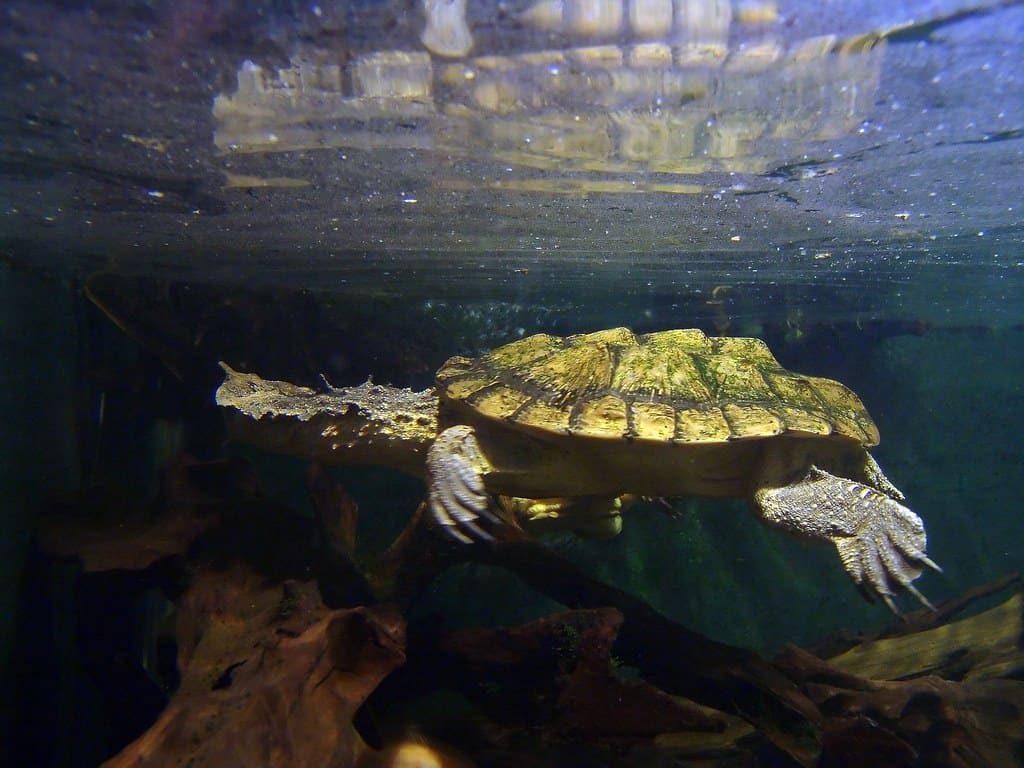
The mata mata turtle might be the most visually bizarre turtle species on our planet. Native to South America’s Amazon and Orinoco basins, this freshwater turtle possesses an otherworldly appearance that seems straight from science fiction. Its most distinctive feature is its extremely flattened, triangular head ending in a tubular, snorkel-like snout. The mata mata’s shell and skin are heavily textured with bumps, ridges, and flaps that perfectly mimic decaying vegetation and submerged debris, providing exceptional camouflage in its murky aquatic habitat.
What truly sets the mata mata apart is its unique hunting strategy. Rather than actively pursuing prey, this ambush predator remains motionless on river bottoms, blending seamlessly with surrounding leaf litter. When fish venture near, the mata mata creates a powerful vacuum by suddenly expanding its highly specialized throat. This explosive suction draws prey directly into its mouth—a technique called vacuum feeding—allowing it to capture fish without actually chasing them. The mata mata’s neck, extraordinarily long and flexible even by turtle standards, further aids this specialized feeding approach. While not currently endangered, habitat degradation and collection for the exotic pet trade pose increasing threats to wild populations of these remarkable turtles.
8. Alligator Snapping Turtle (Macrochelys temminckii)

The alligator snapping turtle earns its reputation as the dinosaur of the turtle world with its prehistoric appearance and massive size. Endemic to river systems flowing into the Gulf of Mexico across the southeastern United States, these freshwater behemoths can reach weights exceeding 200 pounds (90 kilograms) and live for over 100 years. Their most distinctive physical feature is a shell adorned with three pronounced ridges that resemble the armored back of an alligator, complemented by a massive head with powerful, hooked beak capable of delivering bone-crushing bites.
What truly distinguishes the alligator snapping turtle is its remarkable “lingual lure”—a specialized pink appendage on its tongue that resembles a wriggling worm. In a fascinating example of evolutionary adaptation, these turtles lie motionless on river bottoms with mouths agape, wiggling this worm-like lure to attract curious fish. When prey investigates this apparent easy meal, the turtle’s jaws snap shut with lightning speed. Despite their fearsome appearance and powerful bite force (estimated at 1,000 pounds per square inch), alligator snappers pose little threat to humans unless directly provoked or mishandled. These living fossils now face population declines from habitat destruction, water pollution, and historical overharvesting for their meat. Conservation efforts, including captive breeding programs and habitat protection, are critical for ensuring these ancient reptiles continue patrolling America’s southern waterways for generations to come.
7. Roti Island Snake-Necked Turtle (Chelodina mccordi)
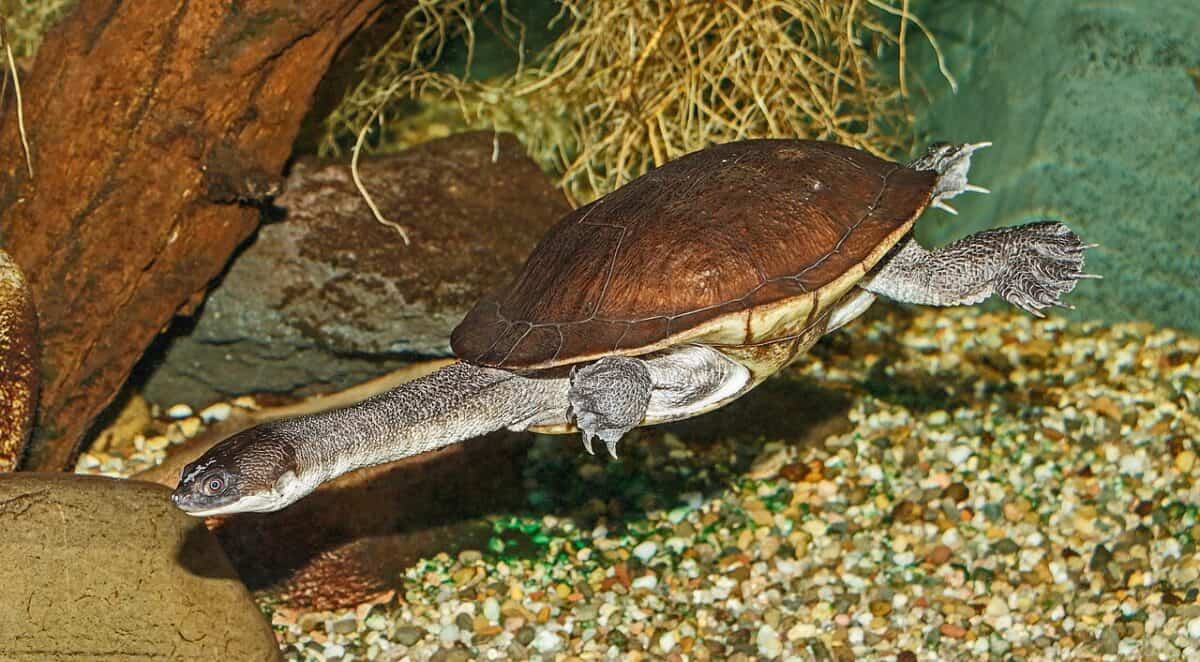
The Roti Island snake-necked turtle showcases one of nature’s most extreme anatomical adaptations among chelonians. Endemic exclusively to Roti Island in Indonesia, this freshwater species possesses a neck that can extend to nearly the same length as its entire shell—a truly remarkable proportion. This extraordinary adaptation allows the turtle to strike rapidly at passing prey, similar to a snake’s strike, while its body remains hidden or stationary. When retracted, this hyper-flexible neck folds sideways beneath the edge of the shell rather than pulling straight back like most turtles, giving these reptiles their distinctive s-shaped resting posture.
Tragically, the Roti Island snake-necked turtle holds the unfortunate distinction of being one of the world’s most endangered turtle species. Discovered by science only in 1994, wild populations collapsed almost immediately after its formal description due to intensive collection for the international pet trade. By 2000—just six years after its scientific discovery—researchers could no longer find any individuals in their natural habitat. Today, these turtles are considered functionally extinct in the wild, with survival of the species dependent entirely on conservation breeding programs. Their plight exemplifies the devastating impact that unregulated wildlife trade can have on localized species, especially those with limited ranges. Conservation efforts now focus on establishing secure captive populations with the long-term goal of potential reintroduction if suitable protected habitat can be secured on their native island.
6. Painted Turtle (Chrysemys picta)

The painted turtle stands as North America’s most widespread native turtle, adorning ponds, lakes, and slow-moving streams from southern Canada to northern Mexico. As their name suggests, these medium-sized freshwater turtles sport some of the most vibrant coloration in the turtle world. Their dark olive to black shells contrast beautifully with stunning red and yellow patterns along the edges of their carapace. Even more striking are the bold red, yellow, and orange stripes decorating their head, neck, legs, and tail, creating a living canvas that makes them instantly recognizable even to casual observers.
Beyond their aesthetic appeal, painted turtles demonstrate remarkable cold-weather adaptations that allow them to survive in northern regions where few other turtles venture. During winter, they can remain submerged beneath ice-covered ponds for up to five months, absorbing sufficient oxygen through specialized areas of their skin and cloaca while their metabolism slows dramatically. Even more impressive, hatchling painted turtles possess natural antifreeze compounds that allow them to survive being frozen solid inside their nest chambers during their first winter—sometimes enduring temperatures as low as 23°F (-5°C) without cellular damage. These adaptations, combined with their omnivorous diet and high reproductive output, have made painted turtles one of North America’s turtle success stories. While many turtle species face population declines, painted turtles remain abundant throughout most of their range, though they still face challenges from habitat loss, road mortality, and climate change impacts on their temperature-dependent sex determination.
5. Radiated Tortoise (Astrochelys radiata)
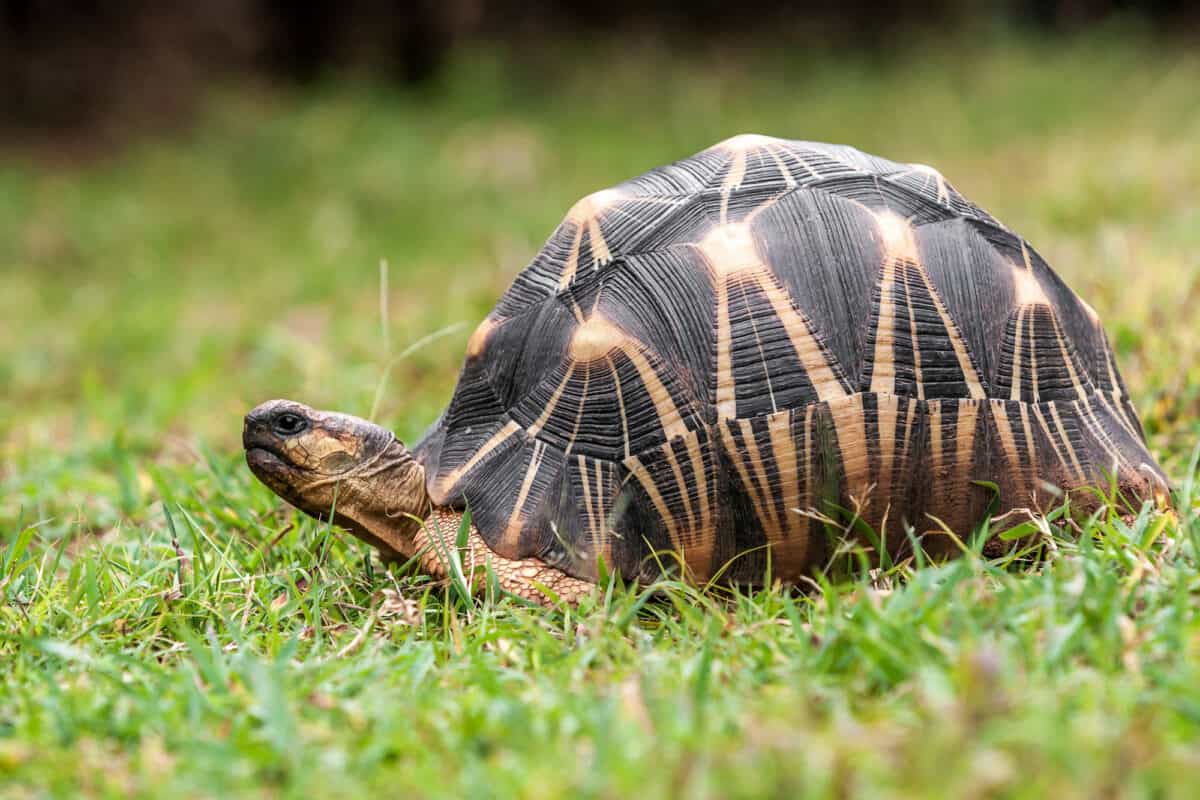
The radiated tortoise of southern Madagascar stands among the world’s most visually striking chelonians. Its high-domed carapace features a spectacular geometric pattern of yellow lines radiating from the center of each black scute (shell plate), creating the star-burst effect that gives this species its name. This exquisite natural patterning serves as more than mere decoration—it provides effective camouflage in the dappled light of their native spiny forests and assists with thermoregulation. With adults typically reaching 16 inches (40 cm) in length and weighing up to 35 pounds (16 kg), radiated tortoises rank among the larger tortoise species.
These magnificent reptiles are central to Madagascar’s ecology as important seed dispersers for native plants, especially the endangered elephant’s foot plant (Didiereaceae). Remarkably long-lived even by tortoise standards, radiated tortoises can survive well beyond 100 years, with some captive individuals estimated to have reached 188 years. Tragically, this species now faces catastrophic population collapse, with numbers plummeting by more than 80% in just the last three decades. Classified as Critically Endangered, they face a perfect storm of threats including habitat destruction from charcoal production, poaching for the bushmeat market, and massive illegal collection for the international pet trade. Despite their protected status, tens of thousands are stolen from the wild annually. Conservation programs combining habitat protection, community education, and captive assurance colonies represent this iconic tortoise’s best hope for avoiding extinction in the wild during this century.
4. Pig-Nosed Turtle (Carettochelys insculpta)
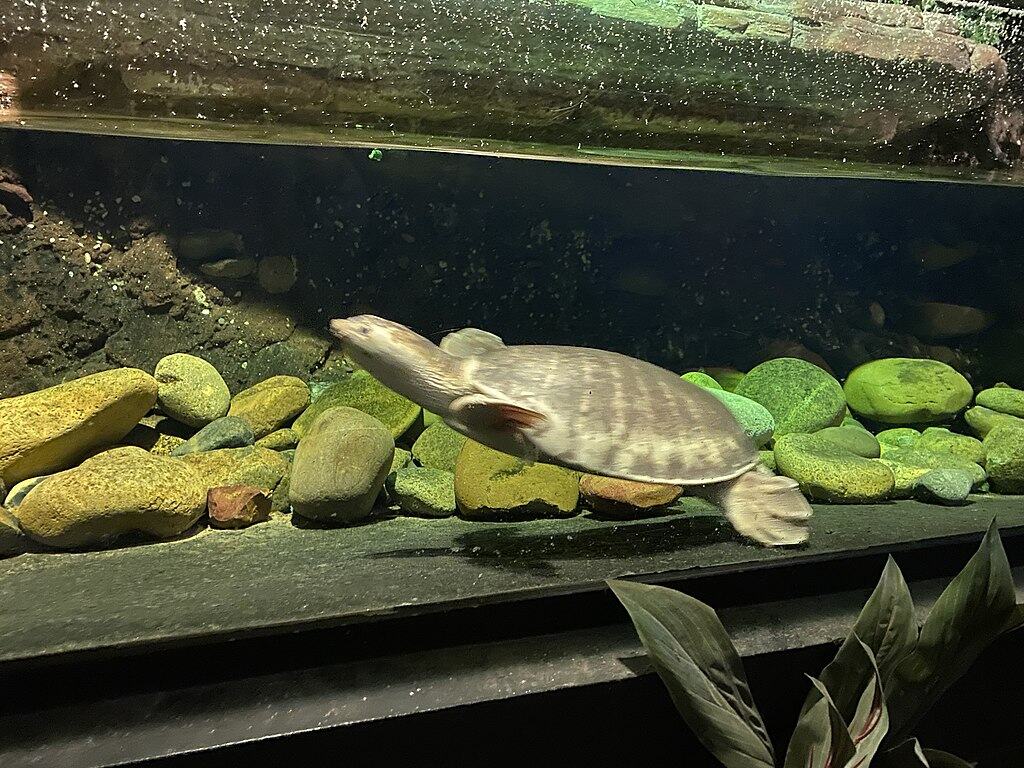
The pig-nosed turtle presents one of nature’s most fascinating evolutionary experiments—a living bridge between sea turtles and freshwater species. Native to northern Australia and southern New Guinea, this unique reptile possesses a distinctive snout resembling a pig’s nose, which functions as a specialized snorkel and sensory organ. Unlike any other freshwater turtle, pig-nosed turtles have true flippers rather than webbed feet, closely resembling those of marine sea turtles. Their smooth, leathery shell lacks the typical scutes (scales) found in most turtles, instead featuring a continuous leathery covering similar to softshell turtles but with a firm bony layer beneath.
These evolutionary oddities are the sole surviving members of the family Carettochelyidae, which dates back over 100 million years, making them a priority for conservation as living fossils. Highly aquatic, pig-nosed turtles inhabit both freshwater rivers and estuarine environments, demonstrating remarkable versatility. Their diet shifts seasonally between plant matter during dry periods and aquatic invertebrates during wet seasons. One of their most unusual adaptations is their reproductive strategy—females lay their eggs not in typical sand nests but beneath the water line during dry seasons, with embryos remaining in suspended development until rising water levels trigger development. Unfortunately, these remarkable creatures face increasing threats from habitat degradation, egg collection for consumption, and capture for the international pet trade, where their unique appearance commands high prices. Conservation efforts focus on protecting nesting habitat and working with indigenous communities who have traditionally harvested eggs to develop sustainable management practices.
3. Spotted Turtle (Clemmys guttata)

The spotted turtle embodies elegance in miniature form. These small freshwater turtles, rarely exceeding 5 inches (12.7 cm) in length, feature a smooth black carapace adorned with distinctive yellow spots that give them their common name. Each individual possesses a unique spotting pattern that remains consistent throughout life, though spots may fade slightly with age. Native to eastern North America from southern Canada to Florida, these diminutive reptiles inhabit shallow, clean wetlands with abundant aquatic vegetation, including bogs, marshes, swamps, and slow-moving streams.
Spotted turtles display fascinating seasonal behaviors, becoming active earlier in spring than most North American turtles, sometimes even swimming beneath thin ice as water temperatures barely rise above freezing. During summer heat, they may estivate (enter a dormant state) buried in mud or beneath leaf litter. Highly social for turtles, they often bask in groups and engage in complex courtship behaviors. Despite their small size and gentle nature, spotted turtles face severe conservation challenges, with populations declining range-wide due to habitat fragmentation, wetland drainage, road mortality, and collection for the pet trade. Their delayed sexual maturity (7-10 years) and low reproductive output make populations extremely vulnerable to even modest increases in adult mortality. These factors have led to their classification as globally endangered, prompting conservation initiatives focused on wetland protection and restoration, as well as programs to monitor and protect remaining populations of these jewel-like turtles.
2. Galapagos Giant Tortoise (Chelonoidis spp.)
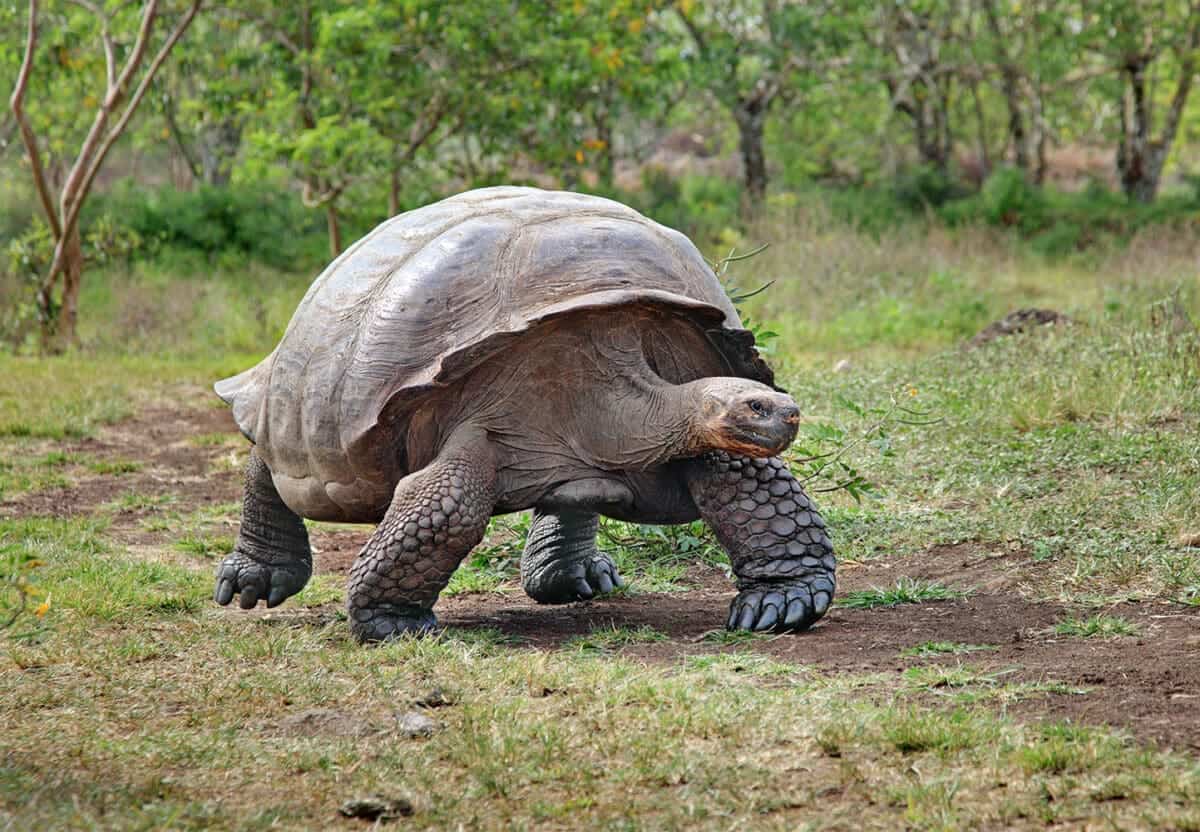
The Galapagos giant tortoise stands as an icon of evolutionary biology and a living testament to Charles Darwin’s observations on natural selection. These enormous reptiles can weigh over 500 pounds (227 kg) and reach lengths of 6 feet (1.8 meters), making them the largest living tortoises on Earth. Originally classified as a single species, modern genetic research has revealed that Galapagos tortoises comprise about 12 distinct species across different islands in the archipelago, each evolved with unique shell adaptations suited to their specific island habitat—from dome-shaped shells in humid highlands to saddleback shells allowing greater neck extension in drier lowlands.
These remarkable reptiles played a pivotal role in Darwin’s development of evolutionary theory and continue to provide insights into adaptation, speciation, and island biogeography. With lifespans exceeding 100 years—and potentially reaching beyond 150 years—Galapagos tortoises are among the longest-lived vertebrates on Earth. Their historic population collapse represents one of conservation’s great tragedies and partial successes. From an estimated 250,000 individuals before human arrival, numbers plummeted below 3,000 by the 1970s due to exploitation by sailors (who stored them alive as fresh meat on long voyages), habitat destruction, and introduced predators. Intensive conservation efforts have since increased their numbers to over 20,000, though several subspecies have been lost forever. The story of Lonesome George, the last Pinta Island tortoise who died in 2012 without producing offspring despite conservation attempts, stands as a poignant reminder of extinction’s permanence. Today, captive breeding programs, invasive species management, and habitat protection offer hope for the remaining Galapagos tortoise species.
1. Red-Eared Slider (Trachemys scripta elegans)

The red-eared slider has achieved a dubious distinction as both one of the world’s most popular pet turtles and one of its most problematic invasive species. Native to the Mississippi River basin of the United States, these medium-sized freshwater turtles are immediately recognizable by the distinctive red stripe behind each eye that gives them their common name. Their natural history is impressive—they’re excellent swimmers, opportunistic omnivores, and highly adaptable to various aquatic environments from slow rivers to ponds and lakes.
The red-eared slider’s journey from regional native species to global presence began in the 1950s with the pet trade. Their attractive appearance, relatively easy care requirements, and low initial purchase price made them extremely popular, with millions exported annually from turtle farms in the southern United States. However, their rapid growth—from cute quarter-sized hatchlings to dinner-plate-sized adults requiring substantial aquariums—led many unprepared owners to release them into local waterways. This practice has established feral populations on every continent except Antarctica, where these highly competitive turtles often outcompete native species for basking sites, nesting areas, and food resources. In places like Spain, France, South Africa, Australia, and throughout Asia, red-eared sliders are now considered among the world’s 100 worst invasive species. Conservation efforts focus on regulations restricting their sale, public education about responsible pet ownership, and in some regions, active removal programs to protect native turtle populations from this unintentionally destructive ecological export.

- How to Attract Pollinators Without Using Sugar Water - July 19, 2026
- Coastal Creatures That Appear at Low Tide in Oregon - July 19, 2026
- How Arctic Wolves Survive in the Harshest U.S. Winters - July 19, 2026