
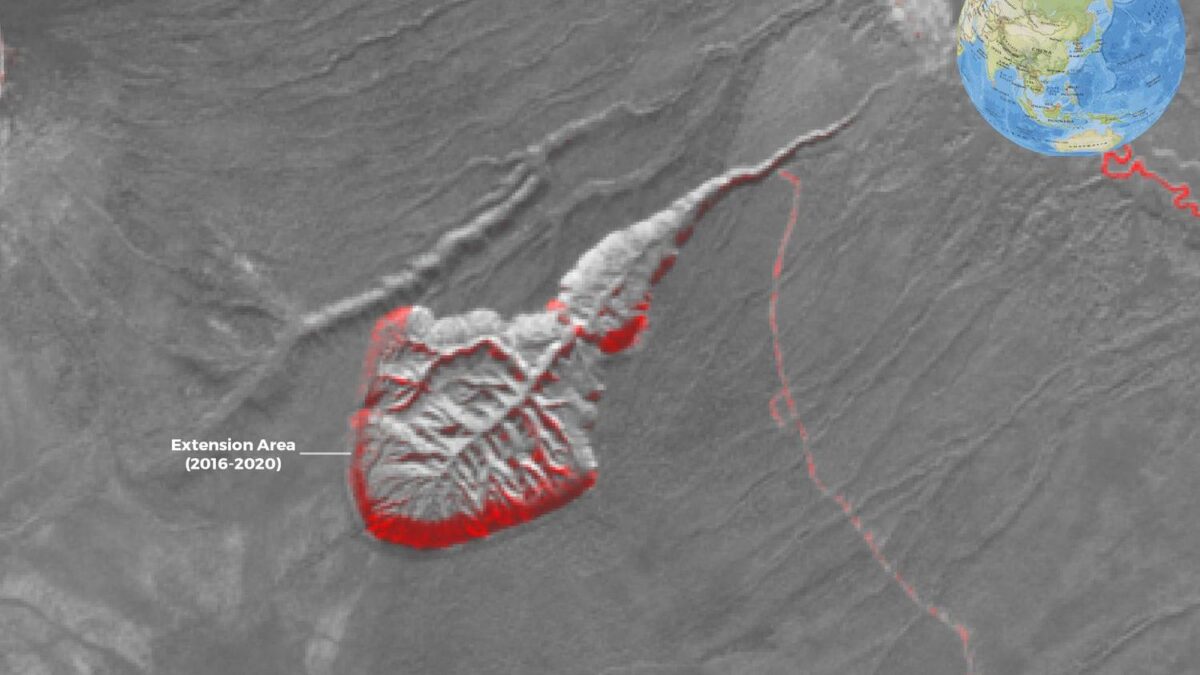
Deep in the Siberian tundra, far from most human settlements, a wound in the earth is getting wider every single year. In a remote area of the Siberian tundra, dotted with low trees and shrubs, there is a place that locals call “The Gateway to Hell.” The sounds that rise from its depths are difficult to forget. Indigenous Yakut people named the slump the “Gateway to Hell” because of the eerie noises of dripping water and blocks booming as they tumble down the migrating headwall.
This is not a myth, a legend, or an exaggerated metaphor. It is a very real geological formation known as the Batagaika crater, and its growth carries implications that stretch far beyond northeastern Siberia. Scientists, climate researchers, and satellite operators are watching it closely, with good reason.
What Exactly Is the Batagaika Crater?
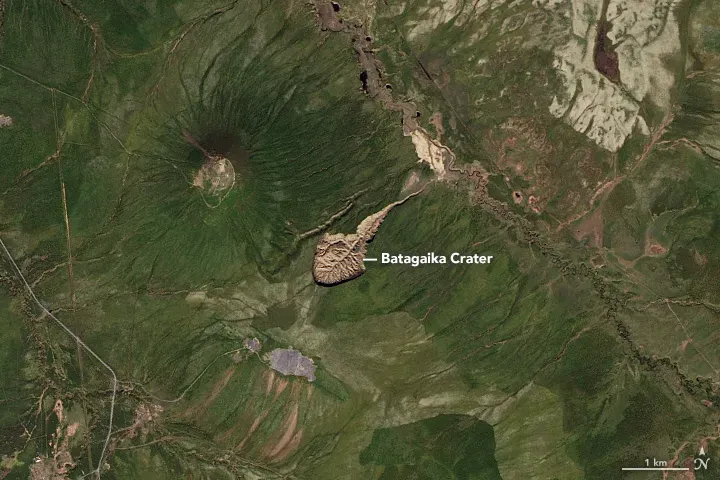
Despite its dramatic nickname, the Batagaika is not technically a crater at all. The Batagay crater is not a crater at all. Rather, it’s a retrogressive thaw slump, a widening chasm caused by permafrost thaw and rapid land subsidence, basically a slow motion landslide.
It’s the largest retrogressive thaw slump in the world, and its ever-expanding size, currently sitting at more than 87 hectares (about 215 acres), qualifies it for the categorization of “megaslump.” To put that in perspective, that is larger than many small towns.
The depression is in the form of a one-kilometre-long gash up to 100 metres deep, and growing, in the East Siberian taiga, located about 660 km north-northeast of the capital Yakutsk. From space, it appears as a raw, brown tear against a green landscape.
How It All Started: Deforestation and Disrupted Ground
The gateway sits in a landscape of larch and birch woodlands that became the target of deforestation from the 1940s onward. Deforestation caused the topsoil to rapidly erode and expose the underlying permafrost, which, due to its icy composition, melted more quickly than if it had been richer in sediments.
The megaslump, now shaped like a giant tadpole, was likely initially triggered by forest clearing and the passage of off-road, tracked vehicles moving across the delicate tundra during mineral and mining exploration. Once the vegetation was gone, the frozen ground beneath it had no protection from the sun and warming air.
Its growth, significantly accelerated since the 1960s due to deforestation and climate change, exposes ancient organic materials and releases greenhouse gases, contributing to a feedback loop that accelerates global warming. What started as a small gully became something far more consequential.
The Staggering Rate of Growth
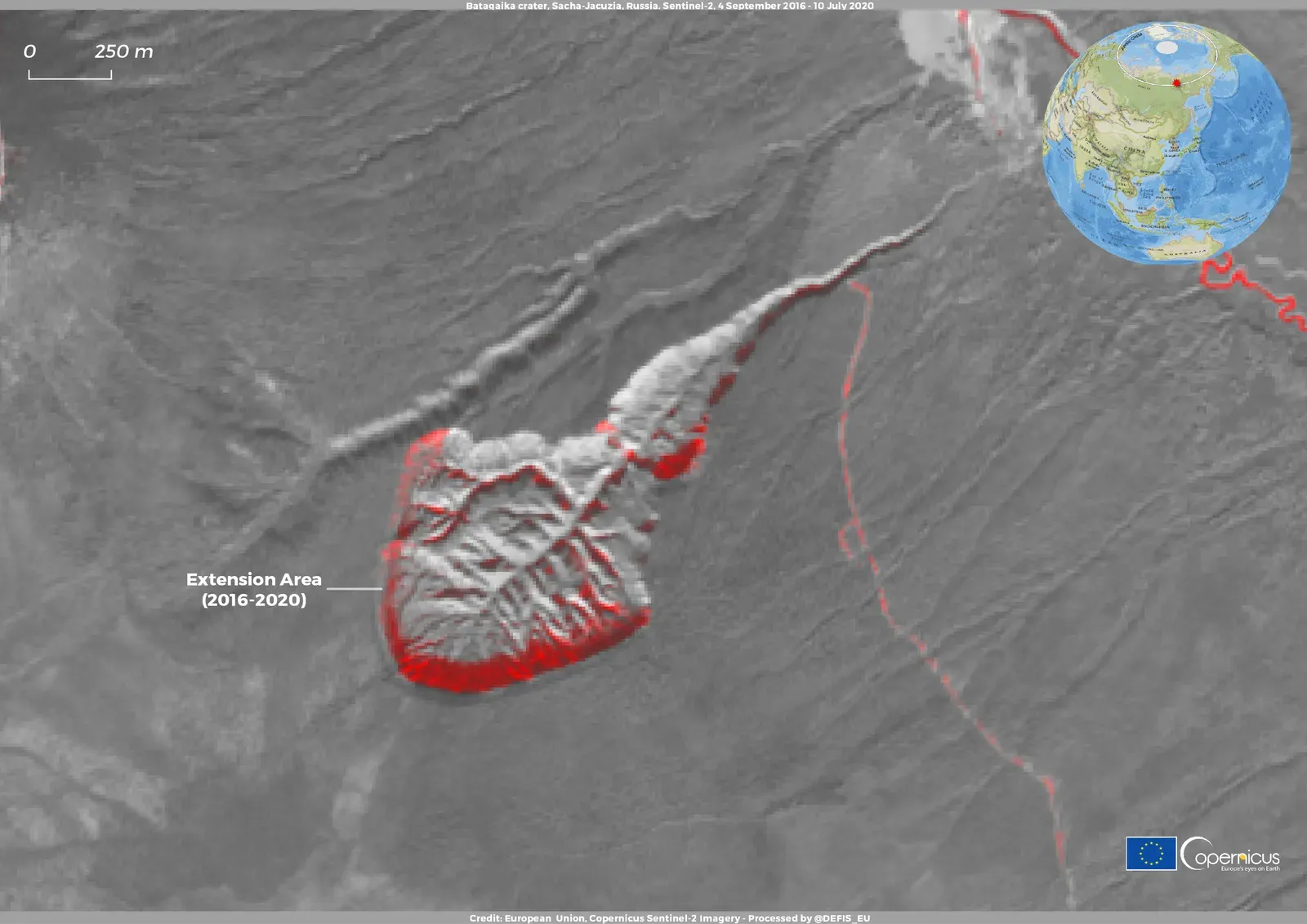
A study published in the journal Geomorphology revealed that the crater expands by an astounding 35 million cubic feet (1 million cubic meters) every year. That figure is difficult to fully absorb until you consider the comparisons researchers have drawn.
The results indicated that a region of ice and sediment equivalent to more than 14 Great Pyramids of Giza has melted off the megaslump since it collapsed. The headwall is not just retreating, it is retreating fast.
The amount of ice and sediment lost from the Batagay megaslump is “exceptionally high” due to the sheer size of the depression, which stretched 3,250 feet wide as of 2023. The megaslump measured 2,600 feet wide in 2014, meaning it grew 660 feet wider in less than 10 years.
The Dangerous Feedback Loop Behind the Expansion
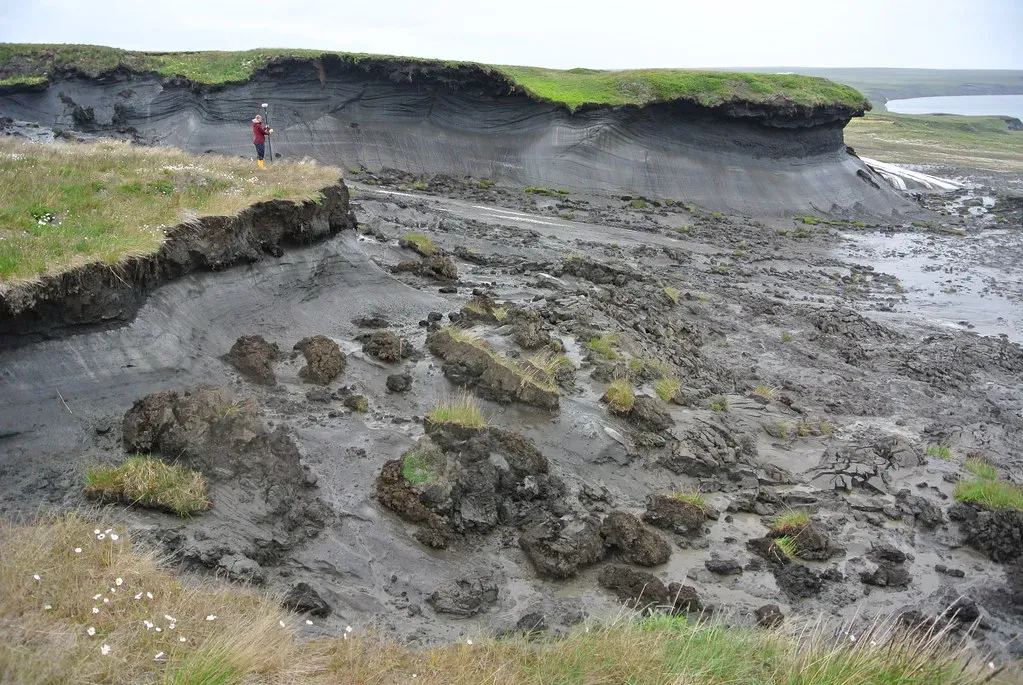
When permafrost thaws, bacteria break down the organic matter trapped inside. As it releases carbon matter into the atmosphere as greenhouse gases, these gases warm the planet, creating a positive feedback loop that then thaws more permafrost. It is a self-reinforcing cycle with no simple off switch.
Microbes feed on newly exposed ancient plant remains, producing greenhouse gases like carbon dioxide, methane, and nitrous oxide that airborne measurements show to be enriched in the air above the crater. Carbon dioxide is being expelled from the crater at up to twice the normal rate for the region.
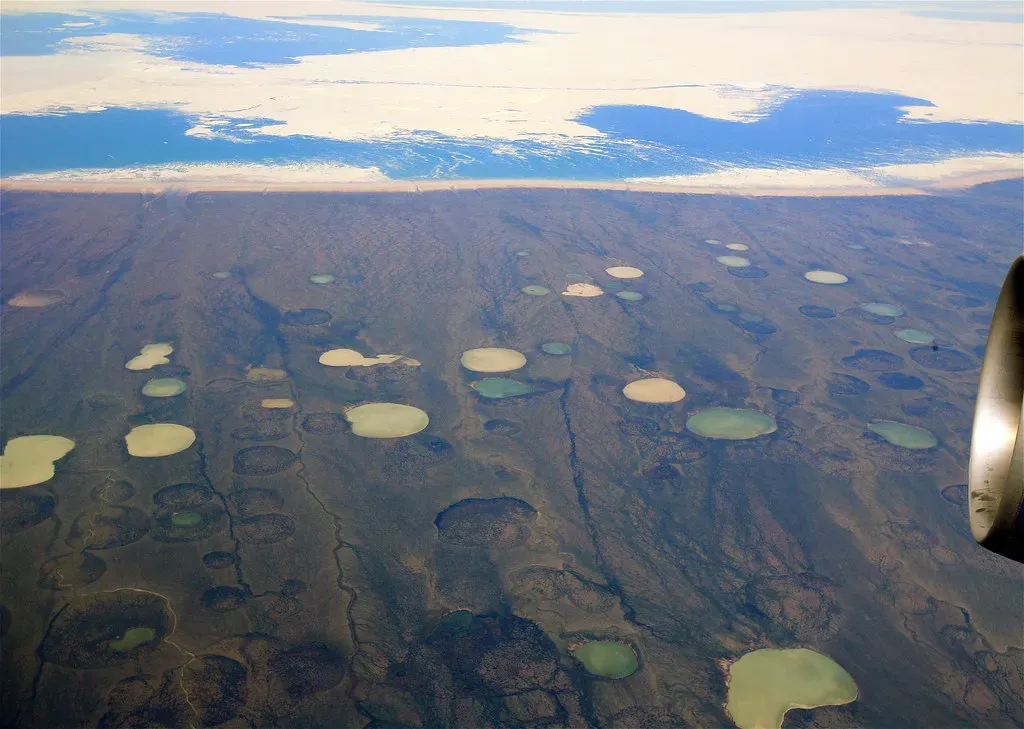
According to research from the National Snow and Ice Data Center and other climate institutes, permafrost contains more carbon than is currently present in the atmosphere. As sites like Batagay expand, they contribute to a feedback loop: warming causes thawing, which releases greenhouse gases, which in turn drives further warming. The crater is, in a very real sense, feeding itself.
A Frozen Archive of Earth’s Deep Past
Each exposed layer of the crater wall is like a snapshot in time, helping scientists understand the past climate. Layers of permafrost exposed at the bottom might be up to 650,000 years old. That is an extraordinary window into conditions that existed long before modern human civilization.
Batagaika has disgorged a handful of animals since it began growing, likely in the early 1980s. Equus lenensis, a Pleistocene horse, and Bison priscus, a prehistoric steppe bison, have emerged from the thawing soil, as have assorted remains of cave lions and wolves.
In 2018, scientists found the remains of an extinct baby horse, with well-preserved skin, hair, tail, and hooves that died 42,000 years ago. That specimen yielded the oldest sample of liquid blood ever found. Each collapse of the crater wall is, paradoxically, a gift to paleontology.
What Comes Next: Limits, Warnings, and Wider Implications
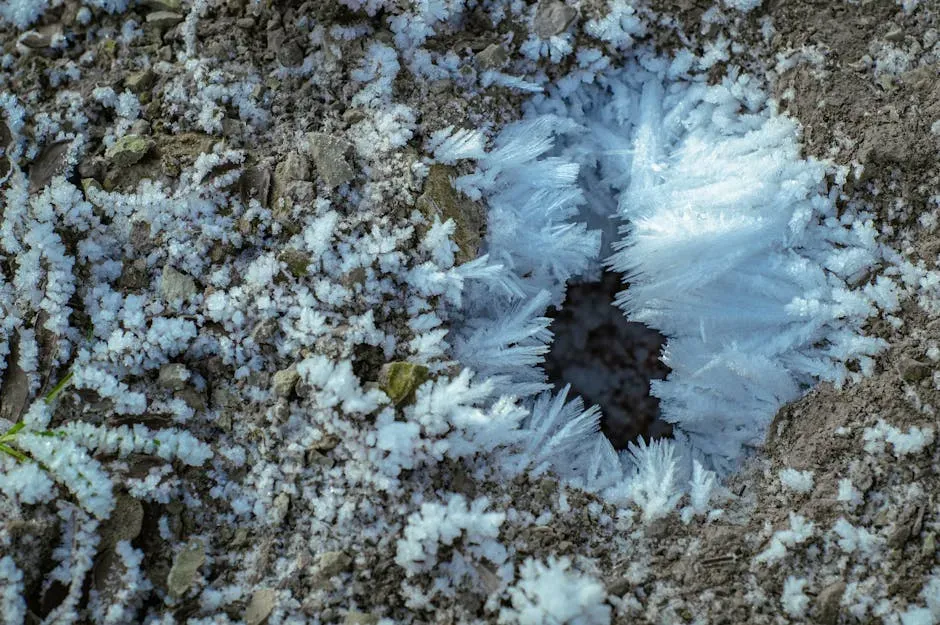
The Batagay megaslump is “still actively growing,” researchers wrote in a recent study, but there is a limit to how far it can expand. The permafrost remaining inside the crater is only a few feet thick, so “the possibility of further deepening has practically already been exhausted due to the underlying bedrock geology.” Its outward spread, however, continues.
Batagay is not an isolated case. Similar, smaller thaw slumps are appearing across the Arctic, from Alaska to Canada. The scale and speed of this formation make it one of the clearest visual indicators of how quickly the landscape is changing.
Nikita Tananayev, lead researcher at the Melnikov Permafrost Institute in Yakutsk, warned that the expansion of the Batagaika crater is a sign of danger; with increasing temperatures and anthropogenic pressure, more and more similar mega-slumps are likely to be formed in the future. The Batagaika is not an anomaly. It may be a preview.
Conclusion
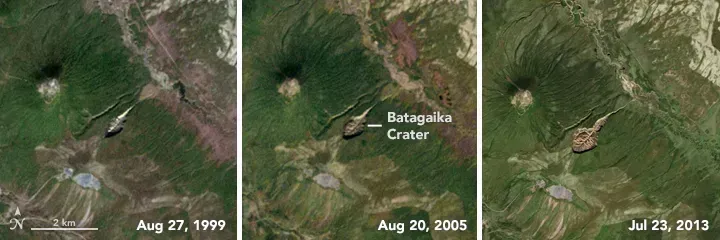
The Batagaika crater is one of those rare natural phenomena that sits at the exact intersection of science, history, and consequence. It is simultaneously a record of our planet’s deep past and a measuring stick for what warming is doing to the present.
What began with logging and tracked vehicles in a remote Siberian forest has become the world’s largest permafrost megaslump, a formation that releases ancient carbon, reshapes the land, and grows by a volume equivalent to millions of cubic meters annually. The science is clear and the satellite images do not lie.
There is something sobering about a place that locals have named with such grim accuracy. The ground beneath the Gateway to Hell was frozen for hundreds of thousands of years. The speed at which it is now opening up says more about the pace of current change than almost any graph or report could.
