

North America is a continent rich with diverse ecosystems, from the Arctic tundra to tropical rainforests, expansive prairies to coastal marshlands. This ecological variety supports an astounding array of wildlife that engage in spectacular natural events throughout the year. For nature enthusiasts and casual observers alike, witnessing these wildlife phenomena can be transformative experiences that deepen our connection to the natural world. From massive migrations spanning thousands of miles to brief but brilliant mating displays, these events showcase the remarkable adaptations and behaviors that have evolved over millennia. This article explores 20 awe-inspiring wildlife events that you can witness across North America, offering insights into when and where to experience these natural wonders.
14. The Great Monarch Butterfly Migration

Every autumn, millions of monarch butterflies embark on one of nature’s most remarkable journeys. These delicate orange and black insects travel up to 3,000 miles from the United States and Canada to overwintering sites in central Mexico. The monarchs that begin this journey are actually several generations removed from those that made the trip the previous year, making their navigational abilities even more astonishing. The best viewing opportunities occur in September and October along migration routes in the Midwest and along the California coast. In Mexico, sanctuaries like El Rosario and Sierra Chincua in Michoacán offer breathtaking views of thousands of butterflies clustered on oyamel fir trees from November through March. Climate change and habitat loss have threatened this migration, making it all the more precious to witness.
13. Caribou Migration Across the Arctic
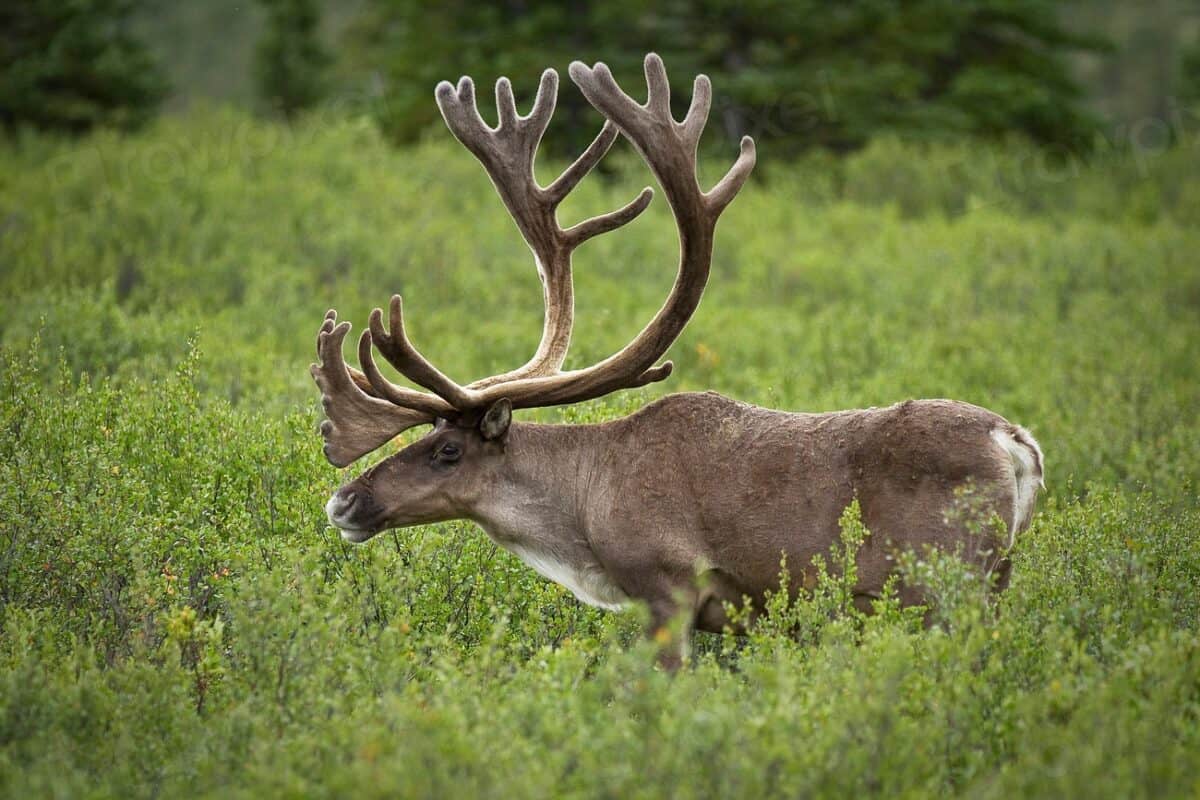
The barren-ground caribou of Alaska and northern Canada undertake one of the longest terrestrial migrations on Earth. Herds numbering in the hundreds of thousands travel up to 800 miles annually between winter grounds in the boreal forests and summer calving grounds on the Arctic coastal plains. The Porcupine Caribou Herd, which moves between Alaska and Canada’s Yukon Territory, offers particularly spectacular viewing opportunities. In late May and June, visitors to the Arctic National Wildlife Refuge can witness thousands of caribou streaming across the tundra, with newborn calves in tow. The migration creates a ripple effect throughout the ecosystem, providing essential food for predators like wolves and grizzly bears. Indigenous communities have relied on this migration for thousands of years, making it not just a wildlife spectacle but a cultural cornerstone of the North.
12. Gray Whale Migration Along the Pacific Coast

The eastern North Pacific gray whale population undertakes a 10,000-mile round-trip journey each year between feeding grounds in the Bering Sea and breeding lagoons in Baja California, Mexico. This coastal migration makes it one of the most accessible marine mammal migrations to witness. From December through April, observers along the west coast from California to Alaska can spot these 45-foot leviathans as they travel south to give birth and then north with their calves. Prime viewing locations include Point Reyes National Seashore in California, Depoe Bay in Oregon, and Lime Kiln Point State Park in Washington. For an intimate encounter, Baja’s San Ignacio Lagoon offers the remarkable opportunity to approach mother whales with their calves by small boat during February and March. After nearly being hunted to extinction in the early 20th century, this population has rebounded to around 20,000 individuals, making this migration a conservation success story.
11. Sandhill Crane Gathering on the Platte River
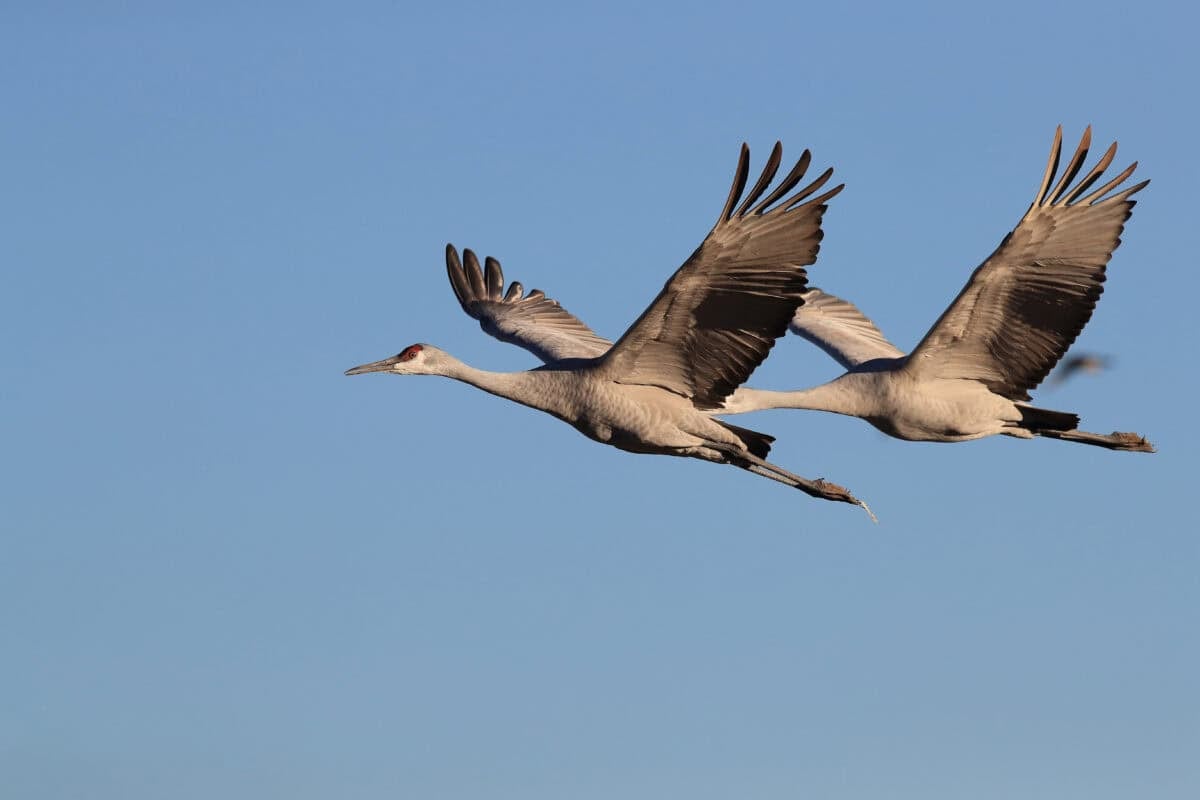
Each spring, approximately 600,000 sandhill cranes—80% of the world’s population—converge on Nebraska’s Platte River during their northward migration. This gathering, occurring from late February through early April, represents one of the greatest concentrations of wildlife in North America. The shallow, braided channels of the Platte provide safe roosting sites, while surrounding cornfields offer abundant food to fuel their journey. Dawn and dusk present the most dramatic scenes as thousands of these elegant gray birds with crimson caps lift off from or settle onto the river, filling the air with their rolling, trumpeting calls. The Rowe Sanctuary and Crane Trust Nature & Visitor Center offer guided viewing experiences from blinds positioned along the river. Beyond the visual spectacle, the cranes’ ancient calls and courtship dances—some of which include leaping and wing-flapping—connect observers to a ritual that has continued for millions of years.
10. Sea Turtle Nesting on Gulf and Atlantic Beaches

From May through October, female sea turtles—primarily loggerheads, greens, and the critically endangered Kemp’s ridleys—haul themselves onto beaches from Texas to North Carolina to lay their eggs. These ancient mariners, who spend almost their entire lives at sea, return to the beaches where they were born to dig nests and deposit clutches of 80-120 eggs. Approximately 45-60 days later, tiny hatchlings emerge and make their perilous dash to the ocean, guided by the reflection of moonlight on water. Organized turtle walks during nesting season provide opportunities to witness these events while minimizing disturbance. Prime viewing locations include Padre Island National Seashore in Texas for Kemp’s ridleys (the only daytime-nesting sea turtle), Florida’s Archie Carr National Wildlife Refuge for loggerheads, and Hobe Sound National Wildlife Refuge for green turtles. Conservation efforts have helped some populations recover, though all North American sea turtles remain protected under the Endangered Species Act.
9. The Salmon Run of the Pacific Northwest

Each fall, millions of Pacific salmon—including Chinook, coho, sockeye, pink, and chum—return from the ocean to the streams and rivers of their birth to spawn and die, completing one of nature’s most poignant life cycles. This phenomenon creates a biological pulse that nourishes entire ecosystems, from bears and eagles that feast on the fish to the forests enriched by nutrients the salmon transport from the sea. Spectacular viewing locations include Alaska’s Brooks Falls in Katmai National Park, where brown bears gather to catch leaping salmon; the Adams River in British Columbia, which hosts a dominant sockeye run every four years; and Seattle’s Ballard Locks, where fish ladders allow urban observers to witness salmon migrating through the city. The salmon’s remarkable journey involves physiological transformations as they adapt from saltwater to freshwater and develop the hooked jaws and bright spawning colors that signal the final chapter of their lives. Despite their tenacity, many salmon populations have declined due to habitat degradation, dam construction, and overfishing, making conservation efforts crucial for this iconic North American wildlife event.
8. Prairie Chicken Mating Displays on the Great Plains

In the pre-dawn darkness of spring mornings across the remaining tallgrass prairies of North America, male greater prairie chickens gather on traditional display grounds called leks to perform one of the most distinctive courtship rituals in the bird world. With orange air sacs inflated on the sides of their necks, tail feathers erect, and wings drooped, the males stamp their feet rapidly, creating a resonant booming sound that can carry for miles across the open landscape. These displays, occurring from March through early May, represent a survival strategy evolved over thousands of years on the once-vast American prairie. Today, the Flint Hills of Kansas and Oklahoma, the Nebraska Sandhills, and parts of South Dakota offer some of the best opportunities to witness this spectacle. Wildlife agencies and conservation organizations operate blinds at several locations, allowing visitors to observe these impressive displays without disturbing the birds. The related but more endangered lesser prairie chicken and the sharp-tailed grouse perform similar displays across their respective ranges, though viewing opportunities are more limited due to population declines from habitat loss.
7. Fall Raptor Migration at Hawk Mountain

Each autumn, tens of thousands of hawks, eagles, falcons, and vultures funnel along the Appalachian Mountains as they journey from their northern breeding grounds to wintering territories in the southern United States, the Caribbean, and Latin America. Hawk Mountain Sanctuary in Pennsylvania, established in 1934 as the world’s first refuge for birds of prey, offers one of the premier locations to witness this spectacle. From mid-August through December, with peak migration in September and October, observers can watch as broad-winged hawks stream by in kettles (groups) of hundreds or even thousands, while golden eagles, peregrine falcons, and other species pass in smaller numbers. The rocky North Lookout provides panoramic views of raptors riding thermal updrafts created by the ridgeline. Other significant raptor migration viewing sites include Cape May Point, New Jersey; Point Reyes, California; and Veracruz, Mexico, where millions of raptors create river-like formations in the sky. This migration represents not just a biological imperative but a conservation success story, as many raptor populations have recovered from the devastating effects of DDT and other environmental challenges of the 20th century.
6. Alligator Bellowing and Courtship in Southern Swamps

In spring, the swamps and marshes of the southeastern United States resonate with the primordial bellows of male American alligators seeking mates. These deep, vibratory roars, often accompanied by displays where the alligator’s body vibrates so intensely that water “dances” on its back, create an unforgettable chorus that echoes through cypress forests and across sawgrass prairies. Peak bellowing and courtship activity occurs from April through May, when warming temperatures trigger breeding behaviors. Florida’s Everglades National Park and Paynes Prairie Preserve State Park, Louisiana’s Atchafalaya Basin, and South Carolina’s ACE Basin offer excellent opportunities to witness these ancient reptiles engaging in behaviors that have remained largely unchanged for millions of years. During courtship, males patrol territories, engage in ritual combat with other males, and perform elaborate swimming displays to attract females. After mating, females build mound nests of vegetation where they lay 20-50 eggs, which they will guard fiercely until hatching. This annual cycle represents the successful recovery of the American alligator from near-extinction in the mid-20th century to a conservation success story with stable populations throughout its range.
5. Grunion Runs on Southern California Beaches
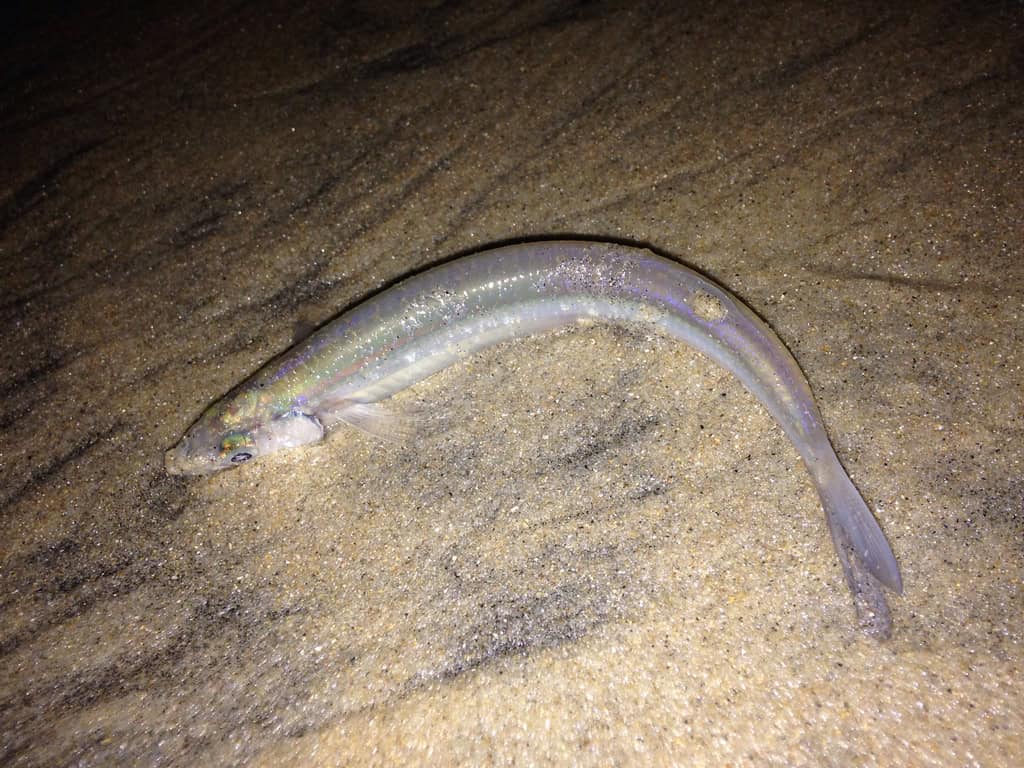
Few wildlife spectacles match the otherworldly sight of thousands of silvery fish writhing on Southern California beaches during spring and summer nights. The California grunion, a small sardine-sized fish found only along the California and Baja coasts, performs a unique spawning ritual that depends on the lunar cycle and tidal patterns. On nights following the full and new moons, from March through September, female grunion ride high waves onto beaches, dig their tails into the sand, and deposit eggs, which males then fertilize. The entire process takes just 30 seconds before the fish flop back toward the ocean. The fertilized eggs develop in the warm, moist sand until the next spring tide two weeks later, when waves unearth and hatch them. Prime viewing locations include Coronado Beach, La Jolla Shores, and Cabrillo Beach, with peak runs typically occurring in April and May. This remarkable adaptation to terrestrial spawning helps protect eggs from ocean predators but creates vulnerability to human disturbance. Conservation measures include closed seasons and catch restrictions, allowing this distinctive natural phenomenon to continue entertaining and amazing beachgoers.
4. Firefly Synchronous Flashing in the Smoky Mountains

For approximately two weeks each year, usually in late May to mid-June, the forests of Great Smoky Mountains National Park in Tennessee host one of North America’s most magical natural light shows. Thousands of Photinus carolinus fireflies—one of the few synchronous firefly species in the world—flash in unison, creating waves of light that pulse through the dark forest. Male fireflies hover a few feet above the ground, emitting a pattern of 4-8 flashes over about 8 seconds, followed by a pause of about 8 seconds, with entire sections of the forest synchronizing their displays. This phenomenon represents a complex mating ritual, with males synchronizing to help females identify potential mates of their own species. The event has become so popular that the national park instituted a lottery system for viewing passes at the primary Elkmont viewing area. Similar but smaller synchronous firefly displays occur in Congaree National Park in South Carolina and Pennsylvania’s Allegheny National Forest. The brief window of this phenomenon—typically lasting just 2-3 weeks while adults are in their reproductive phase—makes it all the more precious to witness.
3. Bald Eagle Congregation on the Skagit River

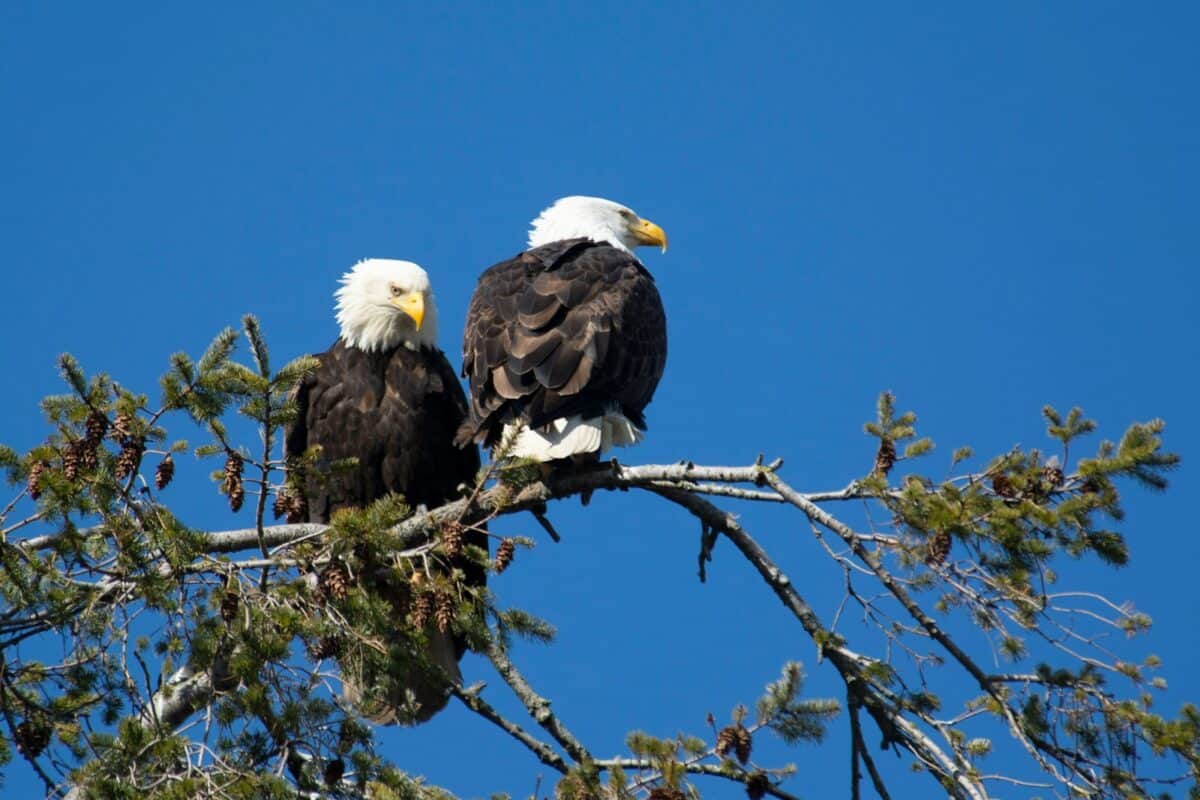
From December through February, hundreds of bald eagles gather along Washington’s Skagit River to feast on salmon carcasses following spawning season. This concentration of America’s national bird creates one of the largest gatherings of bald eagles in the continental United States, second only to Alaska’s gatherings. The best viewing occurs along the upper Skagit between the towns of Rockport and Marblemount, where eagles perch in riverside cottonwoods and swoop down to feed on salmon in the shallow river. The Skagit Eagle Watchers program provides spotting scopes and information at several viewing areas along State Route 20 during peak season. This seasonal congregation not only offers spectacular wildlife viewing but also symbolizes one of North America’s greatest conservation success stories. Bald eagles have recovered from fewer than 500 breeding pairs in the 1960s—decimated by DDT contamination and habitat loss—to more than 71,000 birds today. Similar winter eagle gatherings can be witnessed at British Columbia’s Brackendale Eagles Provincial Park and along the Mississippi River near the locks and dams between Minnesota and Illinois.
2. Bat Emergence from Carlsbad Caverns
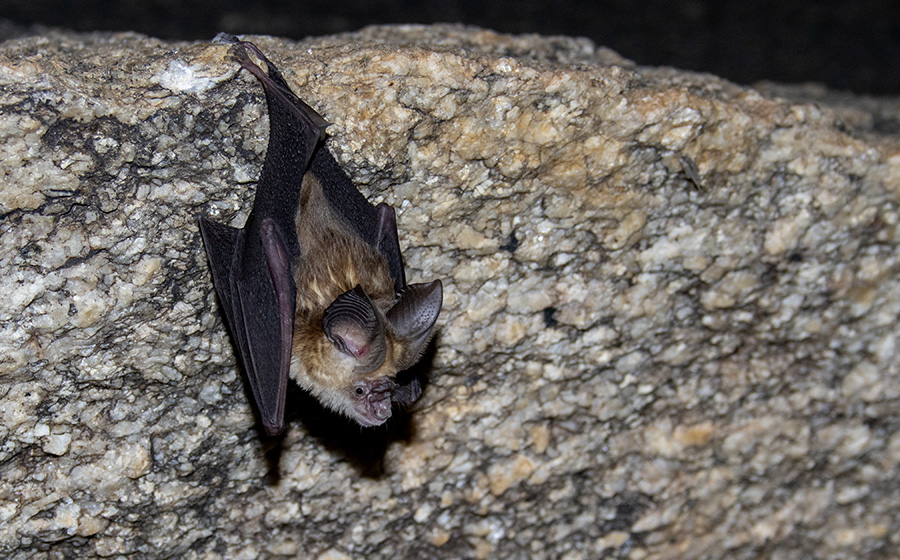
As dusk falls over the Chihuahuan Desert in southeastern New Mexico, one of North America’s most dramatic daily wildlife spectacles begins. From late May through October, hundreds of thousands of Brazilian free-tailed bats spiral out of the natural entrance to Carlsbad Caverns, creating a living vortex that streams across the darkening sky. This colony, consisting primarily of females and their pups, departs each evening to hunt insects, consuming several tons of moths and other agricultural pests nightly across a range that can extend 50 miles from the cave. The most impressive emergences occur in late summer when young bats join the adults in flight. Visitors gather at the cave’s amphitheater to witness this soundless exodus, as the bats’ echolocation calls exceed the range of human hearing. Similar but smaller bat emergences can be viewed at Bracken Cave near San Antonio, Texas (home to the world’s largest bat colony), Congress Avenue Bridge in Austin, Texas, and the Orient Mine in Colorado’s San Luis Valley. These emergences highlight the ecological importance of bats as insect controllers and pollinators while offering a mesmerizing glimpse into the hidden lives of these misunderstood mammals.
1. Pronghorn Migration in Wyoming’s Greater Yellowstone Ecosystem

Each spring and fall, pronghorn—North America’s fastest land mammals—travel up to 150 miles between summer ranges in Grand Teton National Park and winter grounds in Wyoming’s Green River Basin. This journey, which researchers have identified as the longest terrestrial migration in the continental United States, follows ancient pathways used for at least 6,000 years. Unlike many migrating species that travel in large herds, pronghorn typically move in small groups of 5-20 animals, navigating a narrowing corridor of habitat threatened by development, fencing, and energy extraction. Peak movement periods occur in April-May and October-November, with good viewing opportunities along U.S. Highway 191 between Pinedale and Jackson, Wyoming. In recent years, conservation efforts have led to the creation of wildlife overpasses and fence modifications that help maintain this migration corridor. Pronghorn, often mistakenly called “antelope” though they belong to a unique North American family, evolved their exceptional speed (up to 55 mph) to escape now-extinct American cheetahs. Today’s migration represents an evolutionary echo of adaptations developed during the Pleistocene epoch, making it a living connection to North America’s prehistoric past.
Conclusion:

North America’s extraordinary wildlife spectacles are more than just fleeting moments of beauty—they are dynamic expressions of evolution, survival, and interdependence within complex ecosystems. From the synchronized flashes of fireflies in Appalachian forests to the thundering herds of caribou on the Arctic tundra, each event represents the culmination of countless generations of adaptation. These natural phenomena not only awe and inspire, but also remind us of the fragility of the habitats and species that depend on them. As human activities increasingly reshape the environment, many of these wildlife events face mounting threats—from habitat loss and climate change to pollution and development. Yet, through dedicated conservation efforts and public engagement, many species have rebounded, offering hope that these wonders can endure. By witnessing and supporting these phenomena, we not only enrich our own lives but also contribute to the preservation of North America’s wild legacy for generations to come. Whether you’re an experienced naturalist or a curious traveler, the continent’s untamed rhythms invite you to look, listen, and be amazed. These 20 wildlife events are not just spectacles to behold—they are calls to value and protect the living world around us.

As a little kid, I fell in love with nature, wildlife, and animals. Living in the USA, South Africa, Italy, China and Germany gave me the opportunity to discover the world's Wildlife. My favorite animals are Mountain Gorillas, Siberian Tigers, and Great White Sharks.
I'm a certified PADI Open Water Diver, went to Everest Base Camp and Trekked Gorillas in Uganda. I hold a Master of Science in Economics and Finance.
Please send any feedback to feedback@animalsaroundtheglobe.com
- Oceanography Says a Layer of Water Exists in the Pacific That Has Not Mixed With the Surface in Over a Thousand Years and What Lives There Defies Current Classification - June 26, 2026
- 12 Wild Animals That Build Homes Better Than Humans - June 26, 2026
- 13 Flight Patterns That Defy Gravity - June 26, 2026