


In the vast arena of the animal kingdom, the title for the fastest punch doesn’t belong to a heavyweight boxer or a martial arts expert, but to a diminutive sea creature with extraordinary abilities. The mantis shrimp, despite its modest size of just a few inches, possesses what scientists have confirmed as the fastest strike in nature. These colorful crustaceans, dwelling in tropical and subtropical waters around the world, have developed a striking mechanism that accelerates with such force that it rivals the speed of a bullet from a 22-caliber rifle.
What makes this achievement even more remarkable is that this lightning-fast punch occurs underwater, where resistance is significantly higher than in air. The mantis shrimp overcomes this drag with specialized anatomical adaptations that have evolved over millions of years, fascinating marine biologists and biomechanics researchers alike. This unassuming creature has become a subject of intense scientific study, not just for its offensive capabilities, but for the potential applications its unique mechanics could have in fields ranging from materials science to robotics.
The Astonishing Speed of the Mantis Shrimp’s Strike
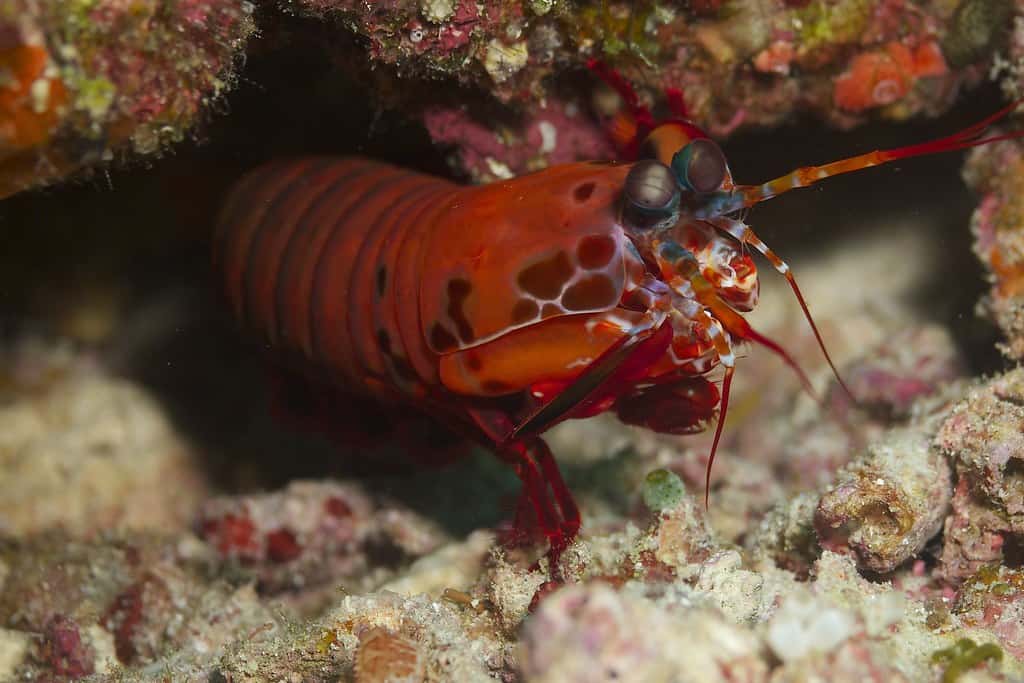
When it comes to raw numbers, the mantis shrimp’s strike is nothing short of phenomenal. Their specialized appendages, known as raptorial appendages, can accelerate at speeds of 23 meters per second, with the entire strike completed in just 800 microseconds. To put this in perspective, that’s about 50 times faster than the blink of a human eye. The acceleration produced during this strike is one of the fastest in the animal kingdom, reaching up to 10,400 g (where g is the acceleration due to gravity). By comparison, a fighter pilot might experience 9 g during extreme maneuvers, and even then only for brief moments before losing consciousness.
This incredible speed generates forces exceeding 1,500 Newtons, despite the creature’s small size. That’s enough force to break aquarium glass, which is why mantis shrimp are rarely kept in conventional tanks. Their nickname “thumb splitter” comes from their ability to inflict serious wounds on unwary humans who handle them incorrectly. The speed is so extreme that the strike creates cavitation bubbles in the water—essentially low-pressure spaces where water vaporizes—which collapse with tremendous force, creating a secondary impact that can stun or kill prey even if the initial strike misses.
The Specialized Anatomy Behind the Power

The secret to the mantis shrimp’s extraordinary striking power lies in its specialized anatomy. Unlike human arms that rely on direct muscle power, the mantis shrimp employs a mechanical system that works like a compressed spring or a cocked crossbow. Their raptorial appendages feature a saddle-shaped structure that, when compressed by muscle action, stores elastic energy in the exoskeleton. This energy-storing mechanism is similar to a bow being drawn back, with specialized latches holding the appendages in place until the shrimp is ready to strike.
When the latch is released, the stored energy converts to kinetic energy almost instantaneously, allowing the appendage to accelerate at rates that direct muscle movement could never achieve. This power amplification system is so efficient that it can generate forces far exceeding what would be possible through muscle power alone. Scientists studying this mechanism have found that the mantis shrimp’s exoskeleton in the striking appendage contains unique arrangements of chitin fibers and minerals that prevent it from shattering under the extreme forces it generates and experiences during strikes.
Two Distinct Striking Styles: Smashers and Spearers

Mantis shrimp aren’t a single species but a group comprising over 450 species, and they’ve evolved two distinct hunting styles that utilize their remarkable striking ability. The “smashers” have developed club-like appendages designed to deliver powerful blows that can crack open hard-shelled prey like clams, snails, and crabs. These species are the true heavyweight champions of the underwater world, using blunt force trauma to access the nutritious soft tissues inside protective shells. The force of their strike is so powerful that it can break shells that would otherwise require tools for humans to open.
The second group, known as “spearers,” have evolved sharp, barbed appendages that impale soft-bodied prey like fish with incredible precision. Rather than relying on pure crushing force, these mantis shrimp use their lightning-fast strikes to skewer prey before it can escape. Their spear-like appendages can extend outward with the same astonishing speed as the smashers’ clubs, allowing them to capture fast-moving prey that other predators might miss. Both hunting styles take advantage of the same fundamental striking mechanism, but have been adapted for different prey preferences and hunting strategies.
The Cavitation Phenomenon: A Secondary Weapon

One of the most fascinating aspects of the mantis shrimp’s strike is that it’s so fast it creates cavitation bubbles in the water. As their appendage accelerates through the water at such extreme speeds, it creates areas of low pressure directly behind it. In these low-pressure zones, water actually vaporizes into gas bubbles at ambient temperature. When these bubbles inevitably collapse as pressure normalizes, they produce a secondary shockwave, complete with a small flash of light (sonoluminescence) and temperatures that can momentarily reach several thousand degrees Celsius.
This cavitation effect essentially gives the mantis shrimp a “double hit”—first from the physical impact of its appendage, and then from the collapsing cavitation bubbles. Even if the initial strike doesn’t land perfectly, the shockwave from these imploding bubbles can stun or kill nearby prey. This natural phenomenon has practical applications as well; understanding how the mantis shrimp creates and utilizes cavitation could lead to innovations in fields ranging from medical ultrasound technology to more efficient propulsion systems for underwater vehicles.
Extraordinary Vision to Match Extraordinary Speed

To complement their lightning-fast striking ability, mantis shrimp possess one of the most remarkable visual systems in the animal kingdom. While humans have three types of color-receptive cones in our eyes, mantis shrimp have between 12 and 16 different photoreceptor types. This doesn’t necessarily mean they see more colors than we do in the traditional sense, but it gives them an instantaneous color recognition system that doesn’t require the brain processing that our vision does. They can detect ultraviolet light, polarized light, and even circularly polarized light—a visual ability almost unheard of in nature.
Their eyes are mounted on mobile stalks and can move independently of each other, giving them true trinocular vision when they focus both eyes on the same spot. This sophisticated visual system allows them to precisely gauge distances and detect the movements of prey or potential threats with extraordinary accuracy. The combination of their visual prowess and striking speed makes them formidable predators despite their small size. Some scientists believe their complex vision helps them identify mates, recognize other mantis shrimp in their territories, and possibly even communicate through body patterns that are invisible to other species.
Evolutionary Development of the Super-Powered Punch

The mantis shrimp’s remarkable striking mechanism didn’t develop overnight but is the result of millions of years of evolutionary refinement. Fossil evidence suggests that the ancestors of modern mantis shrimp were already developing specialized raptorial appendages at least 400 million years ago, during the Devonian period. Over time, natural selection favored individuals with more powerful and faster strikes, as they were more successful at obtaining food and defending themselves against threats.
The energy-storing saddle structure that enables their lightning-fast strikes represents an evolutionary innovation that solved the problem of generating extreme speed in a high-resistance environment. By evolving a mechanism that stores energy and releases it in a controlled burst, rather than relying solely on direct muscle power, mantis shrimp overcame the physical limitations that constrain most aquatic organisms’ movement speed. This evolutionary path demonstrates how remarkable adaptations can emerge when selection pressure consistently favors specific traits over long periods, resulting in biological mechanisms that seem almost engineered in their efficiency and effectiveness.
Habitat and Distribution: Where to Find These Pugilists

Mantis shrimp are found in tropical and subtropical marine waters worldwide, primarily in shallow, coastal areas. They’re particularly abundant in the Indo-Pacific region, especially around coral reefs, where the complex environment provides both hunting opportunities and shelter. Different species have adapted to different microhabitats, from sandy or muddy seafloors to coral crevices and rocky outcroppings. Their distribution spans from the eastern Atlantic Ocean and Mediterranean Sea to the western Pacific Ocean and the Indian Ocean.
Despite their widespread distribution, mantis shrimp can be difficult to spot for casual observers. Many species are burrowers, creating elaborate U-shaped tunnels in the seafloor where they spend much of their time. They’re often territorial about these burrows, defending them aggressively against intruders. Others make their homes in natural crevices among corals and rocks. Their elusive nature, combined with their potentially harmful strike, means that many divers and snorkelers in mantis shrimp habitat may never notice these remarkable creatures unless they know specifically what to look for. Scientists studying mantis shrimp often need to use specialized techniques to locate and observe them in their natural environments.
Scientific Research and Biomimicry Applications

The mantis shrimp’s extraordinary abilities have not gone unnoticed by scientists seeking inspiration for new technologies. Researchers in the field of biomimicry—the practice of emulating nature’s designs and processes to solve human problems—have found particular interest in the mantis shrimp’s striking mechanism. Engineers have studied their energy-storing saddle structure to develop more efficient actuators for robotics, potentially creating machines that can move with greater speed and precision while using less energy.
The impact-resistant properties of their striking appendages have also captured scientific attention. The club of a smasher mantis shrimp must withstand tremendous forces without breaking, and materials scientists have discovered that its composition—featuring a complex arrangement of mineralized chitin fibers—provides exceptional damage resistance. This has inspired the development of new impact-resistant materials for applications ranging from body armor to aerospace components. Similarly, the mantis shrimp’s exceptional visual system has influenced the design of cameras capable of detecting multiple wavelengths of light, with potential applications in medical imaging, satellite technology, and autonomous vehicles.
Behavioral Insights: More Than Just a Fighter

While their powerful punch gets most of the attention, mantis shrimp exhibit fascinating behaviors that extend far beyond their hunting techniques. Many species display complex social interactions, particularly during mating seasons. Some mantis shrimp form monogamous pairs that may stay together for up to 20 years, jointly defending territory and caring for eggs. This level of pair bonding is unusual among crustaceans and suggests a social complexity that belies their primitive appearance. During courtship, they engage in elaborate rituals involving specific movements and visual displays that take advantage of their extraordinary color vision.
Their intelligence also manifests in problem-solving abilities. Mantis shrimp can learn to recognize individual neighbors, remember the locations of food sources, and even use tools in limited contexts. They’ve been observed modifying their burrows with found objects and arranging stones and shell fragments around entrances. Their territorial behavior reveals sophisticated spatial awareness, with individuals patrolling and defending specific boundaries. Some species even engage in ritualized combat with rivals, using specialized displays that minimize the risk of serious injury while establishing dominance—suggesting an evolutionary development of conflict resolution strategies that preserve the species while allowing for competition.
Conservation Status and Environmental Threats
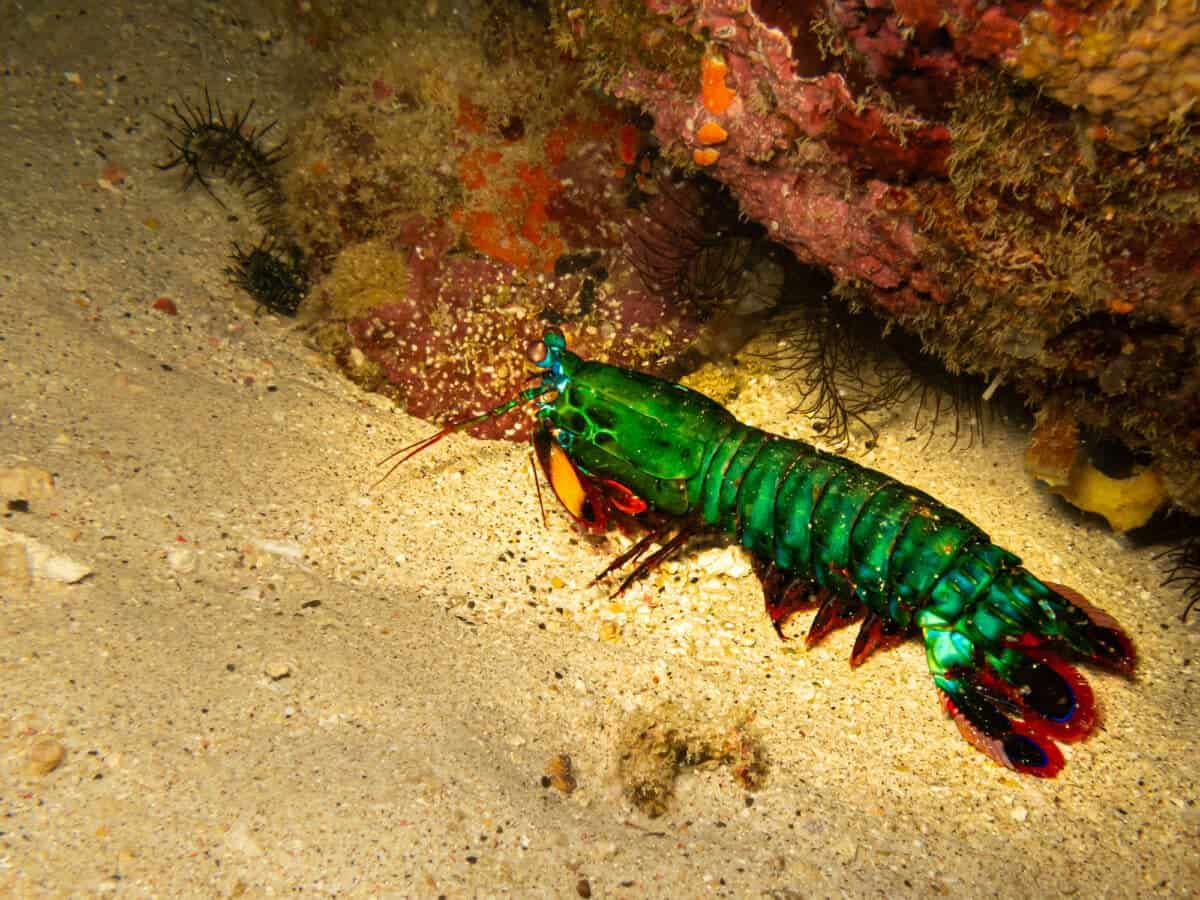
Despite their remarkable adaptations, mantis shrimp face several threats in the modern ocean. While most species haven’t been formally assessed for conservation status, those that depend on coral reef habitats are increasingly vulnerable as reefs decline globally due to climate change, ocean acidification, pollution, and destructive fishing practices. The complex coral reef ecosystems that many mantis shrimp species call home are among the most threatened marine environments, with some estimates suggesting that up to 90% of coral reefs may be at risk of disappearing by 2050 if current trends continue.
In some regions, mantis shrimp are also targeted directly for human consumption or as bycatch in other fisheries. While they’re considered delicacies in certain cuisines, particularly in parts of Asia and the Mediterranean, there’s limited monitoring of harvesting levels for most species. Their territorial nature and relatively slow reproduction rate make some species potentially vulnerable to overfishing. Additionally, as bottom-dwellers in coastal environments, they can be affected by habitat destruction from coastal development, dredging, and trawling. Protecting these remarkable creatures will require comprehensive approaches to marine conservation that address both direct threats and the broader issues affecting their habitats.
The Legacy of the World’s Fastest Punch
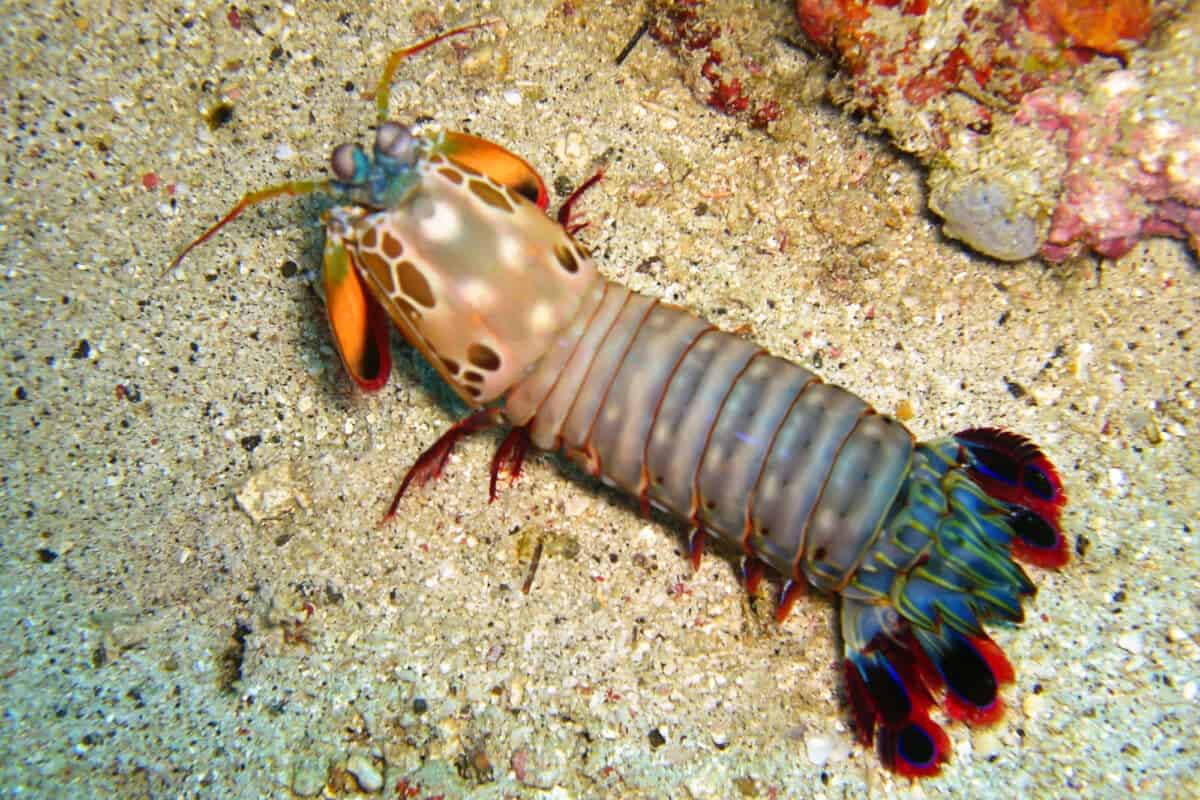
The mantis shrimp’s phenomenal striking ability represents one of nature’s most impressive mechanical adaptations. From their specialized anatomy that stores and releases energy with astonishing efficiency to their ability to create underwater shockwaves, these small crustaceans have pushed the boundaries of what biological systems can achieve. Their remarkable punch has not only allowed them to thrive as predators for hundreds of millions of years but has also inspired scientists and engineers to rethink what’s possible in fields ranging from materials science to robotics.
As we continue to study these extraordinary creatures, we gain not just knowledge about an unusual marine organism, but insights that could lead to technological breakthroughs benefiting humanity. The mantis shrimp serves as a powerful reminder that even after centuries of scientific exploration, nature still holds secrets and solutions that surpass our human innovations. In their tiny appendages lies the culmination of evolutionary refinement that engineers can only dream of replicating—a testament to the ingenuity of natural selection and the remarkable diversity of life on our planet.

From exploring the marine wonders in the Azores and witnessing the vast savannas of Kenya, to delving deep into the rich biodiversity of South Africa and traversing iconic landscapes in Australia and the US like Yellowstone, Chris's experiences are vast.
With a penchant for diving alongside sharks, the ocean holds a special place in his heart.
Through his academic insights, he champions wildlife conservation, striving with 'Animals Around The Globe' to cultivate a profound connection between humans and animals, enhancing our mutual appreciation.
Connect with him at Feedback@animalsaroundtheglobe.com.
- What Happens to Male Chicks in Egg Farming? - July 18, 2026
- How Close Are We to Cloning the Woolly Mammoth? - July 18, 2026
- The Most Venomous Creature in the U.S. - July 18, 2026